
Overview: The Sacred Village of the God of Justice
Nestled on the eastern banks of the roaring Tons River in the Jaunsar-Bawar region of Uttarakhand, Hanol Village is a hidden gem that offers a perfect blend of spirituality, history, and natural beauty. Located at an elevation of approximately 1,429 metres (4,688 feet) above sea level, this small village in the Tyuni tehsil of Dehradun district is home to the ancient Mahasu Devta Temple — one of the most revered shrines in the region.
Hanol is not just a village; it is a pilgrimage centre for the Jaunsari tribe and people from across Uttarakhand and Himachal Pradesh. The temple, dedicated to Mahasu Devta — the supreme arbiter of justice and an incarnation of Lord Shiva — dates back to the 9th century and is a masterpiece of ancient architecture.
With a population of just 180 people spread across 39 households, Hanol remains off the beaten path, offering visitors a tranquil escape into the Himalayas. Whether you are a pilgrim seeking divine justice, a history enthusiast exploring ancient architecture, or a nature lover looking for peace, Hanol promises an unforgettable experience.
Key Information at a Glance
| Aspect | Details |
|---|---|
| Location | Tyuni Tehsil, Dehradun district, Uttarakhand |
| Elevation | 1,429 m (4,688 ft) |
| Population | 180 (approx.) |
| Number of Households | 39 |
| Famous For | Mahasu Devta Temple, God of Justice, ancient architecture, Jaunsari culture |
| Distance from Dehradun | 101 km |
| Distance from Chakrata | 13 km |
| Distance from Delhi | 326 km |
| Nearest Town | Chakrata (13 km) |
| Nearest Railway Station | Dehradun (181 km) |
| Nearest Airport | Jolly Grant Airport, Dehradun (207 km) |
| Best Time to Visit | October–June |
| Temple Timings | 6:00 AM – 7:00 PM (approx.) |
| Entry Fee | Free |
History of Hanol Village
The Pandava Connection
The history of Hanol is deeply intertwined with the epic Mahabharata. According to legends, the village was once known as Chakrapur, and it is believed to be the place where the Pandavas escaped from the Lakshagraha (House of Lac). The Pandavas, along with Mata Kunti, took shelter here after their escape.
It is said that when the Pandavas crossed the Tons River, Yudhishthira was captivated by the beauty of the land and commissioned Vishwakarma, the celestial architect, to build a temple. The Pandavas are also believed to have transported stones from Ghata Mountain in the Shivalik Range for the temple’s construction. The Bhim Chhatri, a massive stone placed atop the sanctum, is said to have been carried by Bhima himself.
The Legend of Huna Bhatt and the Four Brothers
According to another legend, in Kaliyuga, a demon named Kirmir (or Kirmik) terrorised the region, devouring villagers and their animals. A pious Brahmin named Huna Bhatt, after whom the village is named, prayed to Lord Shiva and Goddess Shakti for help.
Following divine instructions, Huna Bhatt ploughed his field on seven consecutive Sundays. On the seventh Sunday, the ground erupted with divine light, and from the furrows emerged the four Mahasu brothers — Botha, Pavasi, Vasik, and Chalda — who were the embodiments of Lord Shiva. With their celestial army, they defeated the demon Kirmir and saved the villagers.
The Name “Hanol”
The name “Hanol” is derived from the word “hanul”, meaning fire. Before Mahasu arrived, the place was used for torturing offenders with the heat of fire by putting them in the hollow of a big drum, placed horizontally and heated from below. The village is also named after Brahmin Huna Bhatt.
The Tons River
The village is situated on the left bank of the Tons River, which was earlier known as the River Tamas (meaning short-tempered). According to another tradition, the water of the Tons River is believed to be the tears from the eyes of Bhubruvanan.
Geography of Hanol Village
Location and Topography
Hanol is located in the Tyuni Tehsil of the Dehradun district in Uttarakhand. It is situated approximately:
| Location | Distance |
|---|---|
| Tyuni (Tehsil HQ) | 15 km |
| Dehradun (District HQ) | 101 km |
| Chakrata | 13 km |
| Delhi | 326 km |
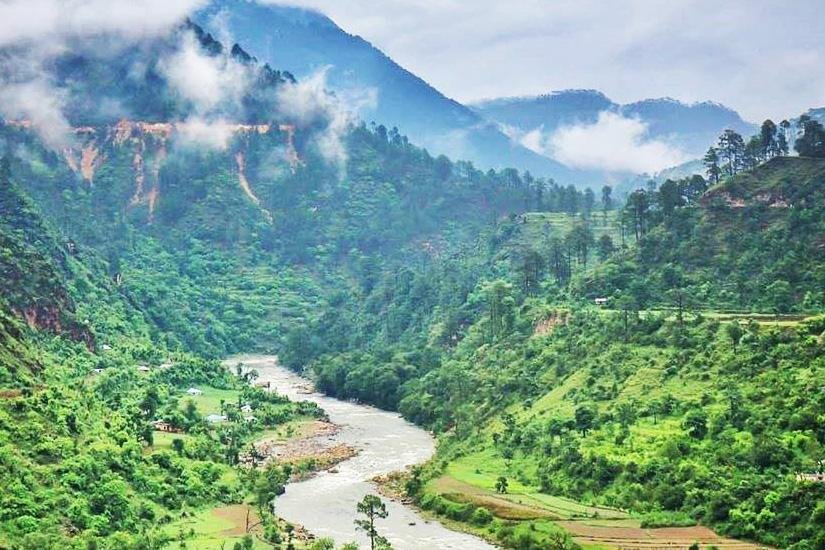
The village is perched at an elevation of 1,429 metres (4,688 feet) above sea level. It is surrounded by lush green hills and dense deodar forests, offering a scenic and tranquil environment.
The Tons River
The village is located on the eastern bank of the Tons River. The river flows through a deep gorge with precipitous banks, making it impossible to draw water from it for irrigation purposes. For this reason, the river is also called Karam Nashini.
The Village Today
Hanol covers a total geographical area of 35.55 hectares. As per the 2011 Census, the village has a population of 180 people (92 males and 88 females) living in **39 households. The literacy rate is approximately 75%.
Mahasu Devta Temple: The Crown Jewel of Hanol
Architecture: A Masterpiece of Ancient Craftsmanship
The Mahasu Devta Temple is the heart and soul of Hanol. Built in the 9th century, the temple is one of the rarest examples of ancient architecture, blending stone and wood in a style known as Kath-Kuni.
Architectural Highlights:
The temple is believed to have been built by the Pandavas with the help of Vishwakarma. The Archaeological Survey of India (ASI) considers it one of the ancient temples of the Dehradun district.
The Deity: Mahasu Devta — The God of Justice
Mahasu Devta is revered as the supreme arbiter of justice and the protector of the domain. He is considered an incarnation of Lord Shiva.
Interestingly, Mahasu is not a single deity but a collective name for four divine brothers:
| Brother | Location |
|---|---|
| Botha (Boothia) Mahasu | Hanol (main temple) |
| Basik Mahasu | Mendrath |
| Pabasi Mahasu | Thadiyar, Uttarkashi |
| Chalda Mahasu | Wandering deity (roams every 12 years) |
The primary deity at the Hanol temple is Botha Mahasu, who is worshipped as a Swayambhu (self-manifested) power residing in a metallic goblet.
Unique Rituals and Beliefs
1. The Lota Pani Ritual (Trial by Water)
The temple is famous for the Lota Pani ritual — a unique trial by water where disputants drink water in the name of Mahasu Devta. It is believed that the guilty party will suffer immediately if they drink falsely. This practice is still used to settle disputes in the region.
2. The Mysterious Sanctum
The sanctum sanctorum (garbhagriha) is off-limits to devotees. Only the temple priest is allowed inside, where a sacred water stream flows mysteriously — its origin and outlet still unknown. A divine flame inside the sanctum burns eternally.
3. The President’s Offering
Every year, the President of India sends salt as a symbolic offering to the deity, reinforcing the temple’s spiritual and national significance.
Festivals and Celebrations
The Mahasu Devta Fair is the most important festival in Hanol.
| Festival | Details |
|---|---|
| Mahasu Devta Fair | Held in August every year |
| Duration | 3–4 days |
| Activities | Procession of the deity, music, folk dances |
| Participants | Jaunsari tribe and visitors from across the region |
During the fair, the deity is taken out in a Doli (palanquin) in a grand procession, accompanied by music and folk dances performed by locals. The fair depicts the cultural harmony between communities.
Religious Beliefs and Significance
Mahasu Devta — The Supreme Deity of Jaunsar-Bawar
Mahasu Devta is the main deity of the Jaunsar-Bawar region. He is worshipped not only in Uttarakhand but also in parts of Himachal Pradesh.
The God of Justice
Mahasu Devta is believed to be the sole arbiter over mortals, reigning supreme over the innumerable indigenous gods and goddesses. His decision is universally accepted by the local people.
The Power of Wishes
Devotees make promises at the temple, believing that if their wishes are fulfilled, they must return to pray and attend the festival.
The Four Mahasu Brothers
Each of the four Mahasu brothers has a dedicated temple and is worshipped in unique ways:
| Brother | Temple Location |
|---|---|
| Botha Mahasu | Hanol |
| Basik Mahasu | Mendrath |
| Pabasi Mahasu | Thadiyar, Uttarkashi |
| Chalda Mahasu | Wandering |
Flora and Fauna of Hanol
Flora
The region around Hanol is blessed with rich Himalayan vegetation:
- Deodar forests — the trek to the temple passes through a beautiful deodar forest
- Pine trees — found on the mountain slopes
- Lush green hills — surrounding the village
Hanol was once home to Asia’s tallest pine tree. Although this iconic specimen no longer stands tall, its remains and preserved bark still inspire curiosity among visitors.
Fauna
The Tiuni to Hanol trail offers an incredible birding trail:
How to Reach Hanol
By Air — Nearest Airports
| Airport | Distance | Details |
|---|---|---|
| Jolly Grant Airport, Dehradun | 207 km | Nearest airport |
| Indira Gandhi International Airport, Delhi | 326 km | Major international hub |
From Dehradun Airport:
- Hire a taxi to Hanol (approx. 5–6 hours)
By Train — Nearest Railway Stations
| Station | Distance | Details |
|---|---|---|
| Dehradun Railway Station | 181 km | Nearest railhead |
| Haridwar Railway Station | ~220 km | Alternative station |
From Dehradun:
- Hire a taxi or take a bus to Chakrata/Tyuni, then continue to Hanol
By Road (Most Popular)
| Route | Distance | Travel Time |
|---|---|---|
| Delhi → Hanol | 326 km | 8–9 hours |
| Dehradun → Hanol | 160–181 km | 4–5 hours |
| Chakrata → Hanol | 13–15 km | 30–40 minutes |
| Tyuni → Hanol | 15 km | 30 minutes |
Route from Delhi:
Delhi → Yamunanagar → Paonta Sahib → Herbertpur → Vikasnagar → Kalsi → Chakrata → Tyuni → Hanol
Route from Dehradun:
Dehradun → Chakrata → Tyuni → Hanol
Alternative Route:
Mussoorie → Damta → Purola → Hanol
Transport Options:
- Private Taxi: Most convenient and flexible
- State Transport Buses: Available from Dehradun to Chakrata/Tyuni
- Self-Drive: Well-maintained roads; drive cautiously on hilly stretches
Important: The road from Tyuni to Hanol is an all-weather motorable road that meanders smoothly through pine-clad mountain slopes.
Distance from Major Cities
Weather and Best Time to Visit
Climate Overview
Hanol experiences a pleasant climate for most of the year, with distinct seasons.
Seasonal Breakdown
| Season | Months | Temperature | Conditions | Suitability |
|---|---|---|---|---|
| Summer | March–June | 15°C – 30°C | Very pleasant, clear skies | ⭐ Best |
| Monsoon | July–September | 15°C – 25°C | Mild rainfall; roads slippery | ❌ Avoid |
| Autumn | October–November | 10°C – 20°C | Crisp air, clear views | ⭐ Best |
| Winter | November–February | 2°C – 15°C | Chilly; possible snowfall | ⭐ Good |
Best Time to Visit by Season
| Season | Months | Suitability | Highlights |
|---|---|---|---|
| Summer | March–June | ⭐ Best | Pleasant weather, clear skies, ideal for temple visits and nature walks |
| Autumn | October–November | ⭐ Best | Post-monsoon clarity, golden landscapes, perfect for photography |
| Winter | December–February | ⭐ Good | Snowfall, fewer crowds, peaceful atmosphere |
| Monsoon | July–September | ❌ Avoid | Slippery roads, risk of landslides |
Why Visit in Summer (March–June)
- Very pleasant weather with clear skies
- Ideal for temple visits and exploring the village
- Comfortable for trekking and nature walks
Why Visit in Autumn (October–November)
- Clear skies and crisp air
- The post-monsoon freshness enhances the beauty of the landscape
- Perfect for photography
Why Visit in Winter (December–February)
Why to Avoid Monsoon (July–September)
What to Wear
| Season | Clothing |
|---|---|
| Summer | Light cotton clothes, comfortable walking shoes, sunscreen |
| Winter | Warm layers, jackets, woollen caps |
| Monsoon | Raincoat, waterproof footwear |
Nearby Places to Visit
Things to Do in Hanol
1. Visit the Mahasu Devta Temple
The primary attraction in Hanol. Explore the 9th-century temple, admire its unique Kath-Kuni architecture, and experience the spiritual energy of the God of Justice.
2. Attend the Mahasu Devta Fair
If you visit in August, don’t miss the annual fair — a three-day celebration with processions, music, and folk dances.
3. Trek to the Temple
The 9 km trek from Tyuni’s Bashik Devta Temple to Hanol offers stunning valley views at every turn, making it an ideal two-day trek for both novice and experienced hikers. The trail passes through a beautiful deodar forest.
4. Birdwatching
The Tiuni to Hanol trail is excellent for birdwatching. Spot babblers, grass-birds, wall-creepers, Himalayan Griffons, and various raptors.
5. Explore the Tons River
Walk along the banks of the roaring Tons River, which flows through a deep gorge.
6. Photography
Capture the beauty of the lush green hills, the ancient temple, and the scenic valley.
7. Nature Walks
Explore the surrounding forests and enjoy the peaceful atmosphere of this offbeat village.
8. Visit Nearby Chakrata
Explore the hill station of Chakrata and visit the famous Tiger Falls.
Accommodation Options
Travel Tip: There is limited accommodation in Hanol itself. Consider staying in Chakrata (13 km) or Tyuni (15 km) for more options.
Local Cuisine — A Taste of Garhwal
Hanol and the surrounding region offer authentic Garhwali cuisine.
Must-Try Dishes
| Dish | Description |
|---|---|
| Kafuli | Traditional spinach and fenugreek curry |
| Phanu | Lentil-based dish, a Garhwali speciality |
| Gahat ka Shorba | Nutritious soup made from horse gram |
| Mandua Roti | Finger millet flatbread |
| Chainsoo | Black gram curry |
| Bal Mithai | Famous chocolate-like sweet from Kumaon |
Where to Eat
- GMVN Guest House: Offers meals to guests
- Local dhabas: Simple, authentic Garhwali food
- Chakrata: Wider range of restaurants
Frequently Asked Questions (FAQs)
General Questions
Q1: Where is Hanol village located?
A: Hanol village is located in the Tyuni Tehsil of the Dehradun district in Uttarakhand, on the eastern bank of the Tons River.
Q2: What is the altitude of Hanol?
A: Hanol is situated at an elevation of approximately 1,429 metres (4,688 feet) above sea level.
Q3: What is Hanol famous for?
A: Hanol is famous for the ancient Mahasu Devta Temple, built in the 9th century and dedicated to the God of Justice.
Q4: What is the Mahasu Devta Temple?
A: It is a 9th-century temple dedicated to Mahasu Devta, the supreme arbiter of justice and an incarnation of Lord Shiva.
Q5: What is the Lota Pani ritual?
A: The Lota Pani is a unique trial by water, where disputants drink water in the name of Mahasu Devta. The guilty party is believed to suffer immediately.
Q6: What is the distance between Delhi and Hanol?
A: The distance from Delhi to Hanol is approximately 326 km.
Q7: What is the nearest railway station to Hanol?
A: The nearest railway station is Dehradun Railway Station, approximately 181 km from Hanol.
Q8: What is the nearest airport to Hanol?
A: The nearest airport is Jolly Grant Airport, Dehradun, approximately 207 km from Hanol.
Q9: What is the best time to visit Hanol?
A: The best time to visit is from March to June and October to November.
Q10: When is the Mahasu Devta Fair held?
A: The Mahasu Devta Fair is held every year in August.
Q11: Is there accommodation available in Hanol?
A: Yes, the GMVN Guest House and temple rooms are available in Hanol. More options are available in Chakrata (13 km).
Q12: Are there trekking options near Hanol?
A: Yes, the 9 km trek from Tyuni’s Bashik Devta Temple to Hanol is a popular option.
Q13: What is the cultural significance of Hanol?
A: Hanol is the spiritual centre of the Jaunsar-Bawar region and is deeply significant to the Jaunsari tribe.
Q14: Is the Mahasu Devta Temple open to all?
A: Yes, the temple is open to all. However, the sanctum sanctorum is off-limits to devotees.
Q15: Is photography allowed inside the temple?
A: Photography may be restricted inside the temple. It is advisable to ask for permission before taking photos.
Q16: What is the population of Hanol?
A: As per the 2011 Census, Hanol has a population of 180 people (92 males, 88 females).
Q17: What is the nearest town to Hanol?
A: The nearest town is Chakrata, approximately 13 km away.
Q18: How can I reach Hanol from Dehradun?
A: The drive from Dehradun to Hanol via Tyuni-Mori Road is approximately 160 km and takes about 4–5 hours.
Q19: Is Hanol safe for tourists?
A: Yes, Hanol is a safe and peaceful destination. However, visitors should be cautious during the monsoon season due to slippery roads.
Plan Your Hanol Journey with Discover Uttarakhand
At Discover Uttarakhand, we’ve been organising unforgettable Himalayan journeys since 1997. As a trusted local operator with deep knowledge of the Garhwal region and its hidden gems, we offer:
✅ Customised Hanol and Chakrata tour packages (2 to 5 days)
✅ Combined itineraries covering Hanol, Chakrata, Tiger Falls, and Mussoorie
✅ Comfortable transport with experienced hill drivers
✅ Verified accommodations in Chakrata and Hanol
✅ Local guides for temple visits and sightseeing
✅ 24/7 customer support throughout your journey
Recommended Packages
| Package | Duration | Starting Point | Highlights |
|---|---|---|---|
| Hanol & Chakrata Escape | 2 Nights / 3 Days | Dehradun | Mahasu Devta Temple, Chakrata, Tiger Falls |
| Jaunsar-Bawar Heritage Tour | 3 Nights / 4 Days | Dehradun | Hanol Temple, Chakrata, Lakhamandal, Mussoorie |
| Garhwal Hidden Gems | 4 Nights / 5 Days | Delhi | Hanol, Chakrata, Tiger Falls, Mussoorie |
📞 Call / WhatsApp: +91-9997187178, 9760222178, 8171977178
📍 Visit Our Office: Himalayan Colony, opposite DSVV, Haripur Kalan, Haridwar, Motichur Range, Uttarakhand 249411
🌐 Website: www.discover-uttarakhand.com
📧 Email: discoveruttarakhand.mail@gmail.com
Discover Uttarakhand – Your Local Partner for Unforgettable Himalayan Journeys Since 1997 🏔️