Introduction: The Land of the Roaring Tiger
Nestled in the foothills of the Himalayas in Uttarakhand, Jim Corbett National Park holds a special place in India’s conservation history as the country’s first national park, established in 1936. Originally named Hailey National Park after Sir Malcolm Hailey, the Governor of the United Provinces, it was later renamed in honour of the legendary hunter-turned-conservationist Jim Corbett, affectionately known as “Carpet Sahib” by the local Kumaoni people.
Spanning an area of over 1,300 square kilometres across the Nainital and Pauri Garhwal districts, the park encompasses a diverse landscape of hills, riverine belts, marshy depressions, grasslands, and a large lake, with elevations ranging from 400 to 1,220 metres. It was chosen in 1973 as the launch site for Project Tiger, India’s landmark wildlife conservation initiative that has helped save the Bengal tiger from the brink of extinction.
Today, Jim Corbett National Park is renowned for having the highest number of tigers among Indian national parks. It is also home to over 580 bird species, 50 mammal species, and 25 reptile species, making it one of the most biodiverse protected areas in India. Whether you are a wildlife enthusiast, a birdwatcher, or simply seeking a peaceful escape into nature, Corbett offers an unforgettable experience in the lap of the wild.
History: From Hunting Ground to Conservation Haven
The Pre-Park Era
Some areas of the present-day park were formerly part of the princely state of Tehri Garhwal. The forests were cleared by the Uttarakhand Forest Department to make the area less vulnerable to Rohilla invaders. The Raja of Tehri formally ceded a part of his princely state to the East India Company in return for assistance in ousting the Gurkhas from his domain. The Buksas—a tribe from the Terai—settled on the land and began growing crops, but in the early 1860s, they were evicted with the advent of British rule.
Efforts to save the forests of the region began in the 19th century under Major Ramsay, the British officer in charge of the area during those times. The first step in protection came in 1868 when the British forest department established control over the land and prohibited cultivation and the operation of cattle stations. In 1879, these forests were constituted into a reserve forest where restricted felling was permitted.
Establishment of the National Park
In the early 1900s, several Britishers, including E. R. Stevans and E. A. Smythies, suggested the setting up of a national park in this region. The British administration considered the possibility of creating a game reserve there in 1907. It was only in the 1930s that the process of demarcation for such an area got underway. A reserve area known as Hailey National Park covering 323.75 square kilometres was created in 1936, and Asia’s first national park came into existence. Hunting was not allowed in the reserve; only timber cutting for domestic purposes was permitted.
Jim Corbett: The Man Behind the Name
Jim Corbett was born and brought up in India and was passionately fond of forests and animals. Initially a game hunter who hunted tigers and leopards for sport, he later became a fierce protector of the tiger and its cousins. He believed, very firmly, that “a tiger is a gentleman” and that tigers turn rogue only if wounded and unable to hunt for some reason.
Corbett was a legendary figure in the Kumaon region, worshipped all over the Terai and Kumaon as “Carpet Saa’b”. The pseudonym arose from the local Kumaoni dialect, referring to his unerring marksmanship. His home in Nainital, Gurney House, remains a landmark, and his jungle tales continue to fascinate readers of all ages.
Post-Independence and Project Tiger
The reserve was renamed Ramganga National Park in 1954–1955 and was again renamed in 1955–1956 to Corbett National Park after author and naturalist Jim Corbett. The park fared well during the 1930s under an elected administration, but during the Second World War, it suffered from excessive poaching and timber cutting.
In 1973, the park was chosen as the location for launching the Project Tiger wildlife conservation project. This initiative, launched by the Indian government in collaboration with the World Wide Fund for Nature (WWF), marked a turning point in tiger conservation in India. The project was so successful that the wild Bengal tiger population increased from fewer than 2,000 in 1972 to over 3,000 by 1979. Today, according to the 2023 Tiger Census, Corbett has the highest tiger population among all tiger reserves in India.
Geography and Location
Geographic Coordinates
- Latitude: 29°32′ N
- Longitude: 78°56′ E
- Elevation: 400–1,220 metres (1,300–4,000 feet) above sea level
- Total Area: 1,318.54 square kilometres (including core and buffer zones)
Location
Jim Corbett National Park is situated in the Nainital and Pauri Garhwal districts of Uttarakhand. The park is part of the larger Corbett Tiger Reserve, which includes:
- Core Zone: 520.82 sq km (the national park itself)
- Buffer Zone: 797.72 sq km
The park is located approximately:
- 260 km from Delhi
- 140 km from Nainital
- 70 km from Haldwani
Topography
The park lies in the foothills of the Himalayas, characterised by a diverse terrain that includes:
- Hills: Ranging up to 1,220 metres
- Riverine Belts: Along the Ramganga River
- Marshy Depressions (Chaurs): Grassy wetlands rich in biodiversity
- Grasslands: Open areas ideal for wildlife spotting
- Lakes: Including the Kalagarh reservoir formed by the Ramganga Dam
The Ramganga River flows through the park from north to south, creating a lifeline for the region’s wildlife. The river is dammed at Kalagarh, creating a large reservoir that supports aquatic life and attracts numerous birds and animals.
Flora and Fauna
Forests and Vegetation
Jim Corbett National Park is blessed with rich, diverse vegetation that changes with altitude and topography. The park’s forests can be classified into several types:
| Forest Type | Altitude | Dominant Species |
|---|---|---|
| Sal Forests | Lower areas | Sal (Shorea robusta) – the dominant tree species |
| Mixed Deciduous Forests | Mid-elevations | Haldu, Rohini, Khair, Sissoo |
| Riverine Forests | Along rivers | Khair, Sissoo, Jamun |
| Grasslands (Chaurs) | Open areas | Elephant grass, Kans grass, Saccharum species |
The park is known for its dense sal forests, which provide excellent cover for tigers and other wildlife. The grasslands, locally called “chaurs,” are particularly important for herbivores and offer the best opportunities for tiger sightings.
Mammals
Corbett is home to approximately 50 species of mammals. The most famous residents are:
| Species | Status | Best Sighting Zones |
|---|---|---|
| Bengal Tiger | Endangered | Dhikala, Bijrani, Jhirna |
| Asian Elephant | Endangered | Dhikala, Bijrani |
| Leopard | Vulnerable | Throughout the park |
| Sloth Bear | Vulnerable | Dhikala, Bijrani |
| Hog Deer | Schedule I | Jhirna, Dhikala |
| Sambar | Least Concern | Throughout the park |
| Chital (Spotted Deer) | Least Concern | Bijrani, Dhikala |
| Barking Deer | Least Concern | Throughout the park |
| Wild Boar | Least Concern | Throughout the park |
| Bengal Fox | Least Concern | Rare sightings |
| Rhesus Macaque | Least Concern | Resort areas, Jhirna |
According to the 2023 Tiger Census, Corbett Tiger Reserve has approximately 260 tigers, the highest among all tiger reserves in India. This makes it one of the best places in the world to spot wild tigers.
Birds
With over 580 recorded bird species, Jim Corbett National Park is a paradise for birdwatchers. The park is one of the most important birding destinations in India, with species ranging from resident to migratory.
Notable Birds:
- Great Hornbill: Found in riverine forests
- Pallas’s Fish Eagle: Seen near the reservoir
- Crested Serpent Eagle: Common throughout
- Red Junglefowl: Ancestor of the domestic chicken
- Peafowl: Abundant throughout
- Storks: Various species near water bodies
- Kingfishers: Several species along the river
- Himalayan Monal: Found in higher elevations
- Waterfowl: Numerous species at Kalagarh reservoir
The best time for birdwatching is from November to March when winter migrants arrive.
Reptiles and Amphibians
The park is home to over 25 species of reptiles :
| Species | Habitat |
|---|---|
| Mugger Crocodile | Ramganga River, Kalagarh reservoir |
| Gharial | Ramganga River |
| Indian Rock Python | Forests, grasslands |
| Monitor Lizard | Rocky areas, riverbanks |
| King Cobra | Dense forests |
| Common Cobra | Throughout |
| Russell’s Viper | Grasslands |
| Indian Rat Snake | Common throughout |
The Kalagarh reservoir is particularly good for spotting crocodiles and gharials during boat safaris.
Safari Zones and Gates
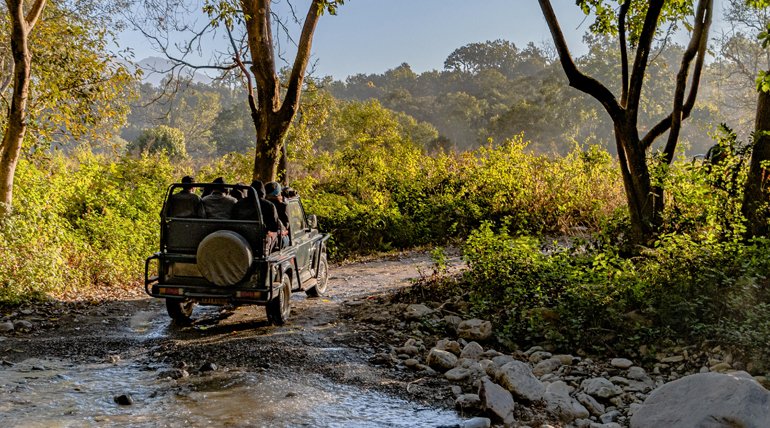
Jim Corbett National Park is divided into several safari zones, each with its own entry gate, landscape characteristics, and wildlife sighting opportunities.
Overview of Safari Zones
| Zone | Area (sq km) | Entry Gate | Best For | Vehicle Type |
|---|---|---|---|---|
| Dhikala | 100+ | Dhangarhi | Tiger sightings, elephants, landscape | Canter (20-seater) |
| Bijrani | 26 | Amdanda | Tiger sightings, leopards, deer | Jeep |
| Jhirna | 30 | Dhela | Year-round access, leopard sightings | Jeep |
| Dhela | 12 | Dhela | Scenic drives, birding | Jeep |
| Durga Devi | 26 | Durga Devi | Birding, crocodiles | Jeep |
| Sitabani | 30+ | Sitabani | Day visits, buffer zone | Jeep |
| Phato | 15 | Phato | Leopard sightings | Jeep |
Detailed Zone Information
Dhikala Zone – The Crown Jewel
Dhikala is the most famous and most sought-after zone in Corbett National Park. It offers the best chance of spotting tigers and elephants in their natural habitat. The zone features vast grasslands, dense sal forests, and the beautiful Ramganga River.
Key Features:
- Safari Type: Canter (20-seater) or jeep
- Entry Gate: Dhangarhi (8 km from Ramnagar)
- Best Time: November to March (winter), April to June (summer)
- Accommodation: Forest rest houses at Dhikala, Gairal, Sarpduli
- Highlights: Grassland views, tiger sightings, elephant herds, panoramic landscapes
Important: Dhikala zone safaris must be booked through the official forest department website. Canter safaris are limited and sell out months in advance.
Bijrani Zone – The Tiger Hotspot
Bijrani is the second most popular zone after Dhikala and is known for excellent tiger sightings. It offers a mix of sal forests and grasslands, making it ideal for wildlife photography.
Key Features:
- Safari Type: Jeep
- Entry Gate: Amdanda (2 km from Ramnagar)
- Best Time: November to June
- Accommodation: Forest rest house at Bijrani
- Highlights: Frequent tiger sightings, leopard sightings, and the deer population
Jhirna Zone – Open Year-Round
Jhirna is the only zone that remains open throughout the year, even during the monsoon season (July–October). It offers good leopard sightings and is less crowded than Dhikala and Bijrani.
Key Features:
- Safari Type: Jeep
- Entry Gate: Dhela (15 km from Ramnagar)
- Best Time: Year-round
- Accommodation: Forest rest house at Jhirna
- Highlights: Leopard sightings, sloth bears, year-round accessibility
Dhela Zone – New Addition
Dhela is the newest eco-tourism zone, opened in 2019. It offers scenic drives and good birdwatching opportunities.
Key Features:
- Safari Type: Jeep
- Entry Gate: Dhela
- Best Time: November to June
- Highlights: Scenic landscapes, birding, and less crowded
Durga Devi Zone – Birdwatcher’s Paradise
Durga Devi is the best zone for birdwatching and spotting crocodiles along the river. It is a less-crowded zone with a rugged landscape.
Key Features:
- Safari Type: Jeep
- Entry Gate: Durga Devi
- Best Time: November to June
- Highlights: Birdwatching, crocodile sightings, riverine landscape
Sitabani Buffer Zone – The Quiet Escape
Sitabani is not part of the core forest area but offers excellent wildlife sightings with fewer restrictions. It is the only area where night stays and night safaris are permitted in certain resorts.
Key Features:
- Safari Type: Jeep (day and night options available)
- Entry Gate: Sitabani
- Best Time: Year-round
- Highlights: Leopard sightings, birding, night safaris, and less crowded
Safari Booking and Permits
How to Book a Safari
Online Booking:
- Visit the official website: www.corbettnationalpark.in
- Create an account and log in
- Select zone, date, and time slot
- Choose vehicle type (jeep or canter)
- Make an online payment
- Carry a printout of the permit for the safari
Booking Window:
- Safaris open for booking 90 days in advance
- Dhikala Canter: Opens 90 days in advance – sells out within hours
- Bijrani Jeep: Opens 45 days in advance
- Jhirna/Dhela/Durga Devi: Opens 30 days in advance
Important Tips:
- Book the Dhikala zone at least 3-4 months in advance for peak season
- Have multiple zone options ready when booking
- Safaris are strictly limited to the number of permits issued per zone
- Carry original ID proof (Aadhaar/Passport) for safari entry
Safari Timings
| Season | Morning Safari | Afternoon Safari |
|---|---|---|
| Winter (Nov–Feb) | 6:30 AM – 10:00 AM | 2:00 PM – 5:30 PM |
| Summer (Mar–Jun) | 5:30 AM – 9:00 AM | 3:00 PM – 6:30 PM |
| Monsoon (Jul–Oct) | Jhirna only: 6:30 AM – 9:00 AM & 2:30 PM – 5:00 PM |
Safari Costs (2026 Estimates)
| Zone | Jeep Cost (per vehicle) | Canter Cost (per person) |
|---|---|---|
| Dhikala | ₹8,500–9,500 | ₹1,500–1,800 |
| Bijrani | ₹5,500–6,500 | Not available |
| Jhirna | ₹5,000–6,000 | Not available |
| Dhela | ₹5,000–6,000 | Not available |
| Durga Devi | ₹5,000–6,000 | Not available |
| Sitabani (Buffer) | ₹3,500–4,500 | Not available |
Note: Costs include entry fees, vehicle charges, and guide charges. Prices vary by season and may increase during peak months.
Permits and Documentation
- Valid ID Proof: Aadhaar, Passport, Voter ID, or Driver’s License
- Foreign Nationals: Passport and a valid visa required
- Accommodation: Advance booking required for forest rest houses
- Photography: Professional photography requires a separate permit
How to Reach Jim Corbett National Park
By Air
Nearest Airport: Pantnagar Airport (approximately 80–95 km from Corbett)
- Airlines: Daily flights from Delhi to Pantnagar (approx. 1 hour)
- Onward Travel: Taxis available from the airport to various resort areas (2–2.5 hours)
By Train
Nearest Railway Station: Ramnagar (approximately 10–20 km from Corbett zones)
| Train Name | From Delhi | Departure | Arrival (Ramnagar) |
|---|---|---|---|
| Ranikhet Express | Delhi | 10:05 PM | 4:30 AM |
| Corbett Link Express | Delhi | 7:30 PM | 12:00 AM |
| Kathgodam Shatabdi | Delhi | 6:00 AM | 11:40 AM (Kathgodam) |
From Ramnagar station, taxis are available to all safari zones and resorts.
Alternative Stations:
- Kathgodam: 70 km from Corbett – well-connected from Delhi
- Haldwani: 65 km from Corbett – regular train connections
By Road
Jim Corbett National Park is well-connected by road to major cities in North India:
| Starting Point | Distance | Travel Time | Route |
|---|---|---|---|
| Delhi | 260 km | 5.5–7 hours | Delhi → Ghaziabad → Hapur → Moradabad → Kashipur → Ramnagar |
| Nainital | 140 km | 4 hours | Nainital → Bhowali → Kaladhungi → Haldwani → Ramnagar |
| Haridwar | 200 km | 5 hours | Haridwar → Najibabad → Kashipur → Ramnagar |
| Rishikesh | 190 km | 4.5 hours | Rishikesh → Najibabad → Kashipur → Ramnagar |
| Dehradun | 220 km | 5.5 hours | Dehradun → Haridwar → Najibabad → Kashipur → Ramnagar |
Distances from Major Cities
| City | Distance (km) |
|---|---|
| Delhi | 260 |
| Nainital | 140 |
| Haridwar | 200 |
| Rishikesh | 190 |
| Dehradun | 220 |
| Almora | 165 |
| Haldwani | 65 |
| Ramnagar | 0 |
| Lucknow | 390 |
| Agra | 350 |
| Jaipur | 510 |
| Chandigarh | 400 |
Weather and Best Time to Visit
Climate Overview
Corbett experiences three distinct seasons: summer, monsoon, and winter. Each season offers a different wildlife experience.
Month-by-Month Temperature Guide
| Month | Min Temp (°C) | Max Temp (°C) | Conditions | Wildlife Activity |
|---|---|---|---|---|
| January | 5 | 18 | Cold, foggy mornings | High activity, winter migrants |
| February | 8 | 22 | Pleasant, occasional fog | Good sightings |
| March | 12 | 28 | Warm, clear skies | Excellent – animals come to water |
| April | 18 | 35 | Hot, dry | Peak – best for tiger sightings |
| May | 22 | 38 | Very hot | Peak – animals near water bodies |
| June | 25 | 40 | Hottest | Good – late morning safaris best |
| July | 24 | 33 | Monsoon, heavy rain | Limited – Jhirna zone only |
| August | 24 | 32 | Monsoon, high humidity | Limited – Jhirna zone only |
| September | 22 | 31 | Post-monsoon, greenery | Moderate – Jhirna zone only |
| October | 18 | 30 | Pleasant, clear | Good – all zones reopen |
| November | 12 | 25 | Cool, crisp | Excellent – peak birding |
| December | 6 | 20 | Cold, morning fog | Good – winter migrants |
Best Time to Visit by Season
| Season | Months | Suitability | Conditions | Best For |
|---|---|---|---|---|
| Winter | Nov–Feb | ⭐ Excellent | 5°C–25°C, pleasant days, cold mornings | Birdwatching, comfortable safaris |
| Summer | Mar–Jun | ⭐ Excellent | 20°C–40°C, hot days, dry | Tiger sightings (animals near water) |
| Post-Monsoon | Oct–Nov | ⭐ Good | 18°C–30°C, clear skies, lush greenery | Photography, pleasant weather |
| Monsoon | Jul–Sep | ⚠️ Closed | 22°C–33°C, heavy rainfall | Only the Jhirna zone is open; not recommended |
Peak Season Considerations
- Peak Months: March–June (summer) and November–December (winter)
- Crowds: High demand during peak season—book safaris and accommodation 2–3 months in advance
- Tiger Sightings: Best during summer (April–June) when animals come to water sources
Accommodation Options
Jim Corbett National Park offers a wide range of accommodation options, from luxury resorts to budget-friendly lodges and forest rest houses.
Forest Rest Houses (Inside the Park)
| Property | Zone | Capacity | Booking | Features |
|---|---|---|---|---|
| Dhikala FRH | Dhikala | 80+ beds | Forest Dept | Near the safari gate |
| Gairal FRH | Dhikala | 30 beds | Forest Dept | Riverside location |
| Sarpduli FRH | Dhikala | 20 beds | Forest Dept | Scenic setting |
| Bijrani FRH | Bijrani | 15 beds | Forest Dept | Near safari gate |
| Jhirna FRH | Jhirna | 15 beds | Forest Dept | Year-round open |
Booking: Forest rest houses must be booked through the official forest department website. Advance booking is essential—Dhikala books up 3-4 months in advance for peak season.
Luxury Resorts (Outside the Park)
| Resort | Location | Features | Price Range |
|---|---|---|---|
| Taj Corbett | Dhikuli | Premium amenities, spa, fine dining | ₹15,000–₹30,000 |
| Jim’s Jungle Retreat | Dhikuli | Eco-luxury, wildlife experiences | ₹12,000–₹25,000 |
| The Den Corbett | Dhikuli | Riverside setting, luxury cottages | ₹10,000–₹20,000 |
| Namah Resort | Dhikuli | Pool, spa, jungle view | ₹8,000–₹18,000 |
| Aahana Resort | Garjia | Eco-friendly, organic farm | ₹8,000–₹20,000 |
Mid-Range Hotels and Resorts
| Property | Location | Features | Price Range |
|---|---|---|---|
| Corbett Riverside Resort | Dhikuli | Riverside location, pool | ₹5,000–₹10,000 |
| Riverview Retreat | Dhikuli | Family-friendly, good food | ₹4,000–₹8,000 |
| Corbett Adventure Resort | Kyari | Adventure activities | ₹3,000–₹6,000 |
| The Solluna Resort | Garjia | Eco-resort, nature walks | ₹5,000–₹12,000 |
Budget Options
| Property | Location | Features | Price Range |
|---|---|---|---|
| Corbett Jungle Lodge | Ramnagar | Basic, comfortable | ₹2,000–₹4,000 |
| Wilderness Resort | Ramnagar | Value-for-money | ₹2,000–₹4,000 |
| Corbett View Resort | Ramnagar | Simple, clean | ₹1,500–₹3,000 |
| GMVN Tourist Rest House | Ramnagar | Government-run | ₹1,500–₹2,500 |
Best Areas to Stay
| Area | Distance to Gates | Best For | Features |
|---|---|---|---|
| Dhikuli | 5–10 km from Bijrani/Dhangarhi | Luxury seekers, families | Wide range of resorts, convenient location |
| Ramnagar Town | 5–15 km from all gates | Budget travelers | Affordable hotels, local markets |
| Garjia | 15–20 km from gates | Peace seekers | Quieter, scenic location |
| Kyari | 10–15 km from Bijrani | Nature lovers | Jungle setting, resorts |
Booking Tips: Book accommodation well in advance for peak seasons (March–June, November–December). Forest rest houses require early booking—Dhikala often sells out within hours of opening.
Nearby Places to Visit
| Destination | Distance | Travel Time | Highlights |
|---|---|---|---|
| Ramnagar | 10–20 km | 30–60 min | Base town, markets, Kosi River |
| Garjia Temple | 15 km | 30 min | Ancient temple in the forest, mythological significance |
| Sitabani Temple | 20 km | 45 min | Lake with an island aquarium |
| Corbett Museum (Kaladhungi) | 50 km | 1.5 hours | Jim Corbett’s former home, heritage site |
| Nainital | 140 km | 4 hours | Lake District, Mall Road, Naini Lake |
| Ranikhet | 100 km | 3.5 hours | Pine forests, golf course, military charm |
| Bhimtal | 120 km | 3.5 hours | Ancient temple in the forest, with mythological significance |
| Sattal | 125 km | 3.5 hours | Seven interconnected lakes, birdwatching |
| Mukteshwar | 130 km | 4 hours | Scenic views, adventure park |
| Corbett Waterfall | 20 km | 45 min | Scenic waterfall near Garjia |
Corbett Museum (Kaladhungi)
Located about 50 km from Ramnagar, the Corbett Museum is housed in Jim Corbett’s former bungalow, “Gurney House.” The museum displays Corbett’s belongings, photographs, and memorabilia, offering insight into the life of the legendary conservationist.
Garjia Devi Temple
This temple is situated on a large rock in the middle of the Kosi River, creating a stunning visual spectacle. The temple is dedicated to Goddess Garjia and is considered highly sacred by locals.
Local Cuisine: What to Eat in Corbett
Kumaoni Cuisine
| Dish | Description | Where to Find |
|---|---|---|
| Aloo ke Gutke | Spicy fried potatoes with local Kumaoni spices | Local restaurants, resort buffets |
| Bhatt ki Churkani | Black bean curry, a Kumaoni specialty | Traditional restaurants |
| Kafuli | Spinach and fenugreek curry | Kumaoni thalis |
| Baadi | Lentil-based dish | Local eateries |
| Bal Mithai | Chocolate-coated khoya sweet | Sweet shops in Ramnagar |
| Singauri | Black bean curry, a Kumaoni speciality | Local sweet shops |
Popular Restaurants
| Name | Location | Cuisine | Known For |
|---|---|---|---|
| The Village Cafe | Ramnagar | North Indian | Authentic Kumaoni food |
| Corbett Hideaway Restaurant | Dhikuli | Multi-cuisine | Buffet meals, jungle theme |
| Taj Corbett Restaurant | Dhikuli | Indian, Continental | Premium dining |
| Local Dhabas | Ramnagar | North Indian | Parathas, dal makhani |
Food Tips
- Most resorts offer buffet meals included in packages
- Pure vegetarian options available at most restaurants
- Carry packaged snacks for safari days
- Avoid eating from roadside stalls for hygiene reasons
Shopping in Corbett
What to Buy
| Item | Description | Where to Find |
|---|---|---|
| Kumaoni Shawls | Traditional patterned shawls | Ramnagar markets |
| Wooden Crafts | Handcrafted items, decorative pieces | Local shops |
| Wildlife Memorabilia | Books, photographs, souvenirs | Resort gift shops |
| Local Honey | Organic honey from forest areas | Local markets |
| Bal Mithai | Famous sweet | Sweet shops in Ramnagar |
Markets to Explore
| Market | Best For |
|---|---|
| Ramnagar Market | Local handicrafts, Kumaoni shawls, souvenirs, sweets |
| Resort Gift Shops | Wildlife books, high-quality souvenirs |
| Dhikuli Roadside Stalls | Wooden crafts, local produce |
Shopping Tips: Bargain politely in local markets. Carry cash—smaller shops may not accept cards.
Travel Tips and Important Information
Safari Tips
- Book Early: Safari permits sell out quickly—book 1–3 months in advance for peak season
- Choose the Right Zone: Dhikala for tigers and elephants, Bijrani for frequent sightings, Durga Devi for birding
- Morning Safaris: Best for wildlife activity; afternoon safaris offer better light for photography
- Dress Appropriately: Neutral colours (khaki, green, brown) are recommended; avoid bright colours and white
- Stay Quiet: Noise disturbs animals and reduces sighting chances
- Listen to Guides: Safari guides are experienced trackers—follow their instructions
- Pack Essentials: Water, snacks, binoculars, camera, sunscreen, hat
General Tips
- Best Route from Delhi: Train to Ramnagar + taxi is most convenient; Shatabdi Express to Kathgodam + taxi is another option
- Avoid Night Travel: Roads can be challenging after dark
- Power Backup: Check hotel reviews for power backup (frequent outages)
- Mobile Signal: BSNL and Jio typically work; other networks may be patchy
- Monsoon Travel: Only the Jhirna zone remains open; avoid visiting during heavy rain
- Documentation: Carry ID proof and safari permit printouts at all times
Responsible Wildlife Tourism
- No Littering: Carry back all trash; help preserve the park
- No Feeding Animals: Feeding wild animals is strictly prohibited
- No Loud Music: Loud noise disturbs wildlife
- Follow Safari Rules: Stay inside the vehicle, do not get out, follow designated routes
- Support Conservation: Choose eco-friendly resorts and operators
Sample Itineraries
2-Day Corbett Weekend Escape (From Delhi)
Day 1: Arrival and Safari
- Morning: Depart Delhi by 5:00 AM (5.5–6 hour drive)
- Afternoon: Check into resort, lunch, rest
- Afternoon Safari: 2:30 PM – 6:00 PM (Bijrani or Jhirna zone)
- Evening: Bonfire, dinner at the resort
Day 2: Safari and Departure
- Morning Safari: 5:30 AM – 9:00 AM (Dhikala or Bijrani zone)
- Breakfast at the resort
- Visit: Garjia Temple or Corbett Waterfall (if time permits)
- Afternoon: Depart for Delhi
3-Day Complete Corbett Experience
Day 1: Arrival and Bijrani Safari
- Arrive, check into the resort
- Afternoon safari in Bijrani zone
- Evening bonfire, dinner
Day 2: Dhikala Safari and Nature Walk
- Morning canter safari to Dhikala (full day or half day)
- Explore the Dhikala grasslands, visit the Kosi River
- Return to the resort, evening at leisure
Day 3: Jhirna Safari and Departure
- Morning safari in Jhirna zone
- Breakfast, check out
- Visit Corbett Museum (Kaladhungi) on return
- Depart for Delhi
4-Day Corbett with Nainital
Day 1: Delhi → Corbett, afternoon safari
Day 2: Corbett full day (Dhikala safari)
Day 3: Corbett → Nainital, evening Mall Road
Day 4: Nainital sightseeing, return to Delhi
Frequently Asked Questions (FAQs)
Q1: Why is Jim Corbett National Park famous?
A: Jim Corbett is famous for being India’s first national park (established in 1936) and one of the best places in the world to spot Bengal tigers in the wild. It has the highest tiger population among all tiger reserves in India.
Q2: What is the best time to visit Jim Corbett?
A: The best time to visit is March to June (summer) for tiger sightings and November to February (winter) for birdwatching and pleasant weather.
Q3: How far is Jim Corbett from Delhi?
A: The distance from Delhi to Corbett is approximately 260 km, with a travel time of 5.5–7 hours by road.
Q4: How do I book a safari in Corbett?
A: Safaris must be booked online through the official website: www.corbettnationalpark.in. Bookings open 45–90 days in advance, depending on the zone.
Q5: Which zone is best for tiger sightings?
A: Dhikala and Bijrani zones offer the best chances of tiger sightings. Dhikala is famous for its grasslands and frequent tiger activity.
Q6: Is Jim Corbett open throughout the year?
A: The core areas (Dhikala, Bijrani, Durga Devi, and Dhela) are open from October 15 to June 30. Only the Jhirna zone remains open during the monsoon season (July–September).
Q7: What is the cost of a safari in Corbett?
A: Jeep safaris cost ₹5,000–₹8,500 per vehicle, depending on the zone. Canter safaris in Dhikala cost approximately ₹1,500–₹1,800 per person.
Q8: Is it safe to visit Jim Corbett with family?
A: Yes, Corbett is very safe for families. Most resorts offer family-friendly amenities, and safaris are conducted with trained guides and drivers.
Q9: What should I wear for a safari?
A: Wear neutral colours (khaki, green, brown) to blend with the environment. Avoid bright colours and white. Carry a hat, sunglasses, and sunscreen.
Q10: How many days are enough for a Corbett trip?
A: 2–3 days is sufficient for a basic visit covering 2–3 safaris. A 4–5 day trip allows time for exploring multiple zones and nearby attractions.
Q11: Can I do a night safari in Corbett?
A: Night safaris are not permitted inside the core area. However, some resorts in the Sitabani buffer zone offer night nature walks and jeep safaris.
Q12: What is the nearest railway station to Corbett?
A: Ramnagar Railway Station is the nearest, located 10–20 km from most safari zones. Regular trains connect Ramnagar to Delhi.
Q13: Is there any dress code for visiting the park?
A: There is no formal dress code, but neutral-colored clothing is recommended for safaris. Bright colours may disturb wildlife.
Q14: What are the safari timings?
A: Summer (Mar–Jun): 5:30 AM – 9:00 AM and 3:00 PM – 6:30 PM. Winter (Nov–Feb): 6:30 AM – 10:00 AM and 2:00 PM – 5:30 PM.
Q15: Can I bring my own vehicle inside the park?
A: Private vehicles are not permitted inside the national park. Safaris must be conducted in registered jeeps or canter vehicles arranged through the forest department.
Plan Your Corbett Adventure with Discover Uttarakhand
At Discover Uttarakhand, we’ve been organising unforgettable wildlife and travel experiences across Devbhoomi since 1997. As a trusted local operator with deep knowledge of Jim Corbett National Park and its surrounding attractions, we offer:
- ✅ Customised Corbett tour packages (2 to 5 days)
- ✅ Safari bookings (all zones) with advance permit assistance
- ✅ Comfortable transport with experienced drivers
- ✅ Verified accommodations ranging from budget to luxury
- ✅ Wildlife guides for enhanced safari experiences
- ✅ Combined Corbett-Nainital-Ranikhet itineraries
- ✅ 24/7 customer support throughout your journey
Recommended Corbett Packages
| Package | Duration | Highlights |
|---|---|---|
| Corbett Weekend Escape | 2 Nights / 3 Days | 2 safaris (Bijrani + Jhirna), resort stay |
| Corbett Tiger Explorer | 3 Nights / 4 Days | 4 safaris across zones, birding tour, and museum visit |
| Corbett & Nainital Combo | 4 Nights / 5 Days | Wildlife + lakes, 2 safaris, Nainital sightseeing |
| Ultimate Corbett Experience | 4 Nights / 5 Days | 4 safaris across zones, birding tour, museum visit |
Book your Jim Corbett adventure today and experience the thrill of spotting the majestic Bengal tiger in its natural habitat.
📞 Call / WhatsApp: +91-9997187178, 9760222178, 8171977178
📍 Visit Our Office: Himalayan Colony, opposite DSVV, Haripur Kalan, Haridwar, Motichur Range, Uttarakhand 249411
🌐 Website: www.discover-uttarakhand.com
📧 Email: info@discover-uttarakhand.com
Discover Uttarakhand – Your Local Partner for Unforgettable Himalayan Journeys Since 1997 🐅