Introduction: The Birthplace of the Mahabharata
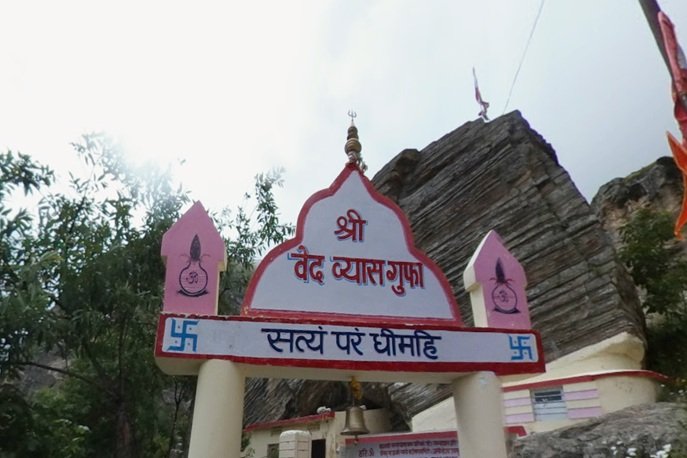
Nestled in the serene Mana village of Uttarakhand’s Chamoli district, Ved Vyas Gufa (also known as Vyas Gufa or Vyasa Cave) stands as a testament to India’s rich spiritual and literary heritage. Perched at an altitude of approximately 3,200 meters (10,500 feet), this ancient cave is revered as the sacred site where Maharishi Ved Vyas —the legendary sage and author of the Mahabharata—composed the epic with the assistance of Lord Ganesha.
Located just 3-4 kilometres from the famous Badrinath Temple, this cave is situated in Mana village, famously known as the “Last Village of India” before the Indo-Tibetan border. The journey to this cave is as remarkable as its history—passing through breathtaking Himalayan landscapes, alongside the mythical Saraswati River, and past other sacred sites like Ganesh Gufa and Bhim Pul.
What makes Ved Vyas Gufa truly extraordinary is the unique natural rock formation of its ceiling, which strikingly resembles stacked palm-leaf manuscripts—believed to symbolise the pages of the scriptures penned by the sage. According to tradition, this is where Sage Vyas dictated the Mahabharata to Lord Ganesha, who broke off a part of his tusk to continue writing when his pen broke.
Whether you are a devout pilgrim seeking to connect with the literary incarnation of Lord Vishnu, a history enthusiast tracing the origins of one of humanity’s greatest epics, a spiritual seeker drawn to the cave’s meditative energy, or a traveller exploring India’s last village, Ved Vyas Gufa promises an experience that is both spiritually profound and historically awe-inspiring.
Key Information at a Glance:
History and Mythology: Where the Mahabharata Was Born
The Legend of Ved Vyas and Lord Ganesha
The most profound legend associated with Ved Vyas Gufa is the story of how the Mahabharata was composed. According to Hindu tradition, Sage Ved Vyas—the literary incarnation of Lord Vishnu—chose this tranquil location in Mana village to compile the great epic.
As the legend goes, Vyasadeva needed someone to transcribe the epic as he recited it. He turned to Lord Ganesha, the elephant-headed god of wisdom, for assistance. Ganesha agreed to take up the task on one condition: that Vyas would recite the Mahabharata without pausing.
Vyasadeva agreed to this condition and, in turn, put a countercondition: that Ganesha should understand every verse before writing it down. Ganesha agreed. As Vyas began narrating the Mahabharata, he would occasionally create complex verses that took time for Lord Ganesha to contemplate, allowing the sage to compose the next verses in the meantime.
The Broken Tusk of Lord Ganesha
While Ganesha wrote down the Mahabharata without stopping, his pen broke in the middle of the task. Unable to find another pen, Ganesha broke off a part of his own tusk and continued writing, which explains the deity’s unique depiction with a broken tusk.
This remarkable collaboration took place in two adjacent caves: Ved Vyas Gufa, where Vyas dictated the epic, and Ganesh Gufa (located just below), where Lord Ganesha wrote it down.
The Vyasa Pothi: Manuscripts Preserved in Stone
One of the most fascinating features of Ved Vyas Gufa is its natural rock ceiling, which resembles stacked palm-leaf manuscripts—the oldest writing material used in ancient India. This unique formation is called Vyasa Pothi (a bundle of palm leaves) and is believed to symbolize the portion of sacred texts that Vyasadeva chose not to reveal to humanity.
Devotees believe that these rock formations represent the actual palm leaves on which the Mahabharata and other scriptures were written—preserved in stone for eternity.
What Was Compiled Here
Within this sacred cave, Sage Ved Vyas accomplished several monumental tasks:
The Meeting of Adi Shankaracharya and Ved Vyas
According to tradition, the great philosopher-saint Adi Shankaracharya met Maharishi Ved Vyas in this very cave to discuss the Brahma Sutras and their commentaries (Bhashyam) . This meeting is considered a pivotal moment in the preservation and propagation of Hindu philosophy.
The Curse of the Saraswati River
An interesting legend associated with the cave involves the Saraswati River that flows nearby. According to tradition, the roaring sound of the Saraswati River disturbed Sage Vyas while he was composing the Mahabharata. When the goddess Saraswati ignored his plea for silence, Vyas cursed the river to disappear underground—which is why the Saraswati flows invisibly for most of its course and is believed to reappear only at the Triveni Sangam in Prayagraj.
The Age of the Cave
The Vyasa Gufa is estimated to be 5,330 years old as of 2022, making it one of the oldest continuously venerated sites in the Himalayas. Its age and the continuity of worship here speak to the enduring spiritual significance of this sacred space.
Geography and Location
Location and Setting
Ved Vyas Gufa is situated in Mana Village, which is located in the Chamoli district of Uttarakhand, in the Garhwal Himalayas. Mana village is famously known as the “Last Village of India” before the Indo-Tibetan border.
Mana Village – The Last Village of India
Mana village is not just the gateway to Ved Vyas Gufa but a destination in itself. Located at an altitude of approximately 3,219 meters, this picturesque hamlet is recognised as the last Indian settlement before the Tibetan border.
The Saraswati River
The mythical Saraswati River flows through Mana village, alongside the cave. According to Hindu tradition, this is one of the few places where the Saraswati River is visible above ground before it disappears underground due to Sage Vyas’s curse. The river is believed to be one of the three sacred rivers that form the Triveni Sangam in Prayagraj (along with the Ganga and Yamuna).
Temple Architecture and Cave Features
The Natural Cave Formation
Unlike man-made temples, Ved Vyas Gufa is a natural cave formation that has been venerated for millennia. The cave’s interior is relatively small and intimate, creating a meditative atmosphere conducive to spiritual contemplation.
The Deities Inside
Inside the limited space of the cave are several deities :
| Deity | Significance |
|---|---|
| Maharishi Ved Vyas | Main shrine, central idol |
| Lord Ganesha | The scribe who wrote the Mahabharata |
| Shuka Muni | Son of Ved Vyas, who narrated the Bhagavata Purana |
| Other deities | Associated with the Vyasa lineage |
The Vyasa Pothi – Manuscripts in Stone
The most distinctive feature of the cave is its ceiling, which naturally formed to resemble stacked palm-leaf manuscripts. Devotees believe these are the actual pages of the scriptures that could not be included in Vyasa’s works—preserved in stone for eternity.
This unique geological feature is found nowhere else, making Ved Vyas Gufa a truly one-of-a-kind spiritual destination.
The Priest and Daily Worship
A priest sits in the limited available space of the cave, welcoming devotees, performing poojas, and narrating the legends (sthala-purana) associated with the cave. The simple yet profound rituals performed here connect modern pilgrims to the ancient sage who once sat in this very spot.
How to Reach Ved Vyas Gufa
By Air
Nearest Airport: Jolly Grant Airport, Dehradun
Helicopter Services: Helicopter services are available from Dehradun to Badrinath for those who wish to shorten the journey.
By Train
Nearest Railway Stations:
| Station | Distance | Travel Time | Connectivity |
|---|---|---|---|
| Rishikesh | 289–297 km | 9–10 hours by road | Most preferred |
| Haridwar | 336 km | 10–11 hours by road | Major station, well-connected |
Popular Trains from Delhi to Haridwar/Rishikesh:
| Train Name | From Delhi | Departure | Arrival | Destination |
|---|---|---|---|---|
| Shatabdi Express | Delhi | 6:00 AM | 11:40 AM | Haridwar |
| Jan Shatabdi | Delhi | 3:20 PM | 9:00 PM | Haridwar |
| Mussoorie Express | Delhi | 10:05 PM | 5:30 AM | Haridwar |
From the railway station, taxis and buses are available for Badrinath.
By Road to Badrinath
Badrinath is well-connected by road to major cities in North India. The route follows the Alaknanda River valley through the Garhwal Himalayas.
| Starting Point | Distance | Travel Time | Route |
|---|---|---|---|
| Delhi | ~500-550 km | 14–16 hours | Delhi → Haridwar → Rishikesh → Devprayag → Srinagar → Rudraprayag → Karnaprayag → Chamoli → Joshimath → Badrinath |
| Rishikesh | ~300 km | 10–11 hours | Rishikesh → Devprayag → Srinagar → Rudraprayag → Karnaprayag → Chamoli → Joshimath → Badrinath |
| Haridwar | ~336 km | 10–11 hours | Haridwar → Rishikesh → Devprayag → Srinagar → Rudraprayag → Karnaprayag → Chamoli → Joshimath → Badrinath |
From Badrinath to Ved Vyas Gufa
From Badrinath Temple, Mana village, and Ved Vyas Gufa are approximately 3–4 km away.
Getting to Mana Village:
| Option | Details |
|---|---|
| Walking | 30–40 minute scenic walk along the Saraswati River |
| Shared Jeep | ₹20–50 per person |
| Private Taxi | ₹200–300 |
From Mana Village to Ved Vyas Gufa:
From the centre of Mana village, you need to climb approximately 100 steps to reach the cave. The path is well-marked and offers beautiful views of the surrounding mountains and the Saraswati River.
Suggested Sequence to Visit Mana Village Sites:
According to experienced travellers, the recommended visiting sequence is :
- Ganesh Gufa (located below Vyas Gufa)
- Ved Vyas Gufa
- Saraswati Janmasthal (origin of Saraswati River)
- Bhim Pul
- Swargarohini Marg (path to heaven of the Pandavas)
- Vasudhara Falls (optional, requires additional trek)
Distances from Major Cities
| City | Distance (km) |
|---|---|
| Delhi | ~500-550 |
| Dehradun | ~315 |
| Rishikesh | ~289-300 |
| Haridwar | ~336 |
| Joshimath | ~45 |
| Badrinath | 0 (base) |
| Mana Village | 3–4 |
| Ved Vyas Gufa | ~4 (from Badrinath) |
Weather and Best Time to Visit
Climate Overview
Ved Vyas Gufa is situated at a high altitude of 3,200 metres, experiencing a cold alpine climate. The region is accessible only during specific months due to heavy snowfall in winter.
Month-by-Month Guide
| Month | Season | Day Temp (°C) | Night Temp (°C) | Conditions | Suitability |
|---|---|---|---|---|---|
| April | Spring | 5–15 | -2–5 | Snow melting, trails opening | ⭐ Good |
| May | Summer | 10–20 | 0–8 | Pleasant, clear skies | ⭐ Best |
| June | Summer | 12–22 | 3–10 | Pleasant, ideal | ⭐ Best |
| July | Monsoon | 10–18 | 5–10 | Heavy rain, landslide risk | ❌ Avoid |
| August | Monsoon | 10–18 | 5–10 | Heavy rain, slippery trails | ❌ Avoid |
| September | Autumn | 8–16 | 0–8 | Post-monsoon, clear | ⭐ Best |
| October | Autumn | 5–12 | -5–0 | Crisp, clear, closing soon | ⭐ Good |
| November–April | Winter | -5–10 | -15–-5 | Heavy snow, roads closed | ❌ Closed |
Best Time to Visit by Season
| Season | Months | Suitability | Conditions | Best For |
|---|---|---|---|---|
| Summer | May–June | ⭐ Best | 10°C–22°C, clear skies, pleasant | Temple visit, Mana village exploration, photography |
| Autumn | September–October | ⭐ Excellent | 5°C–16°C, crisp air, clear views | Peaceful visit, clear mountain views |
| Monsoon | July–August | ❌ Avoid | 10°C–18°C, heavy rainfall, landslides | Not recommended |
| Winter | November–April | ❌ Closed | Below freezing, heavy snow | Region inaccessible |
Why Visit in Summer (May–June)
This is the most popular time to visit Ved Vyas Gufa:
- Pleasant weather with temperatures ranging from 10°C to 22°C
- Clear skies offering spectacular views of the Himalayan peaks
- All facilities and accommodations are operational
- The Badrinath Temple is open for darshan
- Mana village is fully accessible
Why Visit in Autumn (September–October)
Autumn is another excellent time to visit:
- Post-monsoon freshness brings out the lush greenery
- Crisp, invigorating air with clear, cloudless skies
- Perfect for photography
- Fewer crowds compared to the summer peak season
Why Avoid Monsoon (July–August)
The monsoon months are not recommended for visiting due to:
- Heavy rainfall is making paths slippery and dangerous
- High risk of landslides on mountain roads
- Cloud cover obscuring mountain views
- The region becomes prone to flash floods
Winter Closure (November–April)
The entire region, including Badrinath Temple and Mana village, remains closed during winter due to heavy snowfall. The deity of Badrinath is moved to Joshimath for the winter months, and the area is inaccessible to tourists.
Best Time of Day for Visit
| Time | Activity | Tips |
|---|---|---|
| Morning (6:00–9:00 AM) | Temple darshan, cave exploration | Best for peaceful darshan, good natural light |
| Late Morning (9:00–11:00 AM) | Explore Mana village | Comfortable temperatures |
| Afternoon (12:00–3:00 PM) | Photography | Good light for mountain views |
| Evening (4:00–6:00 PM) | Return to Badrinath | Beautiful sunset views |
Temple Timings
Timings may vary during festivals and are subject to weather conditions.
Nearby Attractions in Mana Village
1. Ganesh Gufa – Where Ganesha Wrote the Mahabharata
Located just below Ved Vyas Gufa, Ganesh Gufa is the cave where Lord Ganesha sat and wrote the Mahabharata as dictated by Sage Vyas.
| Aspect | Details |
|---|---|
| Distance from Vyas Gufa | Adjacent/connected |
| Significance | Where Ganesha broke his tusk to continue writing |
| Legend | Ganesha’s pen broke; he used his broken tusk as a pen |
2. Bhim Pul – The Natural Rock Bridge
Bhim Pul is a massive natural rock formation spanning the Saraswati River. According to legend, Bhima—the strongest of the Pandava brothers—placed this enormous boulder over the river so that Draupadi could cross during their final journey to heaven.
| Aspect | Details |
|---|---|
| Distance from Vyas Gufa | Short walk |
| Significance | Symbol of Bhima’s strength |
| Nearby | A 20 ft high marking on a rock is said to be Bhima’s footprint |
3. Saraswati River – The Mythical River
The Saraswati River flows through Mana village, and this is one of the few places where the mythical river is visible above ground. According to legend, the river was cursed by Sage Vyas to flow underground due to its noisy disturbance while he was composing the Mahabharata.
4. Charanpaduka – Footprints of Lord Vishnu
Charanpaduka is a sacred rock bearing the footprints of Lord Vishnu. It is located in Mana village and holds deep spiritual significance for pilgrims.
5. Mata Murti Temple
This temple is dedicated to the mother of Lord Nara-Narayana. Mata Murti had desired that Lord Vishnu should take birth as her son, and Lord Vishnu granted this wish, taking birth as the twins Nara and Narayana. An annual mela is held here in August every year.
6. Vasudhara Falls
Located approximately 8-9 km from Badrinath, Vasudhara Falls is a spectacular 400-foot waterfall. According to legend, the water falls only on those with pure hearts.
| Aspect | Details |
|---|---|
| Trek Distance | 5–6 km from Mana village |
| Difficulty | Moderate |
| Best Time | Post-monsoon (September–October) |
7. Swargarohini Marg
This is believed to be the path taken by the Pandavas on their final journey to heaven (Swargarohini Yatra). The route starts from Mana village and is considered highly sacred.
8. Tapt Kund
A natural hot spring near Badrinath, Tapt Kund, is believed to be the abode of Agni Deva (Fire God). Taking a dip here is considered auspicious before visiting the Badrinath Temple.
Summary of Nearby Attractions
| Destination | Distance from Vyas Gufa | Highlights |
|---|---|---|
| Ganesh Gufa | Adjacent | Where Ganesha wrote the Mahabharata |
| Bhim Pul | Short walk | Natural rock bridge, Pandava legend |
| Saraswati River | Flows alongside | Mythical river visible here |
| Charanpaduka | Within Mana | Lord Vishnu’s footprints |
| Mata Murti Temple | Within Mana | Dedicated to mother of Lord Vishnu |
| Vasudhara Falls | 8–9 km from Badrinath | 400-foot waterfall, moderate trek |
| Swargarohini Marg | Starts from Mana | Path to heaven of the Pandavas |
| Badrinath Temple | 3–4 km | One of the Char Dhams |
Where to Stay: Accommodation Options
In Badrinath (3–4 km from Mana Village)
Most visitors stay in Badrinath and make a day trip to Mana village and Ved Vyas Gufa.
| Category | Price Range (per night) | Examples | Features |
|---|---|---|---|
| GMVN Guest Houses | ₹1,500 – ₹3,000 | GMVN Tourist Rest House | Government-run, reliable, basic amenities |
| Dharamshalas | ₹400 – ₹1,000 | Temple-run accommodations | Simple, spiritual atmosphere |
| Private Guesthouses | ₹1,000 – ₹2,500 | Various properties | Basic amenities |
| Tented Camps | ₹1,500 – ₹3,000 | Seasonal camping options | Near helipad area |
In Joshimath (45 km from Badrinath)
| Category | Price Range (per night) | Features |
|---|---|---|
| Mid-Range Hotels | ₹2,500 – ₹5,000 | Comfortable rooms, hot water, good food |
| Budget Hotels | ₹800 – ₹2,000 | Basic amenities |
| Homestays | ₹1,500 – ₹3,500 | Authentic Garhwali experience |
In Mana Village (Limited Options)
| Accommodation Type | Features |
|---|---|
| Basic Homestays | Very limited availability |
| Simple Guesthouses | Basic amenities |
Note: Most visitors prefer to stay in Badrinath due to more options and better facilities.
Booking Tips
- Book well in advance for peak season (May–June, September–October)
- For stays at GMVN guest houses, book through the official GMVN website
- Carry cash—card facilities may be limited in Badrinath
- The temple guest houses and dharamshalas are the most affordable options
Sample Itineraries
1-Day Mana Village & Vyas Gufa Trip (From Badrinath)
| Time | Activity |
|---|---|
| 7:00 AM | Depart from Badrinath |
| 7:30 AM | Arrive at Mana village |
| 8:00 AM | Visit Ganesh Gufa |
| 8:30 AM | Climb to Ved Vyas Gufa (100 steps) |
| 9:00 AM – 10:00 AM | Explore Vyas Gufa, darshan, meditation |
| 10:00 AM | Walk to Bhim Pul, view Saraswati River |
| 11:00 AM | Explore Mana village, visit “Last Tea Stall of India” |
| 12:00 PM | Lunch in Mana or Badrinath |
| 1:30 PM | Visit Charanpaduka (optional) |
| 3:00 PM | Return to Badrinath |
| 4:00 PM | Badrinath Temple darshan (if time permits) |
2-Day Badrinath & Mana Village Pilgrimage
Day 1: Arrival and Badrinath Darshan
- Arrive in Badrinath, check into the hotel
- Evening: Badrinath Temple darshan
- Night: Overnight in Badrinath
Day 2: Mana Village Exploration
- Morning: Visit Ganesh Gufa, Ved Vyas Gufa, Bhim Pul
- Afternoon: Explore Mana village, visit Charanpaduka
- Evening: Return to Badrinath, depart
3-Day Badrinath, Mana & Vasudhara Falls
Day 1: Arrive in Badrinath, evening temple darshan
Day 2: Mana village exploration (Vyas Gufa, Ganesh Gufa, Bhim Pul, Charanpaduka)
Day 3: Trek to Vasudhara Falls (half day), return to Badrinath, depart
Travel Tips and Important Information
Before You Go
- Physical Fitness: The climb to Ved Vyas Gufa involves approximately 100 steps. It is manageable for most visitors but may be challenging for some elderly pilgrims.
- Carry Cash: ATMs are limited in Badrinath and non-existent in Mana village. Bring sufficient cash from Joshimath or Rishikesh.
- Check Weather: Avoid monsoon (July–August) due to heavy rainfall and landslide risk. The region closes in winter (November–April).
- Advance Booking: Essential for peak season (May–June, September–October) as accommodation in Badrinath is limited.
- Carry a valid ID: The area is near the Indo-Tibetan border; identification may be checked.
During Your Visit
- Dress Modestly: Ved Vyas Gufa is a sacred site; dress appropriately.
- Remove Shoes: Before entering the cave.
- Maintain Silence: The cave is a place of meditation and spiritual significance.
- Photography: Allowed, but be respectful and avoid flash photography inside the cave .
- Carry Warm Clothing: Even in summer, the cave interior can be cool; mornings are chilly.
- Wear Comfortable Shoes: The path involves climbing steps and walking on uneven surfaces.
Suggested Visiting Sequence
To make the most of your visit to Mana village, follow this recommended sequence :
- Ganesh Gufa
- Ved Vyas Gufa
- Saraswati Janmasthal (origin of the river)
- Bhim Pul
- Swargarohini Marg
- Vasudhara Falls (if time permits)
Tips for Elderly Pilgrims
- The climb to Vyas Gufa involves steep steps; pace yourself
- Consider visiting only Ganesh Gufa if the climb is challenging
- Avoid visiting during peak hours (10:00 AM – 1:00 PM) to escape crowds
- Carry drinking water and any necessary medications
Safety Tips
- Road Safety: Mountain roads from Joshimath to Badrinath are winding; avoid night driving
- Monsoon Travel: Avoid July–August due to landslide risk
- Altitude Awareness: At 3,200 m, take it easy if you feel breathless
- Stay Hydrated: Carry water for the climb
Packing Checklist
| Category | Items |
|---|---|
| Clothing | Comfortable walking shoes with a good grip |
| Footwear | Comfortable walking shoes with good grip |
| Accessories | Hat, sunscreen, sunglasses, flashlight |
| Health | Personal medications, water bottle, snacks |
| Documents | ID proof (Aadhaar/Passport) |
| Other | Cash, camera, power bank |
Photography Tips
- Best Spots: Inside the cave (respectfully), the cave ceiling (Vyasa Pothi), views from the cave entrance, Mana village, Saraswati River
- Best Time: Morning for natural light inside the cave
- Note: Be respectful; avoid using flash inside the sanctum
Frequently Asked Questions (FAQs)
Q1: What is Ved Vyas Gufa famous for?
A: Ved Vyas Gufa is famous for being the sacred cave where Maharishi Ved Vyas composed the Mahabharata and compiled the four Vedas, 18 Puranas, and Brahma Sutras. It is also where he dictated the epic to Lord Ganesha, who wrote it down.
Q2: Where is Ved Vyas Gufa located?
A: Ved Vyas Gufa is located in Mana Village, approximately 3–4 km from Badrinath Temple in the Chamoli district of Uttarakhand. Mana village is known as the “Last Village of India” before the Indo-Tibetan border.
Q3: What is the best time to visit Ved Vyas Gufa?
A: The best time to visit is May to June (summer) and September to October (autumn). The region remains closed from November to April due to heavy snowfall.
Q4: What are the timings of Ved Vyas Gufa?
A: The cave is open daily from 6:00 AM to 6:00 PM, subject to weather conditions.
Q5: Is there an entry fee for Ved Vyas Gufa?
A: No, entry to the cave is free.
Q6: How far is Ved Vyas Gufa from Badrinath?
A: The distance from Badrinath Temple to Mana village is approximately 3–4 km, and Ved Vyas Gufa is about a 1 km walk from the village centre.
Q7: How many steps are there to reach Ved Vyas Gufa?
A: You need to climb approximately 100 steps from Mana village to reach the cave.
Q8: What is the Vyasa Pothi?
A: The Vyasa Pothi is the unique rock formation on the ceiling of the cave that resembles stacked palm-leaf manuscripts. It is believed to represent the sacred texts penned by Sage Vyas.
Q9: What is the connection between Ved Vyas Gufa and Lord Ganesha?
A: According to legend, Sage Vyas dictated the Mahabharata to Lord Ganesha in this cave. Ganesha wrote it down, and when his pen broke, he broke off part of his tusk to continue writing—explaining Ganesha’s depiction with a broken tusk.
Q10: What is the age of Ved Vyas Gufa?
A: The cave is estimated to be 5,330 years old (as of 2022).
Q11: Is Adi Shankaracharya associated with Ved Vyas Gufa?
A: Yes, according to tradition, Adi Shankaracharya met Maharishi Ved Vyas in this cave to discuss the Brahma Sutras and their commentaries (Bhashyam).
Q12: What is the curse of the Saraswati River?
A: According to legend, Sage Vyas cursed the Saraswati River to flow underground because its roaring sound disturbed him while he was composing the Mahabharata. The river is visible at Mana before disappearing underground.
Q13: What are the nearby attractions in Mana village?
A: Nearby attractions include Ganesh Gufa, Bhim Pul, Saraswati River, Charanpaduka, Mata Murti Temple, and Vasudhara Falls.
Q14: Is Ved Vyas Gufa accessible during winter?
A: No, the cave is not accessible during winter (November to April) due to heavy snowfall and the closure of the Badrinath Temple.
Q15: What should I wear when visiting Ved Vyas Gufa?
A: Wear comfortable walking shoes and dress in layers. Modest attire is recommended as the cave is a sacred site. A light jacket or sweater is advisable as the cave can be cool.
Plan Your Ved Vyas Gufa Journey with Discover Uttarakhand
At Discover Uttarakhand, we’ve been organising unforgettable spiritual journeys across Devbhoomi since 1997. As a trusted local operator with deep knowledge of the Garhwal Himalayas and the Badrinath region, we offer:
- ✅ Customised Badrinath & Mana Village tour packages (3 to 5 days)
- ✅ Combined itineraries covering Badrinath, Mana Village, and Vasudhara Falls
- ✅ Char Dham Yatra packages including this sacred site
- ✅ Comfortable transport with experienced hill drivers
- ✅ Verified accommodations in Badrinath and Joshimath
- ✅ Local guides for Mana village exploration
- ✅ 24/7 customer support throughout your journey
Recommended Ved Vyas Gufa Packages
| Package | Duration | Starting Point | Highlights |
|---|---|---|---|
| Badrinath & Mana Village | 2 Nights / 3 Days | Haridwar | Badrinath Temple, Ved Vyas Gufa, Ganesh Gufa, Bhim Pul |
| Badrinath with Vasudhara Falls | 3 Nights / 4 Days | Haridwar | Badrinath, Mana village, Vasudhara Falls trek |
| Complete Char Dham Yatra | 10–12 Days | Haridwar | Yamunotri, Gangotri, Kedarnath, Badrinath, Mana village |
Book your Ved Vyas Gufa journey today and stand where the Mahabharata was born.
📞 Call / WhatsApp: +91-9997187178, 9760222178, 8171977178
📍 Visit Our Office: Himalayan Colony, opposite DSVV, Haripur Kalan, Haridwar, Motichur Range, Uttarakhand 249411
🌐 Website: www.discover-uttarakhand.com
📧 Email: info@discover-uttarakhand.com
Jai Shri Vyas! Jai Badri Vishal! 🙏
Discover Uttarakhand – Your Local Partner for Sacred Himalayan Journeys Since 1997 📜