Introduction: The Himalayan Abode of Non-Duality
Perched at an altitude of 1,940 metres (6,365 feet) amidst the dense deodar and oak forests of the Kumaon Himalayas, the Advaita Ashrama – also known as Mayawati Ashram – is one of the most serene and spiritually charged retreats in Uttarakhand. Located approximately 9 km from Lohaghat and 22 km from Champawat in the Champawat district, this ashram stands as a living embodiment of Swami Vivekananda’s vision of pure, non-ritualistic spirituality.
Founded on 19 March 1899 at the behest of Swami Vivekananda, the ashram was established by his Western disciples, Captain James Henry Sevier and Charlotte Elizabeth Sevier, who dedicated their lives to creating a Himalayan retreat for the study and practice of Advaita Vedanta – the philosophy of non-dualism that teaches the oneness of the individual soul (Atman) with the universal consciousness (Brahman).
What makes Advaita Ashrama truly unique among Indian ashrams is its strict adherence to Vivekananda’s vision of a “religion without ritual.” Unlike most Hindu religious centres, there are no idols or images worshipped here, not even of Ramakrishna or Vivekananda themselves. The ashram is dedicated entirely to meditation, study, and the contemplation of the eternal truth of unity.
The ashram is also the publishing headquarters of Prabuddha Bharata (“Awakened India”), the English monthly journal of the Ramakrishna Order, which has been published continuously from Mayawati since 1899. It was here that Swami Vivekananda’s Complete Works were first published, and the ashram remains a major publication centre of the Ramakrishna Order for books in English and Hindi.
Whether you are a spiritual seeker wishing to immerse yourself in the study of Advaita Vedanta, a devotee of Swami Vivekananda tracing his footsteps, a scholar accessing the ashram’s rich library, or a traveller seeking peace away from crowded tourist destinations, Advaita Ashrama promises an experience of profound tranquillity and spiritual depth.
Key Information at a Glance:
History: The Vision of Swami Vivekananda
The Genesis: A Retreat in the Himalayas
The story of Advaita Ashrama begins in 1896, when Swami Vivekananda was travelling through the Swiss Alps recovering from ill health. Gazing at the majestic peaks, he expressed a deep desire to have a similar retreat in the Himalayas – a place where monks could study the Vedas in complete solitude, away from the distractions of the world.
In 1895, Captain James Henry Sevier, a former British Indian Army officer, and his wife Charlotte Elizabeth Sevier met Swami Vivekananda in England. Deeply inspired by his teachings, they became his devoted disciples. For nearly nine months in 1896, they travelled with Vivekananda through Switzerland, Germany, and Italy. It was during this journey through the Alps that Vivekananda shared his dream of establishing a Himalayan retreat, and the Seviers resolved to help him realize it.
Finding Mayawati
In December 1896, the Seviers sailed to India with Vivekananda. Soon after, they began searching for a suitable location in the Kumaon Himalayas. Initially, they rented a bungalow near Almora, which became Vivekananda’s residence for the next two years.
Later, when Vivekananda left for Kashmir, the Seviers, along with Swami Swarupananda (a monastic disciple of Vivekananda), ventured deeper into the interior forests. In July 1898, they discovered the perfect spot – a former tea estate set amidst dense deodar, pine, and oak forests. The land was promptly purchased, and plans for the ashram began.
The Founding (19 March 1899)
With the blessings of Swami Vivekananda and the dedicated efforts of Swami Swarupananda, the ashram was officially established on 19 March 1899. Swami Swarupananda became its first President and also the first editor of Prabuddha Bharata, the journal of the Ramakrishna Order, which was relocated to Mayawati from Madras (now Chennai) .
Upon the ashram’s founding, Vivekananda sent a letter outlining its profound vision and prospectus:
“To give this One Truth a freer and fuller scope in elevating the lives of individuals and leavening the mass of mankind, we start this Advaita Ashrama on the Himalayan heights, the land of its first expiration.
Here it is hoped to keep Advaita free from all superstitions and weakening contaminations. Here will be taught and practised nothing but the Doctrine of Unity, pure and simple; and though in entire sympathy with all other systems, this Ashrama is dedicated to Advaita and Advaita alone.”
The Seviers’ Sacrifice
Captain Sevier passed away on 28 October 1900 and was cremated by the nearby Sarada River according to Hindu traditions, as he had wished. His wife Charlotte continued to stay at the ashram for several years, preserving his memory and supporting the monastic community. Vivekananda visited the ashram from 3 to 18 January 1901, primarily to console her. His residence during this visit has now been converted into a library.
A Living Legacy
Since its founding, Advaita Ashrama has remained a major centre for the publication of Vedantic literature. It is the official publisher of The Complete Works of Swami Vivekananda in English and Hindi, as well as English translations of important Hindu scriptures. The ashram also maintains a charitable hospital at Mayawati, serving the local community .
The Philosophy of Advaita Vedanta
What is Advaita?
The name “Advaita” means “non-dual” or “not two.” Advaita Vedanta, the philosophical system at the heart of the ashram, teaches that the individual soul (Atman) is ultimately identical with the universal consciousness (Brahman). The perception of a separate, individual self is an illusion (Maya) created by ignorance (Avidya). Liberation (Moksha) is achieved not by going somewhere or gaining something new, but by removing the veil of ignorance and realising one’s true nature as the timeless, limitless, blissful Self.
Advaita Ashrama’s Unique Approach
What makes Advaita Ashrama distinct is its strict adherence to a non-ritualistic, purely philosophical approach to spirituality:
This “religion without ritual” was Vivekananda’s vision for a universal spirituality – one that transcends sectarian boundaries and speaks directly to the essence of human existence.
Advaita and Bhakti: The Harmony
While Advaita is often associated with the path of knowledge (Jnana Yoga), the ashram recognises the profound harmony between knowledge and devotion. In the highest state, the devotee and the deity, the lover and the beloved, become one. As the Bhagavad Gita declares, the man of knowledge (Jnani) is the foremost among devotees.
The ashram’s publishing arm, Prabuddha Bharata, continues to explore these profound themes, bridging the paths of knowledge and devotion, and making the treasures of Indian philosophy accessible to a global audience.
Ashram Architecture and Facilities
The Setting
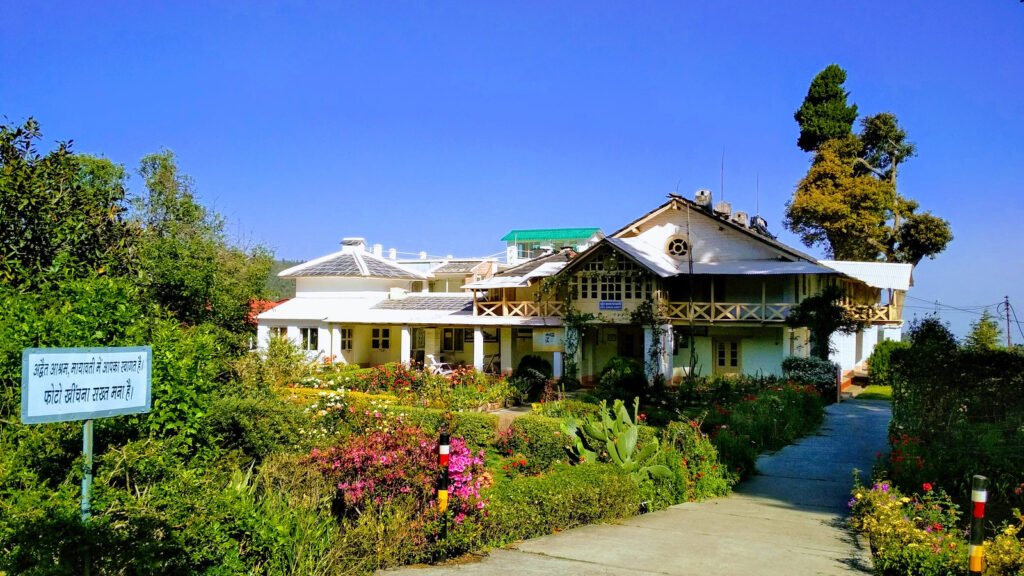
Advaita Ashrama is located in what was once a tea estate. The ashram buildings are simple, functional structures that blend harmoniously with the natural surroundings. The architecture is unpretentious, reflecting the ashram’s emphasis on inner wealth over outer show.
Key Facilities
The Surroundings
The ashram is enveloped by dense deodar and oak forests, with views of the distant snow-capped Himalayan peaks. The absolute silence – broken only by birdsong – creates the ideal environment for meditation and contemplation.
Religious Beliefs: Advaita Vedanta
Core Tenets of Advaita Vedanta
The philosophical foundation of Advaita Ashrama rests on the Upanishads, the Bhagavad Gita, and the Brahma Sutras. Key teachings include:
- The Oneness of Existence: All of reality is one without a second. The distinctions we perceive between self and other, subject and object, are ultimately unreal.
- The Identity of Atman and Brahman: The individual self (Atman) is identical with the ultimate reality (Brahman). Liberation comes from realising this identity, not from acquiring anything new.
- Maya (The Illusion of Duality): The world of separate objects and egos is a superimposition on the one reality, caused by ignorance (Avidya).
- The Means to Liberation: Knowledge (Jnana) – not intellectual understanding alone, but direct, intuitive realisation – is the path to freedom.
- The Harmony of Paths: While Advaita emphasises knowledge, it recognises the validity of devotion (Bhakti) and selfless action (Karma) as preparatory stages that purify the mind and make it receptive to the highest truth.
Advaita Ashrama’s Unique Expression
Unlike most religious institutions, Advaita Ashrama does not prescribe any rituals, prayers, or formal worship. There is no prescribed time for meditation; the entire environment is designed to encourage inner reflection. Visitors are expected to maintain silence and respect the contemplative atmosphere.
The Ashram’s Vision
Vivekananda’s founding prospectus for the ashram remains its guiding light:
“Here it is hoped to keep Advaita free from all superstitions and weakening contaminations.”
This “pure Advaita” is what the ashram has preserved for over 125 years – a place where seekers can encounter the eternal truths of the Upanishads in an environment free from dogma, ritual, and superstition.
How to Reach Advaita Ashrama
By Air
Nearest Airport: Pantnagar Airport (approximately 180 km from Mayawati)
| Details | Information |
|---|---|
| Distance | ~180 km |
| Travel Time | 5–6 hours by taxi |
| Airlines | Limited flights from Delhi to Pantnagar (approx. 1 hour) |
| Onward Travel | Taxis available from the airport |
By Train
Nearest Railway Station: Kathgodam Railway Station (approximately 220 km from Mayawati)
| Details | Information |
|---|---|
| Distance | ~220 km |
| Travel Time | 7–8 hours by taxi |
| Connectivity | Well-connected from Delhi, Lucknow, Kolkata |
Popular Trains from Delhi to Kathgodam:
| Train Name | From Delhi | Departure | Arrival (Kathgodam) | Duration |
|---|---|---|---|---|
| Ranikhet Express | Delhi | 10:05 PM | 5:05 AM | 7 hours |
| Shatabdi Express | Delhi | 6:00 AM | 11:40 AM | 5h 40m |
From Kathgodam station, you can hire a taxi to Lohaghat (approx. 7-8 hours) and then proceed to the ashram.
Alternative Station: Tanakpur Railway Station (approximately 225 km)
By Road
Advaita Ashrama is well-connected by road via Lohaghat town.
Distances from Major Cities
| City | Distance (km) |
|---|---|
| Delhi | ~410 |
| Dehradun | ~379 |
| Nainital | ~130 |
| Almora | ~85 |
| Champawat | 22 |
| Lohaghat | 9 |
| Kathgodam | ~220 |
| Pantnagar Airport | ~180 |
Important Travel Notes
- The last 9 km from Lohaghat to Mayawati is a winding mountain road with stunning views
- A private vehicle is recommended for the final approach
- Public transport options are limited; plan accordingly
Weather and Best Time to Visit
Climate Overview
Mayawati experiences a pleasant high-altitude climate with distinct seasons. The ashram is situated at 1,940 metres, making it significantly cooler than the plains.
Month-by-Month Guide
Best Time to Visit by Season
Why Visit in Summer (March–June)
This is the most popular time to visit Advaita Ashrama:
- Pleasant weather with temperatures ranging from 15°C to 30°C
- Clear skies offering beautiful views of the Himalayan peaks
- Ideal conditions for meditation, study, and nature walks
- Rhododendrons in full bloom, enhancing the scenic beauty
Why Visit in Autumn (October–November)
Autumn is another excellent time to visit:
- Post-monsoon freshness brings out the lush greenery
- Crisp, invigorating air with clear, cloudless skies
- Perfect for photography and long contemplative walks
Why Avoid Monsoon (July–September)
The monsoon months are not recommended for visiting due to:
- Heavy rainfall is making roads slippery and dangerous
- High risk of landslides and road blockages
- Cloud cover obscuring mountain views
Winter Visit (December–February)
Winter transforms the ashram into a serene, snow-dusted landscape:
- Occasional snowfall creates a magical atmosphere
- Very cold temperatures, often dropping below freezing
- Best for those who enjoy solitude and snow
- Carry heavy woollens – thermal layers, jackets, gloves, and woollen caps are essential
Best Time of Day for Meditation
| Time | Experience |
|---|---|
| Morning (Sunrise) | Best for meditation; cool, fresh air; birdsong |
| Late Morning | Good for study and reading in the library |
| Afternoon | Quietest time; ideal for contemplative walks |
| Evening | Beautiful sunset views; closing of the day in silence |
What to See and Do at Advaita Ashrama
1. Meditation in Absolute Silence
The ashram’s primary purpose is to provide an environment for deep meditation. Unlike noisy pilgrimage centres, Advaita Ashrama is deliberately kept silent. Simply sitting in the meditation hall or anywhere on the grounds – listening to the wind in the deodar trees – is the main “activity.”
2. Study at the Library
The ashram houses a well-stocked library with books on Vedanta, comparative religion, and the complete works of Swami Vivekananda. Visitors are welcome to spend hours reading and studying in this peaceful environment.
3. Visit the Museum
A small museum on the premises displays artefacts, photographs, and documents tracing the ashram’s history. The museum offers insight into the lives of the founders and Swami Vivekananda’s connection to Mayawati.
4. See Vivekananda’s Residence
The room where Swami Vivekananda stayed during his January 1901 visit has been preserved and converted into a library. This sacred space allows visitors to connect with the great monk’s presence.
5. Explore the Deodar Forests
The ashram is enveloped by dense deodar and oak forests. Walking trails through the woods offer stunning views of the surrounding mountains and the valley below.
6. Birdwatching
The forests around Mayawati are home to a variety of Himalayan birds, including the Himalayan Monal (state bird of Uttarakhand), woodpeckers, and numerous migratory species.
7. Photography
The ashram grounds, with their rustic buildings, towering deodar trees, and mountain vistas, are a photographer’s delight.
8. Contribute to the Ashram’s Work
The ashram maintains a charitable hospital and publishes spiritual literature. Visitors can support these efforts through donations or by purchasing books from the ashram’s publication centre.
Nearby Places to Visit
Lohaghat – The Gateway Town
Lohaghat is the nearest town to Advaita Ashrama. It is a picturesque hill station situated on the banks of the Lohawati River. Key attractions include:
- Abbotsford: A historic bungalow built during the British era, once used as a prison for Indian freedom fighters.
- Kranteshwar Mahadev Temple: An ancient Shiva temple with stunning views of the surrounding hills.
Champawat – The Ancient Capital
Champawat was the ancient capital of the Chand dynasty, which ruled over the Kumaon region for over 800 years. Key attractions include:
- Baleshwar Temple: A 12th-century stone temple dedicated to Lord Shiva, known for its exquisite architecture.
- Kranteshwar Mahadev Temple: Another ancient temple with panoramic views.
- Devidhura: Located 35 km away, famous for the Varahi Devi Temple and the unique Bagwal festival.
Shyamlatal Lake
Located approximately 25 km from Mayawati, Shyamlatal is a beautiful hill lake known for its crystal-clear waters and serene surroundings. It is also known as the “Blue Lake” due to the colour of its waters.
Where to Stay: Accommodation Options
At Advaita Ashrama
| Accommodation | Price Range | Features |
|---|---|---|
| Ashram Guest Rooms | Nominal donation | Simple rooms, basic amenities, vegetarian meals available on request |
Important Notes:
- Accommodation at the ashram is limited and intended primarily for serious spiritual seekers
- Advance booking is recommended
- Visitors are expected to follow ashram rules – maintain silence, dress modestly, and respect the contemplative atmosphere
In Lohaghat (9 km from Ashram)
| Category | Price Range | Features |
|---|---|---|
| Mid-Range Hotels | ₹2,000 – ₹4,000 | Comfortable rooms, hot water, good food |
| Budget Hotels | ₹800 – ₹1,800 | Basic amenities, clean rooms |
| Guesthouses | ₹500 – ₹1,200 | Simple accommodation, local experience |
In Champawat (22 km from Ashram)
| Category | Price Range | Features |
|---|---|---|
| Mid-Range Hotels | ₹1,500 – ₹3,500 | Comfortable rooms |
| Budget Hotels | ₹600 – ₹1,500 | Basic amenities |
| Homestays | ₹1,000 – ₹2,000 | Authentic Kumaoni experience |
Booking Tips
- Book well in advance for peak seasons (March–June, September–November)
- For stays at the ashram, contact the ashram management directly or inquire through the Ramakrishna Math
- Lohaghat offers the widest range of accommodation options
- Carry cash – card facilities may be limited in smaller towns
Local Cuisine: What to Eat
At the Ashram
The ashram serves simple, pure vegetarian meals. The food is prepared in the traditional sattvic style – light, nutritious, and conducive to meditation.
In Lohaghat and Champawat
| Dish | Description |
|---|---|
| Aloo Ke Gutke | Spiced fried potatoes, a Kumaoni speciality |
| Bhatt ki Churkani | Black soybean curry |
| Chainsoo | Protein-rich black gram curry |
| Mandua Roti | Finger millet flatbread |
| Gahat Ki Dal | Horse gram lentil soup |
| Jhangora Kheer | Barnyard millet sweet pudding |
| Bal Mithai | Famous chocolate-like sweet from Kumaon |
Dining Tips
- Most hotels offer meal packages
- Pure vegetarian options are widely available
- The ashram offers simple, nutritious meals for guests
- Carry packaged snacks for the journey
Travel Tips and Important Information
Before You Go
- Check Weather: Avoid monsoon (July–September) due to heavy rainfall and landslide risk
- Carry Cash: ATMs are limited in Lohaghat and Mayawati; bring sufficient cash from Almora or Kathgodam
- Dress Modestly: The ashram is a place of spiritual significance; dress appropriately
- No Rituals to Perform: Unlike temples, there are no specific rituals to perform here – just be prepared to sit in silence
- Advance Booking: If you wish to stay at the ashram, contact them in advance
During Your Visit
- Maintain Silence: The ashram is a place of contemplation; avoid loud conversations
- No Photography Inside Buildings: Ask permission before photographing interior spaces
- Respect the Rules: No idol worship, no rituals, no offerings – the ashram’s focus is purely on Advaita Vedanta
- Dress Modestly: Shoulders and knees should be covered
- Carry Warm Clothing: Even in summer, evenings are cool; winter requires heavy woollens
Safety Tips
- Road Safety: The roads from Lohaghat to Mayawati are winding; avoid night driving
- Monsoon Travel: Avoid July–September due to landslide risk
- Altitude Awareness: At 1,940 m, altitude sickness is rare but possible; stay hydrated
- Wildlife: The area is forested; be aware of your surroundings
What to Pack
| Category | Items |
|---|---|
| Clothing | Light cotton for summer; heavy woolens for winter; modest attire |
| Footwear | Comfortable walking shoes |
| Accessories | Hat, sunscreen, sunglasses, camera, binoculars (for birdwatching) |
| Health | Personal medications, water bottle, snacks |
| Documents | ID proof (Aadhaar/Passport) |
| Other | Cash, books (if you wish to read in the library), notebook, meditation cushion |
Photography Tips
- Best Spots: The ashram buildings, deodar forest trails, mountain views
- Best Time: Morning for soft light; golden hour for landscapes
- Note: Ask permission before photographing inside buildings or residents
Frequently Asked Questions (FAQs)
Q1: What is Advaita Ashrama famous for?
A: Advaita Ashrama (Mayawati Ashram) is famous for being a Himalayan retreat established by Swami Vivekananda’s disciples in 1899. It is dedicated to the study and practice of Advaita Vedanta – the philosophy of non-dualism. It is also the publishing headquarters of the Prabuddha Bharata journal.
Q2: Why are there no idols at Advaita Ashrama?
A: As per Swami Vivekananda’s vision, the ashram is dedicated to “pure Advaita” – a religion without ritual or superstition. No images or idols are worshipped here, not even of Ramakrishna or Vivekananda.
Q3: What is the best time to visit Advaita Ashrama?
A: The best time to visit is March to June (summer) and October to November (autumn). The weather is pleasant, and the Himalayan views are clear. Monsoon (July–September) is best avoided due to heavy rainfall.
Q4: How far is Advaita Ashrama from Delhi?
A: The distance from Delhi is approximately 410 km, with a travel time of 10–12 hours by road.
Q5: How do I reach Advaita Ashrama?
A: By road from Lohaghat (9 km) or Champawat (22 km), by train to Kathgodam (~220 km) followed by taxi, or by flight to Pantnagar Airport (~180 km) followed by taxi.
Q6: What is the altitude of Advaita Ashrama?
A: The ashram is situated at an altitude of approximately 1,940 metres (6,365 feet) above sea level.
Q7: Can I stay overnight at Advaita Ashrama?
A: Yes, the ashram has simple guest rooms available on request. Booking is recommended. Visitors are expected to follow ashram rules, including maintaining silence and dressing modestly.
Q8: Is there an entry fee for Advaita Ashrama?
A: No, entry to the ashram is free. Donations to support the ashram’s work (publishing, charitable hospital) are welcome.
Q9: What are the timings of Advaita Ashrama?
A: The ashram is open to visitors during daylight hours. Specific timings may vary; it is advisable to contact the ashram directly before visiting.
Q10: Is photography allowed at Advaita Ashrama?
A: Photography of the grounds and exteriors is generally allowed. Ask permission before photographing interior spaces or residents.
Q11: What is the philosophy of Advaita Ashrama?
A: The ashram is dedicated to Advaita Vedanta – the non-dual philosophy that teaches the oneness of the individual soul (Atman) with the universal consciousness (Brahman).
Q12: Are there accommodation options near the ashram?
A: Yes, nearby towns like Lohaghat (9 km) and Champawat (22 km) offer a range of hotels, guesthouses, and homestays.
Q13: What is Prabuddha Bharata?
A: Prabuddha Bharata (“Awakened India”) is the English monthly journal of the Ramakrishna Order, published continuously from Mayawati since 1899. It was Swami Vivekananda’s idea to shift the publication here.
Q14: What is the connection between Swami Vivekananda and Advaita Ashrama?
A: The ashram was founded at the behest of Swami Vivekananda in 1899 by his disciples, Captain and Mrs Sevier. Vivekananda visited the ashram in January 1901, and his residence has been preserved as a library.
Q15: Is Advaita Ashrama suitable for elderly visitors?
A: Yes, the ashram is accessible and suitable for elderly visitors. However, the altitude (1,940 m) and cool temperatures should be considered. Winter visits may be challenging due to cold.
Plan Your Advaita Ashrama Journey with Discover Uttarakhand
At Discover Uttarakhand, we’ve been organising unforgettable spiritual journeys across Devbhoomi since 1997. As a trusted local operator with deep knowledge of the Kumaon region and its sacred sites, we offer:
- ✅ Customised Advaita Ashrama tour packages (2 to 5 days)
- ✅ Combined itineraries covering Mayawati, Champawat, Lohaghat, and nearby temples
- ✅ Comfortable transport with experienced hill drivers
- ✅ Verified accommodations in Lohaghat and Champawat
- ✅ Guidance on ashram etiquette and philosophy
- ✅ 24/7 customer support throughout your journey
Recommended Advaita Ashrama Packages
| Package | Duration | Starting Point | Highlights |
|---|---|---|---|
| Advaita Ashrama Day Trip | 1 Day | Lohaghat/Champawat | Ashram visit, library, museum, deodar forest walk |
| Advaita Ashrama & Champawat | 2 Nights / 3 Days | Kathgodam | Ashram, Baleshwar Temple, Lohaghat |
| Kumaon Spiritual Circuit | 3 Nights / 4 Days | Kathgodam | Advaita Ashrama, Jageshwar, Almora, Kasar Devi |
| Kumaon Heritage Tour | 4 Nights / 5 Days | Delhi | Advaita Ashrama, Champawat, Lohaghat, Shyamlatal |
Book your Advaita Ashrama journey today and experience the profound silence of the Himalayas, where Swami Vivekananda’s vision of Advaita comes alive.
📞 Call / WhatsApp: +91-9997187178, 9760222178, 8171977178
📍 Visit Our Office: Himalayan Colony, opposite DSVV, Haripur Kalan, Haridwar, Motichur Range, Uttarakhand 249411
🌐 Website: www.discover-uttarakhand.com
📧 Email: info@discover-uttarakhand.com
“To give this One Truth a freer and fuller scope… we start this Advaita Ashrama on the Himalayan heights, the land of its first expiration.” – Swami Vivekananda
Discover Uttarakhand – Your Local Partner for Unforgettable Himalayan Journeys Since 1997 🕉️🏔️