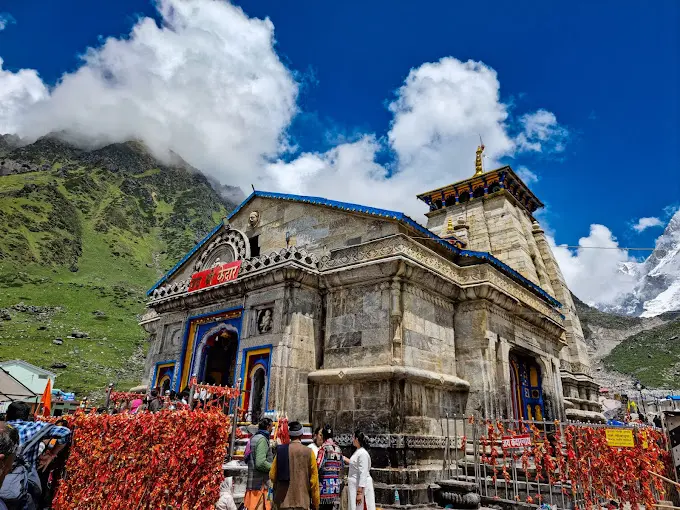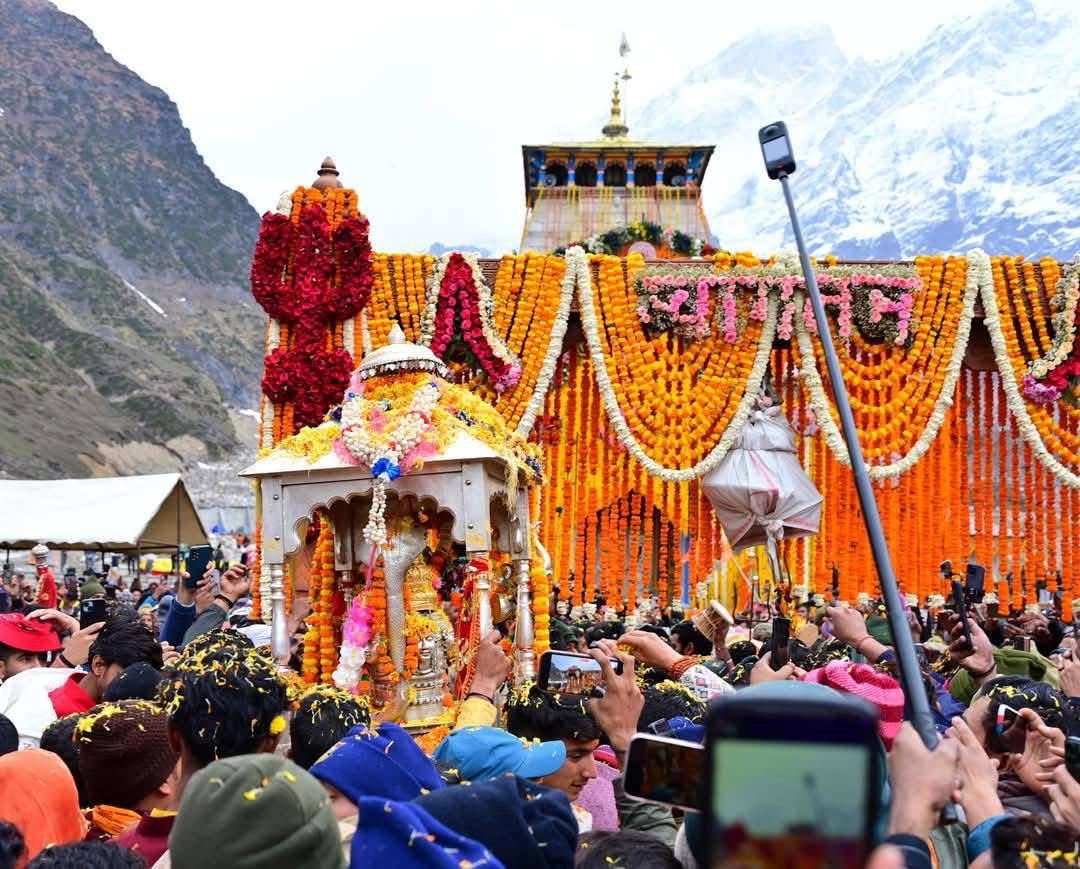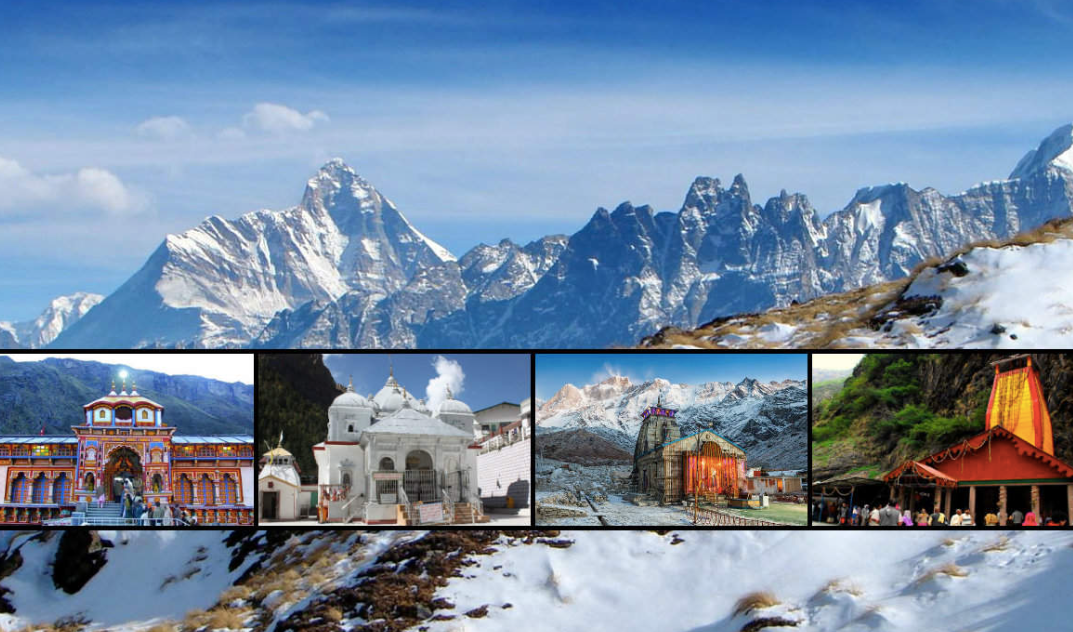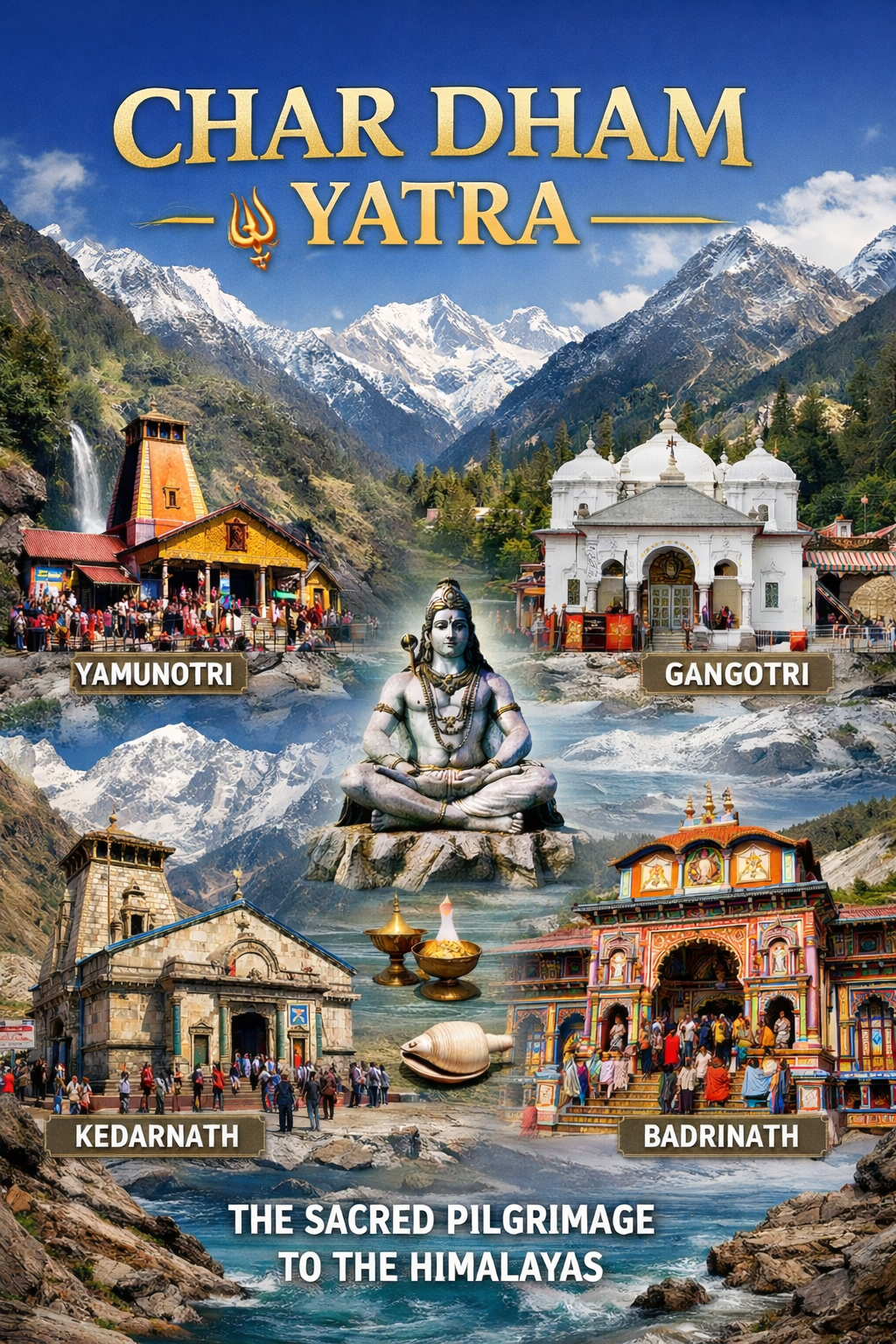
Introduction: The Sacred Abode of Lord Vishnu
Badrinath Dham, nestled in the Chamoli district of Uttarakhand at an altitude of 3,133 meters (10,279 feet), is one of the most revered Hindu temples dedicated to Lord Vishnu. Situated on the banks of the Alaknanda River, between the Nar and Narayana mountain ranges, this sacred site is the most important of the four Char Dham pilgrimage destinations in India. The temple is also one of the 108 Divya Desams—holy shrines for Vaishnavites—where Lord Vishnu is worshipped as Badrinath.
The name “Badrinath” derives from two Sanskrit words: “Badri,” referring to a berry that was said to grow abundantly in the area, and “nath,” meaning “Lord of”. The surrounding region was once covered with Badri trees (Indian Jujube), giving the place its sacred name.
For devout Hindus, a pilgrimage to Badrinath is not merely a journey—it is an act of profound faith. It is believed that visiting this sacred shrine and taking a dip in the holy waters of the Alaknanda River washes away sins and paves the path to salvation (moksha). The temple remains open for six months each year, from late April/early May to November, due to extreme weather conditions in the Himalayan region.
History and Mythology of Badrinath
The Legend of Nara and Narayana
According to the Bhagavata Purana, the area around Badrinath—referred to as Badarikashram—is where Lord Vishnu, in his incarnation as the twin sages Nara and Narayana, underwent great penance since time immemorial for the welfare of all living entities. The twin sages performed years of austere penance at this spot, seeking union with the divine. The mountains surrounding Badrinath—Nar and Narayana—are named after these two manifestations of Vishnu.
The Legend of the Pandavas
The mountains around Badrinath are mentioned in the Mahabharata, when the Pandavas were said to have expired one by one while ascending the slopes of Swargarohini peak in western Garhwal—the “Ascent to Heaven”. The Pandavas passed through Badrinath and the town of Mana, 4 km north of Badrinath, on their way to Svarga (heaven). There is also a cave in Mana where Vyasa, according to legend, wrote the Mahabharata.
The Story of Goddess Ganga
One legend tells that when the goddess Ganga was requested to descend to Earth to help suffering humanity, the Earth was unable to withstand the force of her descent. Therefore, the mighty Ganga was split into twelve holy channels, with the Alaknanda River being one of them. Badrinath sits on the banks of this sacred river, which flows through the region as a testament to divine grace.
The Legend of Adi Shankaracharya
Badrinath was re-established as a major pilgrimage site by the great philosopher-saint Adi Shankaracharya in the 9th century CE. According to legend, Shankaracharya discovered a black stone image of Lord Badrinarayan made of Shaligram stone in the Alaknanda River. He originally enshrined it in a cave near the Tapt Kund hot springs. In the 16th century, the King of Garhwal moved the murti to the present temple. This connection ties the physical temple to the revival of sacred knowledge and pilgrimage culture in the region.
The Legend of Badri Vishal
Another legend explains both the name and the sitting posture: This place was full of Badri bushes, and as Vishnu meditated, his beloved consort Lakshmi stood next to him, sheltering him from the scorching sunlight. She transformed into a Badri tree herself, becoming “Badri Vishal,” and her Lord (Nath) became Badrinath—the Lord of the Badri forest.
Geography and Location
Geographic Coordinates
- Latitude: 30°44′ N
- Longitude: 79°29′ E
- Elevation: 3,133 meters (10,279 feet) above sea level
- Area: Approximately 3 sq km
Topography
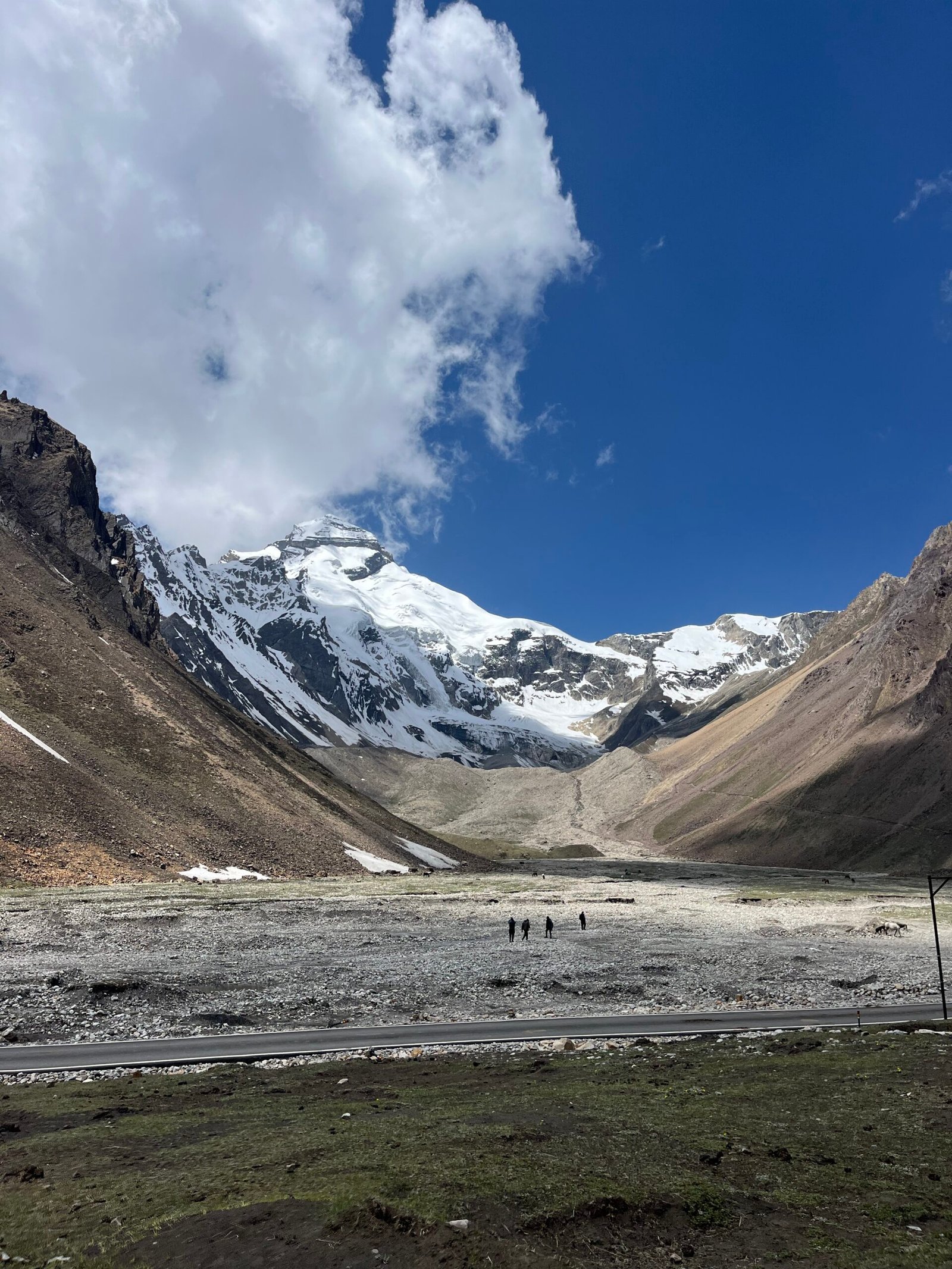
Badrinath is situated in the Garhwal Himalayas on the banks of the Alaknanda River. The town lies between the Nar and Narayana mountain ranges, approximately 9 km east of the Nilkantha peak (6,596 meters). It is located 62 km northwest of Nanda Devi peak and 301 km north of Rishikesh. From Gaurikund (near Kedarnath) to Badrinath by road is 233 km.
The Alaknanda River
The Alaknanda River flows through Badrinath, originating from the Satopanth Glacier and later meeting the Bhagirathi River at Devprayag to form the Ganga. This river is considered one of the most sacred in Hinduism, and its waters are believed to have purifying properties.
Badrinath Temple: Architecture and Significance
Temple Architecture
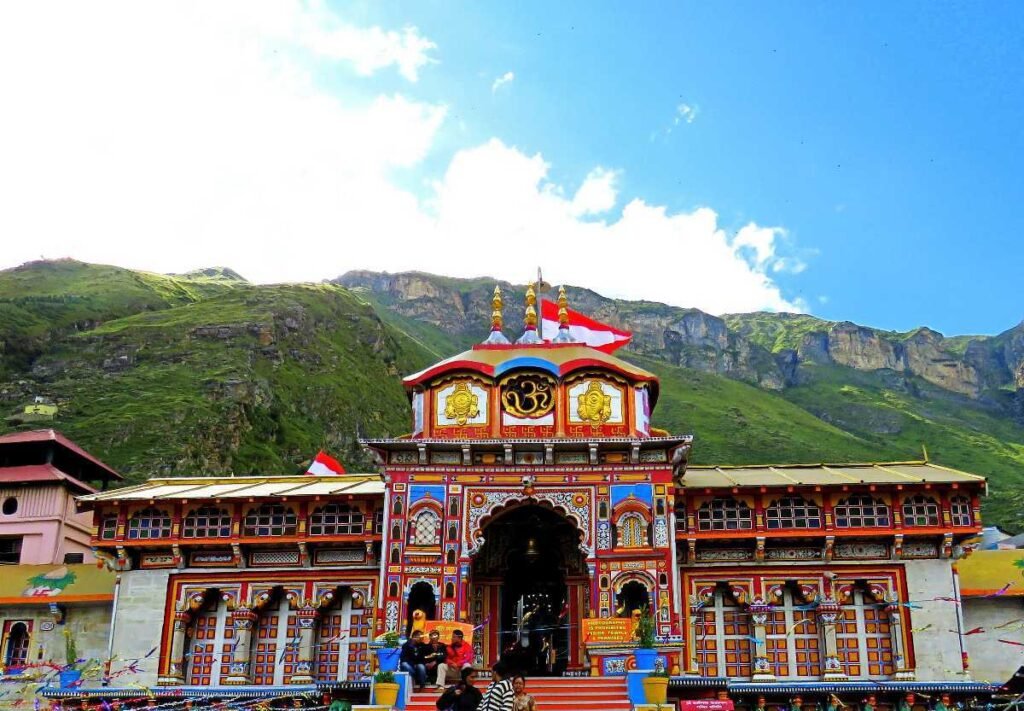
The Badrinath Temple is a masterpiece of traditional North Indian temple architecture. The temple is approximately 50 feet (15 meters) tall with a small cupola on top, covered with a gold gilt roof. The facade is built of stone, with arched windows, and a broad stairway leads up to a tall arched gateway, which is the main entrance. The architecture resembles a Buddhist vihara (temple), with the brightly painted facade also more typical of Buddhist temples.
The Sanctum
Just inside the entrance is the mandapa, a large pillared hall that leads to the garbha griha (main shrine area). The walls and pillars of the mandapa are covered with intricate carvings. The main sanctum houses a 1-meter-tall black stone idol of Lord Badrinarayan made of Shaligram stone. The idol depicts Lord Vishnu in a meditative posture with four arms—holding the Shankh (conch) and Sudarshana Chakra (discus) in two arms raised, while the other two arms rest on the lap in Yogamudra (meditative pose) .
Deities and Worship
The main deity is Lord Vishnu, worshipped as Badrinarayan. The temple is one of the 108 Divya Desams—holy shrines for Vaishnavites. Daily rituals include morning aarti, abhishekam (anointing of the idol), and evening aarti. The temple is managed by the Nambudiri Brahmin priests from Kerala, following the traditions established by Adi Shankaracharya.
Temple Timings
| Activity | Timing |
|---|---|
| Opening | 4:00 AM |
| Morning Aarti | 4:30 AM – 5:00 AM |
| Darshan | 6:00 AM – 12:00 PM, 4:00 PM – 9:00 PM |
| Evening Aarti | 8:00 PM – 8:30 PM |
Timings may vary by season; check before visiting
Religious Significance and Sacred Sites
Tapt Kund – The Holy Hot Spring
Located approximately 0.5 km from the Badrinath Temple, Tapt Kund is a natural hot water spring on the banks of the Alaknanda River with temperatures reaching up to 45°C . Every pilgrim visiting Badrinath is expected to take a dip here before entering the main temple, as it is believed to purify the body and soul. The water is locally believed to have medicinal properties, especially for skin ailments. In the middle of the Himalayan cold, stepping into these warm waters is an experience that’s hard to describe unless you’ve done it.
Narad Kund
Narad Kund is a revered hot water spring located near Badrinath Temple on the banks of the Alaknanda River. It is believed to be the place where the idol of Lord Badrinath was originally found by Adi Shankaracharya in the 8th century. Pilgrims consider it a sacred site for purification and meditation. The site takes its name from Narad Muni, a great devotee of Lord Vishnu and a divine sage known for his devotion. According to legends, Narad Muni performed penance here and wrote the famous Narada Bhakti Sutra, a scripture on devotion.
Brahma Kapal
Brahma Kapal is a highly revered ghat on the banks of the Alaknanda River near the Badrinath Temple. Devotees perform Shradh rituals (ancestral rites) and Pind Daan (offering food and prayers to ancestors) at this sacred site. According to Hindu mythology, Lord Brahma resides here and relieves ancestors of their past sins, granting them moksha (liberation). Legends also say that Lord Shiva’s head (Kapal) fell at this spot after Lord Vishnu removed his curse, giving the place its name, Brahma Kapal.
Charan Paduka
Charan Paduka is a revered rock located 3 km from Badrinath Temple, bearing the footprints of Lord Vishnu. According to Hindu mythology, Lord Vishnu set foot here while descending from Vaikuntha (his heavenly abode) to bless the Earth. Pilgrims believe that visiting this sacred site brings good fortune, protection, and spiritual upliftment. The place is surrounded by breathtaking views of the Himalayan peaks and the Alaknanda Valley. The approach is an uphill trek that takes about 45 minutes to an hour. The view from Charan Paduka offers sweeping panoramic views of the Badrinath valley and the surrounding Himalayan peaks.
How to Reach Badrinath
By Air
Nearest Airport: Jolly Grant Airport, Dehradun (approximately 298-317 km from Badrinath)
From the airport:
- Taxis are available to Badrinath (a 10-12 hours journey)
- Helicopter services available from Sahastradhara (Dehradun) to Badrinath (50-60 minutes flight)
By Train
Nearest Railway Stations:
| Station | Distance from Badrinath | Travel Time |
|---|---|---|
| Rishikesh | 295-314 km | 10-11 hours by road |
| Haridwar | 320 km | 10-12 hours by road |
| Kotdwara | 327 km | 10-12 hours by road |
From the railway station, travellers must continue by road to reach Badrinath.
By Road
Badrinath is reached by the national highway NH58 that connects Delhi with Mana Pass in Uttarakhand near the Indo-Tibet border.
Key Distances:
| Starting Point | Distance | Travel Time |
|---|---|---|
| Delhi | 315-530 km | 14-18 hours |
| Haridwar | 320 km | 10-12 hours |
| Rishikesh | 293-314 km | 10-11 hours |
| Dehradun | 298-350 km | 9-12 hours |
| Rudraprayag | 140 km | 4-5 hours |
| Joshimath | 42-45 km | 2-3 hours |
Route Details:
Delhi → Haridwar → Rishikesh → Devprayag → Srinagar → Rudraprayag → Karnaprayag → Chamoli → Joshimath → Badrinath
Road Conditions:
- Delhi to Haridwar: Smooth highway on NH 334
- Haridwar to Joshimath: Hilly roads with steep climbs and sharp turns
- Joshimath to Badrinath: Narrow mountain road; travel not permitted after sunset
Bus Services: Regular state transport and private buses operate from Rishikesh and Haridwar to Badrinath. The last bus from Rishikesh leaves before dawn; if you miss it, you must stop at Rudraprayag, Chamoli, or Joshimath for the night.
By Helicopter
Helicopter services to Badrinath are available as part of the Do Dham (Kedarnath–Badrinath) packages.
Key Details:
- Departure Point: Sahastradhara (Dehradun)
- Travel Time: 50-60 minutes
- Cost: ₹70,000–₹90,000 per person (same-day round trip)
- Booking: Online or via authorised travel agencies
- Best For: Travellers with limited time, senior citizens, or those avoiding long road travel
Tip: Early morning slots are recommended to avoid weather disruptions. Weather can cause cancellations.
Weather and Best Time to Visit
Climate Overview
Badrinath experiences a subarctic climate with extremely cold winters, cool summers, and heavy monsoon rainfall. The given location is in the northern hemisphere, and summer begins at the end of June and ends in September.
Month-by-Month Temperature Guide
| Month | Average Min (°C) | Average Max (°C) | Precipitation (mm) | Conditions |
|---|---|---|---|---|
| January | -13.8 | -7.3 | 130 | Extreme cold, heavy snow |
| February | -12.8 | -6.2 | 168 | Very cold, snowy |
| March | -10.6 | -2.7 | 143 | Cold, snow melting |
| April | -7.8 | 1.4 | 93 | Cool, trails begin to clear |
| May | -3.6 | 4.7 | 55 | Pleasant, ideal for yatra |
| June | 0.9 | 8.6 | 96 | Pleasant, peak season |
| July | 5.4 | 10.8 | 230 | ⭐ Warmest, but monsoon rains |
| August | 5.6 | 10.7 | 217 | Monsoon, high rainfall |
| September | 1.7 | 8.5 | 129 | Post-monsoon, clear |
| October | -4.9 | 4.1 | 43 | Cool, clear, ideal |
| November | -8.5 | 0.5 | 36 | Cold, closing season |
| December | -11.7 | -3.6 | 63 | Very cold, temple closed |
Best Time to Visit
| Season | Months | Suitability | Conditions |
|---|---|---|---|
| Summer | May-June | ⭐ Excellent | Pleasant weather (7°C–18°C), clear skies, all services operational |
| Autumn | September-October | ⭐ Excellent | Post-monsoon clarity (4°C–14°C), crisp air, fewer crowds |
| Monsoon | July-August | ❌ Not Recommended | Heavy rainfall, landslide risk, road closures |
| Winter | November-April | ❌ Closed | Temple closed, heavy snowfall, roads blocked |
Temple Opening and Closing Dates (2026)
- Opening Date: Akshaya Tritiya (late April/early May 2026)
- Closing Date: Vijayadashami (October/November 2026)
- Winter Abode: During winter closure, the idol of Lord Badrinath is shifted to Narasimha Temple in Joshimath, where worship continues throughout the winter
Nearby Places and Attractions
Badrinath is surrounded by some of the most extraordinary places in the Himalayas—mythological caves, a UNESCO World Heritage Site, glacial lakes, hot springs, and a living tribal village at the very edge of India.
1. Mana Village – India’s Last Village
Located just 3–4 km north of the Badrinath Temple, Mana is officially designated as India’s “First Village”—a rebranding from its older title, “Last Village before Tibet” . The village sits at around 3,200 meters (10,500 feet) and is home to the Bhotiya tribe, whose semi-nomadic lifestyle has made them the cultural gatekeepers of this Himalayan frontier for centuries.
Highlights:
- Saraswati River: Flows through the village and disappears underground here
- Saraswati Temple: Dedicated to Goddess Saraswati at the origin of the river
- Vyas Gufa: Cave where Maharishi Ved Vyas is believed to have dictated the Mahabharata to Lord Ganesha
- Ganesh Gufa: Cave where Ganesha sat and wrote as Vyas dictated
- Bheem Pul: Natural rock bridge where Bheem placed a massive stone over the Saraswati River
- Last Tea Stall of India: Famous chai stall at the edge of the village
Best time: May–June & September–October
How to reach: 10-minute drive or 30-minute walk from Badrinath Temple
2. Vasudhara Falls
Vasudhara Falls is a stunning 400-foot waterfall located about 9 km from Mana Village (roughly 12–13 km from Badrinath). The trek to reach it is one of the most rewarding, easy-to-moderate walks in the region. The waterfall pours down in a fine misty spray from a cliff on the Mana plateau.
Legend: The water is said to avoid falling on anyone with a troubled conscience—a fascinating local belief that adds to the site’s mystique.
Distance from Badrinath: ~12–13 km total
Trek difficulty: Easy to moderate
Time required: 4–5 hours (round trip from Mana)
Best time: May–June, September–October
3. Valley of Flowers National Park – UNESCO World Heritage Site
The Valley of Flowers is situated at an altitude of 3,658 meters in the Bhyundar valley in Chamoli district. It is part of the Nanda Devi Biosphere Zone and holds UNESCO World Heritage Site status. The park spans roughly 87 square kilometres and is home to over 520 species of alpine plants, of which 498 are flowering plants.
Flora: Alpine flowers, Vajardanti, Marsh Marigold, Brahmakamal
Fauna: Asiatic black deer, snow leopard, musk deer, red fox, brown bear, blue sheep
Base: Govindghat (25 km from Badrinath)
Trek Distance: Govindghat to Ghangaria (9 km), Ghangaria to Valley of Flowers (6 km one way)
Best time: Mid-July to mid-September (peak bloom)
Difficulty: Easy to moderate
4. Hemkund Sahib – World’s Highest Gurudwara
Paired almost always with the Valley of Flowers trek, Hemkund Sahib is the highest Gurudwara in the world, sitting at an elevation of approximately 4,329 meters (14,100 feet). The trek starts from Ghangaria and covers about 6 km each way, taking 7–9 hours for the round trip.
Highlights:
- Gurudwara sits beside a perfectly still glacial lake
- Reflects the surrounding Saptarishi Peaks during clear skies
- Near the Gurudwara, there is also a Laxman Temple
Elevation: 4,329 m (14,100 ft)
Distance from Ghangaria: 6 km one way
Best time: June–October
Difficulty: Moderate to challenging
5. Satopanth Lake – The Trinity’s Sacred Lake
Located about 24 km from Mana Village (roughly 27 km from Badrinath), Satopanth Lake sits at an elevation of approximately 4,600 meters (15,100 feet) and is considered one of the most sacred glacial lakes in India. The lake is triangular in shape, and local Hindu belief holds that Lord Brahma meditates at one corner, Lord Vishnu at another, and Lord Shiva at the third.
Distance from Badrinath: ~27 km
Trek Difficulty: Difficult, requires good physical fitness
Best time: May–June, September–October
6. Joshimath and Auli
Joshimath is located 42-47 km from Badrinath and serves as the winter abode of Lord Badrinath. The town has the Narasimha Temple, where the Badrinath idol is worshipped during the winter months.
Auli is a famous skiing destination accessible via a ropeway from Joshimath. The Auli ropeway offers stunning views of the Himalayas and is one of the longest cable car rides in India.
7. Other Sacred Sites
Distances from Major Cities
| City | Distance (km) |
|---|---|
| Delhi | 315-530 |
| Haridwar | 320 |
| Rishikesh | 293-314 |
| Dehradun | 298-350 |
| Rudraprayag | 140 |
| Karnaprayag | 100 |
| Chamoli | 58 |
| Joshimath | 42-45 |
| Kedarnath | 233 |
| Gangotri | 320 |
| Yamunotri | 250 |
Accommodation Options
Types of Accommodation
| Category | Estimated Cost (per night) | Distance from Temple | Facilities |
|---|---|---|---|
| GMVN Yatri Niwas | ₹1,500 – ₹2,500 | 0–200 m | Clean rooms, attached bathrooms, hot water, and power backup |
| GMVN Hotel Devlok | ₹2,500 – ₹3,500 | 200–300 m | Attached bathrooms, charging facilities, and comfortable bedding |
| Private Guesthouses & Lodges | ₹3,000 – ₹5,000 | 200–700 m | Cosy beds, private washrooms, heating option |
| Base Camp Tents & Prefab Huts | ₹2,000 – ₹4,000 | Around 1 km | Warm bedding, common toilets, resting area |
| Luxury Tents (Seasonal) | ₹5,000 – ₹8,000 | 800 m – 1 km | Cozy beds, private washrooms, heating option |
| Dharamshalas & Ashrams | ₹600 – ₹1,500 | 200–800 m | Basic accommodation, vegetarian meals, spiritual ambience |
Booking Tips
- Book well in advance for peak seasons (May–June, September–October)
- Carry warm clothes for evenings
- Stay hydrated and take it easy due to the high altitude
Essential Packing List
Clothing Essentials
- Thermal innerwear (top and bottom) – multiple pairs
- Fleece jacket and heavy woollen sweater
- Down jacket or thick winter coat
- Waterproof outer shell/raincoat
- Woollen gloves, muffler, and woollen cap
- Heavy woollen socks (3-4 pairs)
- Sturdy, broken-in trekking shoes with good grip
- Comfortable slippers for evenings
Accessories and Gear
- Trekking pole for stability
- Headlamp or torch with extra batteries
- Power bank for charging devices
- Sunglasses with UV protection
- Sunscreen and lip balm (high altitude sun is intense)
- Reusable water bottle (insulated recommended)
Health and Hygiene
- Personal medications with a prescription
- First-aid kit with bandages, antiseptics, and pain relievers
- Altitude sickness medication (consult doctor)
- Portable oxygen can (recommended)
- Basic toiletries, wet wipes, and hand sanitiser
- Moisturiser (high altitude causes dry skin)
Documents
- Valid ID proof (Aadhaar/Passport/Voter ID)
- Yatra registration printout
- Doctor’s prescription for regular medications
- Travel insurance documents
Travel Tips and Important Information
Before You Go
- Medical Check-up: Consult your doctor before undertaking the yatra, especially if you have heart or respiratory conditions
- Yatra Registration: Complete mandatory registration through the official Uttarakhand tourism portal
- Physical Preparation: Start walking and light exercise 1-2 months before the yatra
- Book in Advance: For May-June and September-October, book accommodations and transport 2-3 months ahead
During the Yatra
- Acclimatisation: Spend a night at Joshimath (1,890 m) before proceeding to Badrinath (3,133 m)
- Start Early: Begin your journey early to reach Badrinath before the afternoon fog sets in
- Stay Hydrated: Drink plenty of water to prevent altitude sickness
- Dress in Layers: Temperatures can change rapidly—layers allow adjustment throughout the day
- Avoid Night Travel: Mountain roads become risky after dark; reach your destination before sunset
Health Precautions
- Altitude Sickness: Symptoms include headache, nausea, and breathlessness. If symptoms worsen, descend immediately
- Oxygen Support: Portable oxygen canisters are available at shops in Badrinath
- Emergency Numbers: Keep local emergency contact numbers handy
Photography Tips
- Sunrise over the Badrinath peaks is spectacular
- Photography inside the temple may be restricted; check with temple authorities
- Carry extra batteries—cold drains battery quickly
Frequently Asked Questions (FAQs)
Q1: Why is Badrinath Dham important?
A: Badrinath is one of the four Char Dham pilgrimage sites and one of the 108 Divya Desams. It is believed to be where Lord Vishnu meditated in his Nara-Narayana form. The temple houses a 1-meter-tall black stone idol of Lord Badrinarayan.
Q2: What is the best time to visit Badrinath?
A: The best time to visit is May to June (pleasant weather) and September to October (post-monsoon clarity). The temple is open from late April/early May to October/November.
Q3: When does Badrinath Temple open in 2026?
A: The temple opens on Akshaya Tritiya (late April/early May 2026) and closes on Vijayadashami (October/November 2026). Exact dates are announced closer to the season.
Q4: What is the temperature in Badrinath?
A: Summer temperatures range from 7°C to 18°C; winter temperatures can drop below -10°C with heavy snowfall. The warmest month is July with an average max of 10.8°C.
Q5: What is the distance from Delhi to Badrinath?
A: The distance is approximately 315-530 km by road, taking 14-18 hours.
Q6: How to reach Badrinath?
A: The journey involves:
- By Air: Fly to Jolly Grant Airport, Dehradun (298 km), then drive 10-12 hours
- By Train: Take a train to Rishikesh (295 km) or Haridwar (320 km), then drive
- By Road: Drive from Delhi via Haridwar and Rishikesh
Q7: Are there hotels in Badrinath?
A: Yes, Badrinath has GMVN guest houses, dharamshalas, private hotels, and seasonal luxury tents. Booking in advance during peak season is essential.
Q8: Is Badrinath safe for senior citizens?
A: Yes, but special arrangements are recommended:
- Consider the helicopter option from Dehradun
- Book accommodations near the temple
- Consult a doctor before travelling
- Carry oxygen support
Q9: What is the significance of Tapt Kund?
A: Tapt Kund is a natural hot water spring where pilgrims take a dip before entering the temple. The water is believed to have healing properties.
Q10: What is Mana Village known for?
A: Mana Village is India’s last village before the Tibetan border. It is home to the Bhotiya tribe and has mythological sites like Vyas Gufa, Ganesh Gufa, and Bheem Pul.
Q11: What is the distance from Badrinath to the Valley of Flowers?
A: Valley of Flowers is approximately 25 km from Badrinath via Govindghat. The trek to the valley requires a multi-day commitment.
Q12: Is there a mobile network in Badrinath?
A: Mobile connectivity is limited. BSNL typically offers better coverage than other networks. Internet availability is poor.
Q13: What documents are required for the yatra?
A: Valid ID proof (Aadhaar/Passport/Voter ID) and yatra registration. Foreign nationals require a valid visa.
Q14: Can I visit Badrinath in winter?
A: No, the temple is closed from November to April due to heavy snowfall. The idol is moved to Joshimath during this period.
Q15: What is the Panch Badri?
A: Panch Badri refers to five sacred shrines dedicated to Lord Vishnu in the Garhwal region: Badrinath, Yogadhyan Badri, Vriddha Badri, Bhavishya Badri, and Adi Badri.
Plan Your Badrinath Yatra with Discover Uttarakhand
At Discover Uttarakhand, we’ve been organising spiritual journeys across Devbhoomi since 1997. As a trusted local operator with deep knowledge of the Badrinath route, we offer:
- ✅ Customised Badrinath Yatra packages (3 to 7 days)
- ✅ Combined Char Dham itineraries
- ✅ Helicopter package arrangements
- ✅ Comfortable transport with experienced mountain drivers
- ✅ Verified accommodations in Joshimath, Badrinath, and nearby areas
- ✅ Local guidance for visiting Mana Village, Valley of Flowers, and other attractions
- ✅ 24/7 customer support throughout your journey
Recommended Badrinath Packages
| Package | Duration | Highlights |
|---|---|---|
| Badrinath Darshan from Haridwar | 2 Nights / 3 Days | Badrinath Temple, Tapt Kund, Mana Village |
| Badrinath with Valley of Flowers | 5 Nights / 6 Days | Badrinath, Govindghat, Ghangaria, Valley of Flowers |
| Do Dham Yatra (Kedarnath + Badrinath) | 5 Nights / 6 Days | Both shrines, Guptkashi, Joshimath |
| Char Dham Yatra | 10-12 Days | Complete pilgrimage circuit |
Book your Badrinath Yatra today and experience the divine energy of Lord Vishnu’s sacred abode.
📞 Call / WhatsApp: +91-9997187178, 9760222178, 8171977178
📍 Visit Our Office: Himalayan Colony, opposite DSVV, Haripur Kalan, Haridwar, Motichur Range, Uttarakhand 249411
🌐 Website: www.discover-uttarakhand.com
📧 Email: info@discover-uttarakhand.com
Jai Badri Vishal! Om Namo Narayanaya! 🙏
Discover Uttarakhand – Your Local Partner for Sacred Himalayan Journeys Since 1997