Sapta Badri Yatra – Complete Travel Guide & Tour Package 2026
The Sapta Badri Yatra is a sacred pilgrimage circuit comprising seven temples dedicated to Lord Vishnu, nestled in the Garhwal Himalayas of Uttarakhand. While the world-famous Badrinath Temple draws millions of devotees annually, few are aware that it is part of a larger constellation of seven Vishnu shrines collectively known as Sapta Badri . These temples are spread across the Alaknanda river valley, from the spiritual heights of Satopanth near the Tibetan border down to Nandprayag, an area traditionally known as Badri Kshetra .
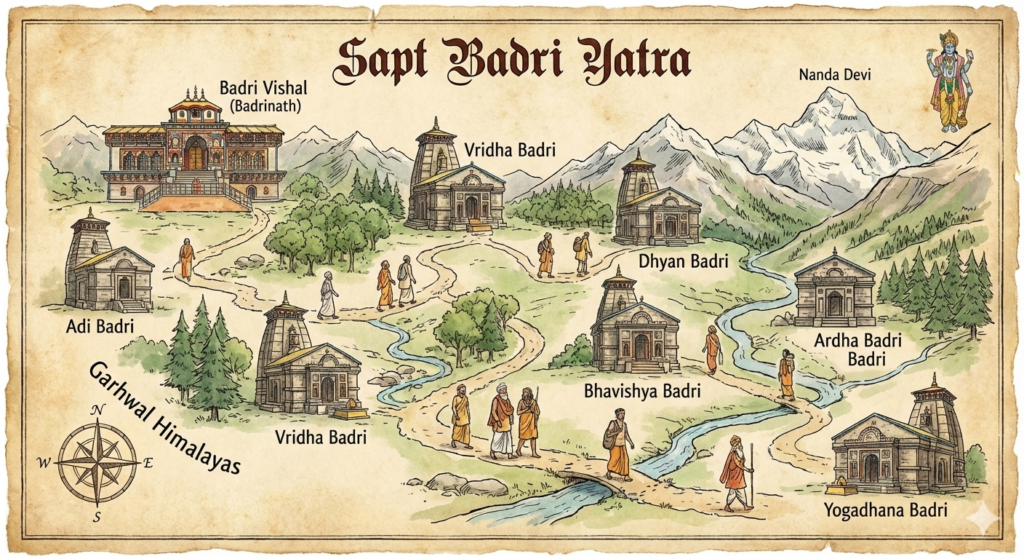
The name “Badri” derives from the wild berries (badri van) that once densely covered the forests along the ancient pilgrim routes to these shrines . Each of the seven temples has its own unique legend, architectural style, and spiritual significance, offering pilgrims a profound journey through the heart of Vaishnavite tradition in the Himalayas.
The Seven Temples of Sapta Badri: A Complete Overview
The Sapta Badri group consists of the following seven temples, with Badrinath (also called Badri Vishal) being the primary shrine :
| Temple | Altitude (m) | Location | Body Part/Form of Vishnu | Key Feature |
|---|---|---|---|---|
| Badri Vishal (Badrinath) | 3,133 | Badrinath town | Vishal (majestic form) | Main shrine, Char Dham temple |
| Adi Badri | Variable | Near Karnaprayag | Ancient form | Complex of 16 small temples |
| Vriddha Badri | 1,380 | Animath village | Old man form | Vishnu appeared as elderly sage |
| Bhavishya Badri | 2,744 | Subhain village | Future form | Believed to be future abode of Badrinath |
| Yogadhyan Badri | 1,829 | Pandukeshwar | Meditative form | Bronze idol in meditation posture |
| Dhyan Badri | Variable | Urgam Valley | Meditative form | Four-armed black stone idol |
| Ardha Badri | Variable | Near Joshimath | Half/small form | Smallest among the seven |
1. Badri Vishal (Badrinath) – The Primary Shrine
Badrinath is the most prominent among the Sapta Badri temples and forms the northern Dham of the Char Dham pilgrimage circuit . Located at an altitude of 3,133 meters on the banks of the Alaknanda River, the temple is nestled between the Nar and Narayan mountain ranges with the majestic Neelkanth Peak as its backdrop .
Legend: According to Hindu mythology, Lord Vishnu in his incarnation as the sages Nara and Narayana performed intense penance at this location. His consort Lakshmi created shelter for him in the form of a Badri tree (berry tree) to protect him from harsh climatic conditions . The sage Narada also performed penance here and continues to do so eternally, reciting the Ashta Akshara mantra “Om Namo Narayanaya” .
Temple Architecture: The temple features three enclosures: the Garbhagriha (Sanctum Sanctorum), Darshan Mandap (worship hall), and Sabha Mandap (conference hall). The sanctum houses a 1-meter tall black stone image of Badrinarayan (Vishnu) with four arms – holding Shankh (conch) and Sudarshana Chakra (discus) in two arms raised, while the other two arms rest on the lap in Yogamudra (meditative pose) .
Opening Dates 2026: The temple opens on Vasant Panchami (late April/early May) and closes on Vijayadashami (October/November) .
2. Adi Badri – The Ancient Temple Complex
Adi Badri is considered the first among the Sapta Badri temples and is located 17 kilometers from Karnaprayag, near the confluence of the Pindar and Alaknanda rivers in Chamoli district . It is actually a complex of 16 small shrines, with seven of them dating back to the late Gupta period (5th-8th century) .
Legend: In ancient times, when the main Badrinath temple was closed due to harsh winter weather, pilgrims would worship Lord Vishnu at Adi Badri . According to prophecy, when Badrinath shifts to Bhavishya Badri at the end of Kali Yuga, Adi Badri will be known as Yog Badri .
Temple Features: The main temple is built on a raised platform with a pyramidal enclosure. The sanctum houses a 1-meter tall black stone image of Vishnu holding a mace, lotus, and chakra . The complex area measures approximately 14 meters by 30 meters, with temple heights varying from 2 to 6 meters .
Interesting Fact: Maharishi Ved Vyas is believed to have divided the Vedas into Rigveda, Samaveda, Yajurveda, and Atharvaveda at this very location .
Darshan Timings: 5 AM – 12 PM and 2 PM – 9 PM
3. Vriddha Badri – The Old Age Form
Vriddha Badri is located in Animath village, about 7 kilometers from Joshimath on the Rishikesh–Joshimath–Badrinath road, at an altitude of 1,380 meters .
Legend: Sage Narada performed intense penance here to appease Lord Vishnu. Pleased with his devotion, Vishnu appeared before him in the form of an old man (Vriddha), hence the name . According to another legend, the original image of Badrinath was carved by the divine craftsman Vishwakarma and worshipped here. At the advent of Kali Yuga, Vishnu removed himself from this place. Later, Adi Shankaracharya found the partially damaged image in Narad Kund and established it at the main Badrinath shrine .
Unique Feature: The idol in this temple depicts Vishnu as an elderly man, making it distinct from all other Vishnu temples .
Accessibility: Unlike most other Badri temples, Vriddha Badri remains open throughout the year .
4. Bhavishya Badri – The Future Abode
Bhavishya Badri is located in Subhain village at an altitude of 2,744 meters, about 17 kilometers from Joshimath beyond Tapovan, accessible only by trekking through dense forest . It lies on an ancient pilgrim route to Mount Kailash and Manasarovar, along the Dhauli Ganga River .
Prophetic Legend: The name “Bhavishya Badri” literally means “Badri of the future.” According to mythology, when evil transcends the world, the Nar and Narayan mountains will block the route to Badrinath, making the shrine inaccessible. The present world will be destroyed and a new one established. At that time, Badrinath will appear at this temple and be worshipped here instead of the main Badrinath shrine .
Current Deity: Interestingly, the Bhavishya Badri temple currently houses an image of Narasimha, the lion-faced incarnation (avatar) of Vishnu .
How to Reach: Motorable road runs from Joshimath to Saldhar (19 km), followed by a 6 km trek to reach the shrine .
5. Yogadhyan Badri – The Meditative Form
Yogadhyan Badri is located at Pandukeshwar (elevation 1,829 meters), near Govind Ghat on the way to Hanuman Chatti, about 21 kilometers from Joshimath .
Mythological Significance: This site is closely associated with the Mahabharata. King Pandu, father of the Pandavas, meditated here to cleanse himself of the sin of killing two mating deer (who were ascetics in their previous lives) . The Pandavas were also born here, and after the Kurukshetra war, they handed over their kingdom to their grandson Parikshit and came here to perform penance .
Temple Features: The temple houses a life-size bronze image of Vishnu in a meditative posture, believed to have been installed by King Pandu himself . The idol is carved from Shaligram stone and evokes a deeply contemplative atmosphere .
Location Note: Pilgrims need to descend about half a kilometer from the road level to reach the temple on the banks of the Alaknanda River .
6. Dhyan Badri – The Meditation Temple
Dhyan Badri is located in the picturesque Urgam Valley, near Kalpeshwar (which is part of the Panch Kedar circuit), in Chamoli district .
Legend: Urvarishi, son of King Puranjaya of the Pandava lineage, meditated in the Urgam Valley and achieved the vision of Lord Vishnu after intense penance. He established this temple in honor of the deity .
Temple Features: The shrine houses a four-armed image of Lord Vishnu made of black stone, depicted in a meditative posture . Festivals such as Krishna Janmashtami and Makar Sankranti are celebrated here with great devotion .
Atmosphere: The temple remains relatively untouched by crowds and exudes a serene, unperturbed spiritual allure .
7. Ardha Badri – The Smallest Shrine
Ardha Badri, meaning “half Badri” or “little Badri,” is located in a remote region near Joshimath and requires a trek to reach .
Significance: As the name suggests, this is the smallest among the Sapta Badri temples. The idol of Lord Vishnu here is smaller in size compared to the other temples, representing humility and simplicity . Despite its size, it holds equal spiritual importance in the Sapta Badri circuit.
Location Note: Being the most remote and least visited, Ardha Badri offers pilgrims an opportunity for undisturbed meditation and prayer in a pristine Himalayan setting .
Additional Temple: Narsingh Badri (Joshimath)
While not always included in the Sapta Badri list, Narsingh Temple at Joshimath deserves special mention. This temple is dedicated to Lord Narasimha, the fourth incarnation of Vishnu (half-man, half-lion) and is one of the 108 Divya Desams (sacred Vishnu temples) .
Special Significance: During the winter months when the Badrinath temple closes, the idol of Badrinath is brought down to Narsingh Temple and placed alongside the Narasimha idol . Thus, for six months of the year, this temple serves as the surrogate abode of Lord Badrinath.
Prophecy: An interesting legend states that the right wrist of the Narasimha idol is gradually shrinking. When it completely falls off, a destructive landslide will occur, and the route to Badrinath will close forever . At that time, Bhavishya Badri will become the primary shrine.
Best Time to Visit Sapta Badri
The Sapta Badri temples, located at varying altitudes, have different visiting seasons:
Note: The main Badrinath temple opens in late April/early May and closes in October/November . Plan your yatra accordingly.
How to Reach the Sapta Badri Circuit
By Air
- Nearest Airport: Jolly Grant Airport, Dehradun (approximately 206-270 km from various temples)
- From the airport, hire taxis or take buses to Haridwar/Rishikesh to begin the yatra
By Train
- Nearest Railway Stations: Haridwar (212.8 km from Adi Badri) and Rishikesh (189.3 km from Adi Badri)
- Both stations are well-connected to major cities like Delhi, Mumbai, Kolkata, and Varanasi
By Road
- Regular state transport and private buses run from Delhi, Haridwar, Rishikesh, and Dehradun to major towns like Karnaprayag, Joshimath, and Badrinath
- Private taxis are available for hire from all major cities
Sapta Badri Yatra Tour Packages 2026
Several tour operators offer comprehensive Sapta Badri packages from major starting points. Below are sample packages with typical inclusions and pricing.
Package 1: Sapta Badri Yatra from Delhi (7 Nights / 8 Days)
Price Range: Starting from ₹23,900 per person (minimum 4 persons)
Places Covered: Delhi → Haridwar → Rishikesh → Rudraprayag → Joshimath → Badrinath → Saldhar (Bhavishya Badri) → Pandukeshwar (Yogadhyan Badri) → Animath (Vriddha Badri) → Karnaprayag (Adi Badri) → Srinagar → Haridwar → Delhi
Detailed Itinerary:
| Day | Route | Activities | Overnight Stay |
|---|---|---|---|
| Day 1 | Delhi to Haridwar | Arrival, transfer to Haridwar, evening Ganga Aarti at Har Ki Pauri | Haridwar |
| Day 2 | Haridwar to Rudraprayag via Rishikesh | Visit Laxman Jhula, Ram Jhula, Triveni Ghat in Rishikesh, then drive to Rudraprayag | Rudraprayag |
| Day 3 | Rudraprayag to Joshimath | Visit Koteshwar Mahadev, drive to Joshimath, visit Narsingh Temple and Shankaracharya Ashram | Joshimath |
| Day 4 | Joshimath to Badrinath via Vishnuprayag | Visit Vishnuprayag Sangam, reach Badrinath, visit Badri Vishal temple | Badrinath |
| Day 5 | Badrinath Darshan and return to Joshimath | Holy dip in Tapt Kund, Badrinath darshan, visit Mana Village, enroute visit Pandukeshwar (Yogadhyan Badri) | Joshimath |
| Day 6 | Joshimath to Saldhar to Bhavishya Badri and Ardha Badri | Drive to Saldhar, trek to Bhavishya Badri (6 km), visit Ardha Badri, return to Joshimath | Joshimath |
| Day 7 | Joshimath to Srinagar via Vriddha Badri and Dhyan Badri | Visit Vriddha Badri at Animath, Dhyan Badri enroute, drive to Srinagar | Srinagar |
| Day 8 | Srinagar to Haridwar to Delhi | Early morning drive to Haridwar, transfer to Delhi for onward journey | – |
Package 2: Sapta Badri Yatra from Haridwar (6 Nights / 7 Days)
Price Range: ₹20,000 – ₹25,000 per person
Inclusions:
- Accommodation in hotels (budget/deluxe as per package category)
- Daily breakfast and dinner (pure vegetarian)
- All transfers by private vehicle (as per itinerary)
- Driver allowance, fuel charges, toll taxes, and parking
- 24/7 customer support
Exclusions:
- 5% GST
- Lunch and personal expenses
- Travel insurance
- Any expenses due to natural calamities or road blocks
- Porter/pony charges during treks
Package 3: Comprehensive Sapta Badri with Panch Kedar (12 Nights / 13 Days)
For pilgrims wishing to combine both Vishnu and Shiva circuits, combined Sapta Badri and Panch Kedar packages are available ranging from ₹45,000 to ₹65,000 per person depending on group size and accommodation category.
Temple-wise Darshan Details
| Temple | Best Time to Visit | Approx. Visit Duration | Special Notes |
|---|---|---|---|
| Badrinath | 6 AM – 12 PM | 2-3 hours | Tapt Kund holy dip before darshan |
| Adi Badri | 5 AM – 12 PM, 2 PM – 9 PM | 1-2 hours | Complex of 16 temples |
| Vriddha Badri | Any time | 30-45 minutes | Open year-round |
| Bhavishya Badri | Morning (start early) | 3-4 hours (including trek) | 6 km trek required |
| Yogadhyan Badri | 8 AM – 5 PM | 1 hour | Descend 500m from road |
| Dhyan Badri | 8 AM – 5 PM | 1 hour | In Urgam Valley near Kalpeshwar |
| Ardha Badri | Morning | 2-3 hours (including trek) | Remote location |
Accommodation Options Along the Route
| Location | Accommodation Type | Amenities |
|---|---|---|
| Haridwar/Rishikesh | Hotels from budget to luxury | All modern amenities |
| Rudraprayag | Mid-range hotels, guesthouses | Attached bathrooms, hot water |
| Joshimath | Hotels, lodges, Narsingh Temple guesthouse | Good facilities, medical stores nearby |
| Badrinath | GMVN guesthouses, private hotels, dharamshalas | Basic to comfortable, limited luxury |
| Pandukeshwar | Basic guesthouses | Simple amenities |
| Karnaprayag | Budget hotels, lodges | Basic facilities |
| Srinagar (Garhwal) | Hotels, guesthouses | Good connectivity |
Travel Tips for Sapta Badri Yatra
- Physical Preparation: The yatra involves driving through mountainous terrain and some trekking (especially to Bhavishya Badri and Ardha Badri). Prepare with regular walking and light exercise 1-2 months before .
- Altitude Awareness: Badrinath is at 3,133 meters. Acclimatize properly by spending a night at Joshimath (1,890 m) before proceeding higher .
- Packing Essentials: Carry warm clothes (even in summer), sturdy walking shoes, rain gear, personal medications, torch, and power bank .
- Documentation: Keep valid ID proof (Aadhaar/Passport) handy, as it may be required for hotel check-ins and permits .
- Booking Timeline: For the peak season (May-June), book accommodations and transport at least 2-3 months in advance .
- Cash Availability: ATMs are limited in higher reaches like Badrinath and Joshimath. Carry sufficient cash for expenses .
- Health Precautions: If you have heart or respiratory conditions, consult a doctor before undertaking the yatra. Carry a basic first-aid kit with altitude sickness medication .
Frequently Asked Questions (FAQs)
Q: What is the difference between Panch Badri and Sapta Badri?
A: The original Panch Badri consisted of only five temples (Badrinath, Adi Badri, Vriddha Badri, Bhavishya Badri, and Yogadhyan Badri). Later, two more temples (Dhyan Badri and Ardha Badri) were added to form Sapta Badri. Sometimes Narsingh Badri is also included, making it eight temples .
Q: How many days are required for Sapta Badri Yatra?
A: A complete Sapta Badri Yatra typically takes 7-8 days from Delhi or Haridwar .
Q: Is trekking required for all Sapta Badri temples?
A: No. Most temples are accessible by motorable roads except Bhavishya Badri (6 km trek) and Ardha Badri (requires trekking). Some temples like Yogadhyan Badri require a short descent from the road .
Q: Which Sapta Badri temple is open throughout the year?
A: Vriddha Badri is the only temple among the Sapta Badri that remains open all year. The other temples close during winter due to snow .
Q: What is the significance of the term “Badri” in temple names?
A: The term “Badri” comes from “Badri van” (forest of berries) through which ancient pilgrims passed to reach these shrines. It is suffixed to all temples in this sacred circuit .
Q: Are the Sapta Badri temples part of Char Dham Yatra?
A: Yes, Badrinath (Badri Vishal) is one of the four Char Dham temples. The other Sapta Badri temples are considered extensions of the main Badrinath shrine and are often included in extended Char Dham itineraries .
Q: Can senior citizens undertake Sapta Badri Yatra?
A: Yes, with proper planning. Most of the circuit involves road travel. For the trekking portions (Bhavishya Badri), arrangements can be made for ponies or porters with prior notice to your tour operator .
Q: What is the best time for Sapta Badri Yatra?
A: May to June and September to October are the ideal months when all temples are open and weather is pleasant .
Conclusion
The Sapta Badri Yatra offers pilgrims a profound journey through the heart of Vaishnavite tradition in the Himalayas. Beyond the world-famous Badrinath Temple lie six other sacred shrines, each with its unique legend, architectural style, and spiritual energy. From the ancient Adi Badri complex dating back to the Gupta period, to the prophetic Bhavishya Badri in its remote forest setting, and the meditative Yogadhyan Badri where King Pandu sought redemption – each temple adds a unique dimension to this sacred circuit.
This pilgrimage is not merely a tour but a spiritual odyssey through the Badri Kshetra, the divine abode of Lord Vishnu on earth. The journey through the Alaknanda valley, with its breathtaking Himalayan vistas, pristine rivers, and ancient temples, creates an experience that lingers in the heart and soul forever.
Whether you are a devout Vaishnavite seeking to complete the full circuit of Vishnu temples, or a spiritual seeker drawn to the mystical energy of the Himalayas, the Sapta Badri Yatra offers an unparalleled opportunity for divine connection and inner transformation.
Book Your Sapta Badri Yatra 2026 Today
Let Discover Uttarakhand—your trusted partner for sacred Himalayan journeys since 1997—guide you on this spiritually enriching pilgrimage through the seven divine abodes of Lord Vishnu.
Contact us for customized Sapta Badri tour packages:
📞 Call / WhatsApp: +91-9997187178, 9760222178, 8171977178
📍 Visit Our Office: Himalayan Colony, opposite DSVV, Haripur Kalan, Haridwar, Motichur Range, Uttarakhand 249411
🌐 Website: www.discover-uttarakhand.com
📧 Email: info@discover-uttarakhand.com
Early booking is strongly recommended due to limited accommodations during peak season.
Om Namo Narayanaya 🙏