Introduction: The Sacred Origin of the Ganges
Gangotri Dham, nestled in the Garhwal Himalayas at an altitude of 3,100 meters (10,200 feet), is one of the four sacred sites of the Char Dham pilgrimage circuit. This revered town, situated on the banks of the Bhagirathi River—the source stream of the holy Ganges—holds immense spiritual significance for millions of devotees who visit each year seeking purification and salvation.
The moment you stand on the banks of the Bhagirathi at Gangotri, you are witnessing the river in its purest, most pristine form—before it has been touched by civilisation, before it becomes the mighty Ganga that sustains millions across the northern plains. This is where the goddess Ganga descended to Earth, responding to the penance of King Bhagiratha, and where Lord Shiva released her from his matted locks to flow gently upon the earth.
For devout Hindus, a pilgrimage to Gangotri is not merely a journey—it is an act of profound faith. It is believed that a holy dip in the icy waters of the Bhagirathi cleanses sins committed in the present and past births, while performing ancestral rites here frees the spirits of one’s forefathers from the cycle of rebirth.
History of Gangotri Dham
The Legend of King Bhagiratha
According to Hindu mythology, King Bhagiratha, an ancestor of Lord Rama, performed severe penance for thousands of years to bring the goddess Ganga down to Earth. His goal was to purify the ashes of his 60,000 ancestors, who had been burnt to ashes by the sage Kapila’s curse. However, the force of Ganga’s descent was so powerful that it would have destroyed the Earth. Lord Shiva agreed to receive Ganga in his matted locks, breaking her fall and releasing her as seven gentle streams. The place where Ganga first touched the Earth is believed to be Gangotri.
A sacred stone near the Gangotri Temple marks the spot where King Bhagiratha is said to have worshipped Lord Shiva to bring Ganga down to Earth. This site remains a focal point of devotion for pilgrims today.
The Pandava Connection
According to another legend, the Pandavas—the five brothers of the Mahabharata—performed the great “Deva Yajna” (fire sacrifice) at Gangotri to atone for the deaths of their kinsmen in the epic battle of Kurukshetra. It is believed that Lord Shiva granted them liberation from their sins at this sacred site. The Pandava Gufa (Pandava Cave), located about 1.5 km from Gangotri, is said to be where the Pandavas meditated during their journey to Kailash.
Construction of the Gangotri Temple
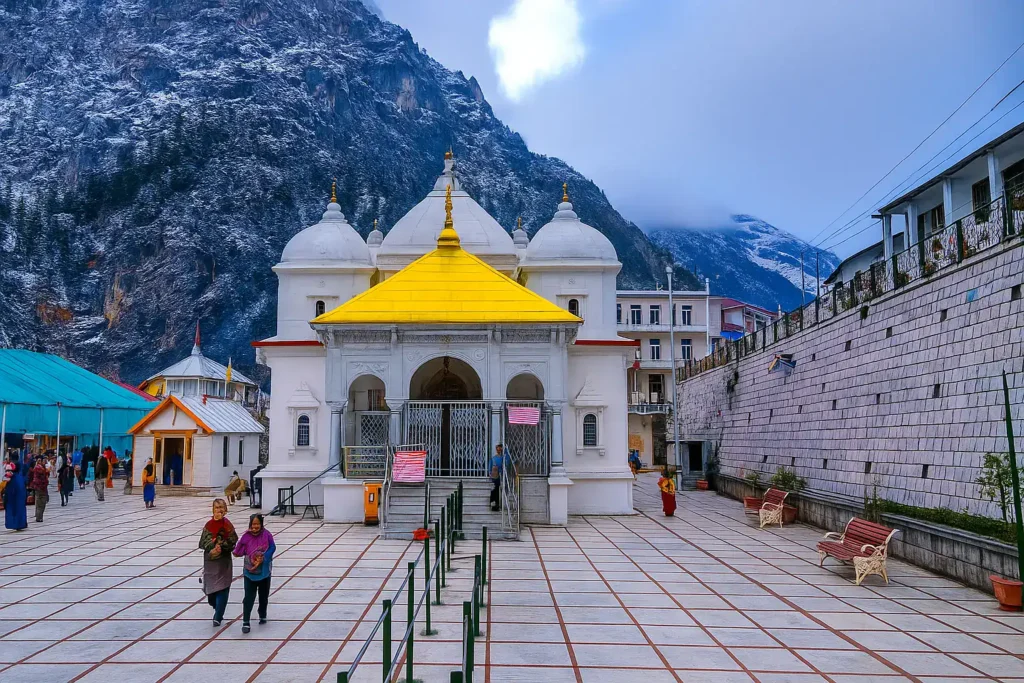
The original Gangotri Temple was built by the Nepalese general Amar Singh Thapa in the early 18th century. The temple, constructed from white granite, stands 20 feet high and is one of the most important temples dedicated to the goddess Ganga. In the 20th century, the Maharaja of Jaipur renovated and restored the temple.
The temple is managed by the Semwal family of pujaris (priests), who hail from Mukhba village—the winter abode of the deity.
Geography and Location
Geographic Coordinates
Topography
Gangotri is situated in the Uttarkashi district of Uttarakhand, in the Greater Himalayan Range. The town lies on the banks of the Bhagirathi River, surrounded by majestic snow-capped peaks rising to approximately 6,000 meters.
The Gangotri Glacier
The Gangotri Glacier is one of the largest glaciers in the Himalayas, measuring approximately 30 kilometres in length. From this glacier emerges the Bhagirathi River at a point called Gaumukh (literally “Cow’s Mouth”), which is located about 18-19 km from Gangotri town. The river is called Bhagirathi from its source until it meets the Alaknanda River at Devprayag, where it acquires the name Ganga.
Religious Beliefs and Significance
The Seat of Goddess Ganga
Gangotri is revered as the earthly abode of the goddess Ganga. According to Hindu belief, the goddess descended here when Lord Shiva released the mighty river from the locks of his hair. The temple is dedicated to Goddess Ganga, making it the highest and most important temple of the Ganges River.
Sacred Bathing and Ancestral Rites
Hindus believe that performing ancestral rites (pind daan and tarpan) on the banks of the Bhagirathi at Gangotri frees the spirit of the ancestor from the cycle of rebirth. A holy dip in its waters is believed to cleanse sins committed in the present as well as past births. The icy cold waters of the Bhagirathi are considered exceptionally pure, as this is where the river first emerges onto the earth.
Part of Char Dham
Gangotri is one of the four sacred sites in the Chota Char Dham pilgrimage circuit, along with Yamunotri, Kedarnath, and Badrinath. Completing all four Dhams is considered essential for achieving salvation (moksha).
Flora and Fauna of the Gangotri Region
Forest Types
The Gangotri region falls within the high-altitude Himalayan ecosystem, characterised by diverse vegetation zones:
Wildlife in the Region
The Gangotri area is rich in wildlife, including several endangered species:
Mammals:
- Snow Leopard: Found in the upper alpine zones, listed as endangered
- Musk Deer: Known for its musk, found in high-altitude regions
- Himalayan Black Bear: Commonly found in hilly forests
- Himalayan Tahr: Large mountain goat, listed as endangered
- Bharal (Blue Sheep): Found in high-altitude meadows
Birds:
- Himalayan Monal: The state bird of Uttarakhand, a vibrant pheasant
- Golden Eagle: Majestic raptor seen soaring over mountain ridges
- Various species of pheasants, partridges, and migratory birds
Gangotri National Park
Gangotri National Park is one of the protected areas in Uttarakhand, established to conserve the unique Himalayan ecosystem. The park spans a vast area encompassing the Gangotri Glacier and surrounding alpine zones, providing critical habitat for endangered species.
How to Reach Gangotri
By Air
Nearest Airport: Jolly Grant Airport, Dehradun (approximately 242-277 km from Gangotri)
From the airport:
- Taxis are available to Gangotri via Uttarkashi
- The journey takes 10-12 hours, covering approximately 360 km
By Train
Nearest Railway Stations:
| Station | Distance from Gangotri | Travel Time |
|---|---|---|
| Rishikesh | 250 km | 8-10 hours by road |
| Haridwar | 270-288 km | 10-12 hours by road |
| Dehradun | 242 km | 8-10 hours by road |
From the railway station, travellers must continue by road to reach Gangotri.
By Road
Gangotri is well-connected by road to major cities in Uttarakhand:
Bus Services: Regular state transport and private buses operate from Rishikesh, Haridwar, and Dehradun to Gangotri. Shared jeeps (sumo) are also available, offering a cost-effective option.
Helicopter Services
Helicopter services are available from Dehradun to Harsil, which is approximately 25 km from Gangotri. From Harsil, pilgrims can proceed by road to Gangotri.
Distances from Major Cities
| City | Distance (km) |
|---|---|
| Delhi | 480-500 |
| Haridwar | 288 |
| Rishikesh | 250-264 |
| Dehradun | 242 |
| Uttarkashi | 98-100 |
| Harsil | 25 |
| Yamunotri | 230 (via Barkot-Uttarkashi) |
| Kedarnath | 300 |
| Badrinath | 370 |
Weather and Best Time to Visit
Climate Overview
Gangotri experiences a cold alpine climate throughout the year due to its high altitude. Winters are extremely harsh with heavy snowfall, while summers remain cool and pleasant.
Month-by-Month Temperature Guide
Best Time to Visit
Temple Opening and Closing Dates
- Opening Date: Akshaya Tritiya (typically late April or early May)
- Closing Date: Diwali (October/November)
- Winter Abode: During winter closure, the idol of Goddess Ganga is shifted to Mukhba Village (also called Mukhyamath Temple), approximately 20 km downstream, where worship continues
Top Attractions and Places to Visit
1. Gangotri Temple
The Gangotri Temple is the main attraction, dedicated to Goddess Ganga. Built in the 18th century by General Amar Singh Thapa, this 20-foot white granite structure stands on the left bank of the Bhagirathi River, surrounded by deodar and pine forests.
Timings: Typically 6:00 AM – 9:00 PM (varies by season)
Best Time to Visit: Early morning for aarti
The temple’s architecture is simple yet elegant, reflecting the spiritual significance of the site. Near the temple is a sacred stone where King Bhagiratha is believed to have worshipped Lord Shiva.
2. Gaumukh – The Source of the Ganges
Gaumukh, located 18-19 km from Gangotri at an altitude of 13,200 feet (4,023 meters), is the actual source of the Bhagirathi River and one of the primary sources of the Ganges. The name “Gaumukh” means “Cow’s Mouth,” as the glacier snout once resembled the face of a cow.
Trek Distance: 18 km one way from Gangotri
Trek Duration: 6-8 hours
Best Time: May-June and September-October
The trek to Gaumukh is a popular pilgrimage and adventure route, passing through scenic landscapes and ending at an enormous cavern where the river emerges from the glacier. According to pilgrims, this is where the goddess Ganga physically manifests on Earth.
3. Pandava Gufa (Pandava Cave)
Located approximately 1.5 km from Gangotri, Pandava Gufa is a natural cave where the five Pandava brothers are said to have meditated during their journey to Kailash.
Access: 1.5 km trek from Gangotri
Duration: 30-45 minutes walk
Highlights: Scenic trail enveloped in lush greenery, serene atmosphere for meditation
4. Gauri Kund and Surya Kund
Located about 500 meters from the Gangotri Temple, these two sacred kunds (ponds) lie on either side of an iron bridge near the GMVN Tourist Bungalow.
Surya Kund: Known for its spectacular waterfall, where the Bhagirathi River cascades through deep gorges. The waterfall with vibrant sounds is a spectacular sight. Visitors can reach the falls via a walkway past Dandi Kshetra and Tapovan Kuti ashrams.
5. Bhaironghati (Bhairon Ghati)
Situated about 9 km from Gangotri, Bhaironghati is a small settlement at the confluence of the Jadh Ganga and Bhagirathi Rivers. The colourful Bhagirathi (Ganga) is seen here, where it is joined by the blue Jadh Ganga.
Attractions:
- Bhairav Nath Temple is surrounded by dense forests
- Scenic confluence view
- Easily accessible by road
6. Tapovan
Tapovan, meaning “forest of penance,” is a high-altitude meadow located approximately 23 km from Gangotri at an altitude of 4,460 meters. It lies beyond Gaumukh at the feet of Mount Shivling.
Significance: A cold, barren, dry land suitable for penance, considered one of the best high-altitude meadows in India. Base camp for mountaineering expeditions to Shivling Peak and Bhagirathi peaks.
Trek Distance: 4-day trek from Gangotri (via Gaumukh and Bhojbasa)
7. Nandanvan
Located 27 km from Gangotri at an altitude of 4,330 meters, Nandanvan is a small meadow at the base of the Bhagirathi Glacier. It offers astounding views of Shivling, Bhagirathi, Sudarshana, Thalay Sagar, and Kedar Dome peaks.
Trek: Requires trekking along the Gangotri and Chaturangi glaciers, considered difficult and requiring good physical fitness.
8. Gangani Hot Springs (En route)
Located approximately 50 km from Uttarkashi on the Gangotri highway, Gangani Hot Springs is a natural hot water spring that serves as a popular resting point for pilgrims. The springs feature stone pools channelling naturally warm water, offering a soothing experience after long road journeys.
Distance from Gangotri: Approximately 55 km
Best For: Relaxation before ascending to Gangotri
9. Harsil Valley
Harsil is a picturesque valley located about 25 km from Gangotri. Known for its apple orchards, deodar forests, and stunning views of the Himalayas, Harsil is a perfect stop for nature lovers. It also serves as the helipad for those taking helicopter services to Gangotri.
Trekking in Gangotri
Popular Treks Starting from Gangotri
Trekking Costs
Trekking costs generally range from ₹8,000 to ₹15,000 per person for guided treks, depending on the trek duration, services, and inclusions.
Permits and Documentation
Permits are required for trekking in Gangotri National Park. These can be obtained from the local forest office at Gangotri or at park entry gates.
Accommodation Options
Types of Accommodation
Booking Tips
- Book accommodations well in advance for May-June and September-October
- GMVN properties offer reliable, clean stays
- During peak season, Gangotri accommodations fill up quickly
- For trekkers, advance booking at Bhojbasa is recommended
What to Pack for Gangotri Yatra
Clothing Essentials
- Thermal innerwear (top and bottom) – multiple pairs
- Fleece jacket and heavy woollen sweater
- Down jacket or thick winter coat
- Waterproof outer shell/raincoat
- Woollen gloves, muffler, and woollen cap
- Heavy woollen socks (3-4 pairs)
- Sturdy, broken-in trekking shoes with good grip
- Comfortable slippers for evenings
Accessories and Gear
- Sunglasses with UV protection
- Sunscreen and lip balm (high altitude sun is intense)
- Trekking pole for stability
- Headlamp or torch with extra batteries
- Power bank for charging devices
- Reusable water bottle (insulated recommended)
Health and Hygiene
- Personal medications with prescription (enough for entire trip + extra days)
- First-aid kit with bandages, antiseptics, and pain relievers
- Altitude sickness medication (consult doctor)
- Portable oxygen can be recommended for seniors and those prone to altitude sickness.
- Basic toiletries, wet wipes, and hand sanitiser
- Moisturiser (high altitude causes dry skin)
Documents
- Valid ID proof (Aadhaar/Passport/Voter ID)
- Yatra registration printout
- Doctor’s prescription for regular medications
- Travel insurance documents
Food and Snacks
- Energy bars, dry fruits, nuts
- Electrolyte sachets
- Glucose for quick energy
- Chocolate for instant energy
Travel Tips and Important Information
Before You Go
- Check Road Conditions: Roads can be affected by landslides, especially during the monsoon. Check local updates before departure.
- Medical Check-up: Consult your doctor before undertaking the yatra, especially if you have heart or respiratory conditions.
- Yatra Registration: Complete mandatory registration through the official Uttarakhand tourism portal before travelling.
- Book in Advance: For May-June and September-October, book accommodations and transport 2-3 months ahead.
During the Yatra
- Acclimatisation: Spend a night at Uttarkashi (1,158 m) before proceeding to Gangotri (3,100 m) to adjust to the altitude.
- Start Early: Begin your trek to Gaumukh or other sites early in the morning to avoid afternoon fog.
- Stay Hydrated: Drink plenty of water to prevent altitude sickness.
- Dress in Layers: Temperatures can change rapidly—layers allow adjustment throughout the day.
- Avoid Night Travel: Mountain roads become risky after dark; reach your destination before sunset.
Health Precautions
- Altitude Sickness: Symptoms include headache, nausea, and breathlessness. If symptoms worsen, descend immediately.
- Oxygen Support: Portable oxygen canisters are available at shops in Gangotri.
- Emergency Numbers: Keep local emergency contact numbers handy.
Photography Tips
- Sunrise over the Himalayas from Gangotri is spectacular
- Photography inside the temple may be restricted; check with temple authorities
- Carry extra batteries—cold drains battery quickly
Nearby Places to Visit
Sample Itinerary
3-Day Gangotri Yatra from Haridwar
| Day | Route | Activities | Overnight Stay |
|---|---|---|---|
| Day 1 | Haridwar → Uttarkashi (100 km) | Drive via Chamba, visit Kashi Vishwanath Temple, rest | Uttarkashi |
| Day 2 | Uttarkashi → Gangotri (100 km) | Early start, visit Gangani Hot Springs enroute, reach Gangotri, temple darshan, evening aarti | Gangotri |
| Day 3 | Gangotri → Haridwar | Morning darshan, visit Surya Kund and Gauri Kund, return to Haridwar via Uttarkashi | – |
5-Day Gangotri Yatra with Gaumukh Trek
| Day | Route | Activities | Overnight Stay |
|---|---|---|---|
| Day 1 | Haridwar → Uttarkashi | Drive, acclimatization | Uttarkashi |
| Day 2 | Uttarkashi → Gangotri | Temple darshan, evening aarti | Gangotri |
| Day 3 | Gangotri → Bhojbasa (14 km trek) | Start Gaumukh trek, scenic Himalayan views | Bhojbasa |
| Day 4 | Bhojbasa → Gaumukh → Gangotri | Gaumukh darshan, return trek | Gangotri |
| Day 5 | Gangotri → Haridwar | Return journey | – |
Frequently Asked Questions (FAQs)
Q1: Why is Gangotri Dham important?
A: Gangotri is the origin of the Ganges River and one of the four Char Dham pilgrimage sites. It is believed to be where Goddess Ganga descended to Earth and where King Bhagiratha performed penance to bring her down.
Q2: What is the best time to visit Gangotri?
A: The best time to visit is May to June and September to October, when the weather is pleasant, and the temple is open.
Q3: When does Gangotri Temple open in 2026?
A: The temple opens on Akshaya Tritiya (late April/early May) and closes on Diwali (October/November). Exact dates are announced closer to the season.
Q4: What is the temperature in Gangotri?
A: Summer temperatures range from 2°C to 10°C; winter temperatures can drop below -15°C with heavy snowfall.
Q5: How far is Gaumukh from Gangotri?
A: Gaumukh is approximately 18-19 km from Gangotri, requiring a 6-8 hour trek.
Q6: Is Gangotri safe for senior citizens?
A: Yes, with proper planning. However, the high altitude (3,100 m) and cold weather require precautions. Consult a doctor before travelling and allow time for acclimatisation.
Q7: Are there hotels in Gangotri?
A: Yes, Gangotri has GMVN guest houses, dharamshalas, and private hotels. Booking in advance during peak season is recommended.
Q8: What is the distance from Delhi to Gangotri?
A: The distance is approximately 480-500 km, taking 14-16 hours by road.
Q9: How can I reach Gangotri from Haridwar?
A: By road, the distance is 288 km, taking 10-12 hours via Uttarkashi. Buses and taxis are available.
Q10: Is there a mobile network in Gangotri?
A: Mobile connectivity is limited and often poor. BSNL typically offers better coverage than other networks. Internet availability is poor.
Q11: What is the significance of Gangani Hot Springs?
A: Gangani Hot Springs are natural hot water springs located on the Gangotri route, about 55 km from Gangotri. Pilgrims stop here to bathe and relax before the final ascent.
Q12: Can I visit Gangotri in winter?
A: No, the temple is closed from Diwali to Akshaya Tritiya due to heavy snowfall. The idol is moved to Mukhba village during this period.
Q13: What documents are required for the Gangotri Yatra?
A: Valid ID proof (Aadhaar/Passport) and yatra registration. Foreign nationals require a valid visa.
Q14: Are there ATM facilities in Gangotri?
A: ATMs are limited in Gangotri. Carry sufficient cash for your stay and expenses.
Q15: What should I wear in Gangotri?
A: Heavy woollens, thermal inners, jackets, gloves, and sturdy shoes. Even in summer, evenings and mornings are very cold.
Plan Your Gangotri Yatra with Discover Uttarakhand
At Discover Uttarakhand, we’ve been organising spiritual journeys across Devbhoomi since 1997. As a trusted local operator with deep knowledge of the Gangotri route, we offer:
- ✅ Customised Gangotri Yatra packages (3 to 7 days)
- ✅ Combined Gangotri-Yamunotri itineraries
- ✅ Comfortable transport with experienced mountain drivers
- ✅ Verified accommodations in Gangotri, Uttarkashi, and Harsil
- ✅ Gaumukh trek arrangements with experienced guides
- ✅ 24/7 customer support throughout your journey
Recommended Gangotri Packages
| Package | Duration | Highlights |
|---|---|---|
| Gangotri Darshan from Haridwar | 2 Nights / 3 Days | Gangotri Temple, Surya Kund, Gauri Kund |
| Gangotri-Yamunotri Yatra | 4 Nights / 5 Days | Both Dhams, Barkot, Uttarkashi |
| Char Dham Yatra | 10-12 Days | Complete pilgrimage with Gangotri |
| Gangotri with Gaumukh Trek | 5 Nights / 6 Days | Gaumukh trek, Bhojbasa camping |
Book your Gangotri Yatra today and experience the divine origin of the Ganges.
📞 Call / WhatsApp: +91-9997187178, 9760222178, 8171977178
📍 Visit Our Office: Himalayan Colony, opposite DSVV, Haripur Kalan, Haridwar, Motichur Range, Uttarakhand 249411
🌐 Website: www.discover-uttarakhand.com
📧 Email: info@discover-uttarakhand.com
Har Har Gange! Jai Maa Ganga! 🙏
Discover Uttarakhand – Your Local Partner for Sacred Himalayan Journeys Since 1997