
Introduction: Where Music and Meditation Meet
Hidden inside the dense forests of the Rajaji Tiger Reserve on the eastern bank of the Ganges, the Beatles Ashram – officially known as Chaurasi Kutia – is one of Rishikesh‘s most intriguing and offbeat attractions. This abandoned ashram, where the legendary English rock band The Beatles studied Transcendental Meditation in 1968, has transformed from a spiritual retreat into a hauntingly beautiful ruin that draws pilgrims, music lovers, and curious travellers from across the globe.
The name “Chaurasi Kutia” translates to “84 huts” – a number deeply significant in yogic traditions, representing the 84 classic yoga asanas and the 84 lakh life forms mentioned in Hindu philosophy. Originally established by Maharishi Mahesh Yogi, the founder of the Transcendental Meditation (TM) movement, the ashram was designed as a secluded meditation centre for spiritual seekers from around the world.
But it was the arrival of John Lennon, Paul McCartney, George Harrison, and Ringo Starr in February 1968 that forever etched this place into pop culture history. During their stay, the Fab Four wrote approximately 48 songs – many of which appeared on their iconic White Album, including classics like “Dear Prudence,” “Ob-La-Di, Ob-La-Da,” and “While My Guitar Gently Weeps”.
After decades of abandonment, the ashram was reopened to the public in 2015 and is now maintained by the Uttarakhand Forest Department. Today, visitors can explore the mushroom-like meditation domes, crumbling stone huts, and walls covered with vibrant graffiti art, all while monkeys swing from the trees and peacocks call in the distance.
Whether you are a Beatles fan retracing the footsteps of your idols, a photography enthusiast capturing the eerie beauty of nature reclaiming concrete, a history lover fascinated by the 1960s counterculture, or a spiritual seeker looking for a quiet place to meditate, the Beatles Ashram promises an experience like no other.
Key Information at a Glance:
| Aspect | Details |
|---|---|
| Official Name | Chaurasi Kutia (Maharishi Mahesh Yogi Ashram) |
| Location | Swarg Ashram area, Rajaji Tiger Reserve, Rishikesh, Uttarakhand |
| Also Known As | Beatles Ashram, Beatles Camp, International Academy of Meditation |
| Distance from Ram Jhula | 1 km (walking distance) |
| Distance from Rishikesh City | ~2 km |
| Area | 18 acres |
| Number of Huts | 84 (Chaurasi Kutia) |
| Famous For | Stay of The Beatles in 1968; 48 songs written here |
| Year Established | 1961 (by Maharishi Mahesh Yogi) |
| Year Closed | 1981 (lease expired) |
| Reopened to Public | 2015 |
| Entry Fee (Indian) | ₹200 per person |
| Entry Fee (Senior Citizen) | ₹100 per person |
| Entry Fee (Student, 18+) | ₹100 per person |
| Entry Fee (Student, Under 18) | ₹50 per person |
| Entry Fee (Foreign Tourist) | ₹1,200 per person |
| Timings (Summer) | 9:00 AM – 5:00 PM |
| Timings (Winter) | 9:00 AM – 4:00 PM |
| Managed By | Uttarakhand Forest Department / Rajaji Tiger Reserve |
| Best Time to Visit | October–March |
| Nearest Airport | Jolly Grant Airport, Dehradun (~20 km) |
| Nearest Railway Station | Rishikesh (~6 km) |
| Distance from Delhi | ~230 km |
History: From Meditation Retreat to Rock & Roll Legend
The Maharishi Mahesh Yogi Era (1961–1981)
The ashram was established in 1961 by Maharishi Mahesh Yogi, a spiritual leader who popularised Transcendental Meditation (TM) across the world. The Maharishi leased approximately 18 acres of land inside a reserved forest area from the Uttar Pradesh Forest Department (now Uttarakhand Forest Department). He envisioned a peaceful retreat where spiritual seekers could escape the distractions of modern life and immerse themselves in deep meditation.
The ashram was built as a self-contained campus with 84 meditation huts (kutiyas) – hence the name “Chaurasi Kutia”. The number 84 holds deep spiritual significance in Hindu and yogic traditions, symbolising the 84 classic yoga asanas and the 84 lakh (8.4 million) life forms through which a soul journeys before attaining human birth. The complex also featured residential quarters, lecture halls, a large meditation hall, dining facilities, and administrative buildings.
The International Academy of Meditation, as it was officially known, attracted spiritual seekers from around the world, including many celebrities and intellectuals from the West. The Maharishi offered a structured three-month course in meditation with a well‑defined syllabus:
- First two weeks: Simplifying life – eating sparingly, cutting down on stimulants, going to bed at regular hours, waking up early to the stillness of dawn
- Daily schedule: Morning meditation, discourse by the Maharishi in the evenings, and nighttime bhajan (devotional song) sessions
- Mantra initiation: Each disciple was given a personal mantra – a ritual phrase – to repeat every morning and evening
The ashram was surprisingly modern for its time and location. It had smart cottages with hot and cold running water, electric heating, and an English cook who had previously worked in a Nottingham hotel. The Maharishi catered to affluent Westerners, a fact that drew criticism from other Hindu ascetics in Rishikesh who accused him of “gross commercialisation”.
Despite the criticism, the ashram flourished throughout the 1960s and 1970s as a centre for TM.
The Beatles Arrive (February 1968)
The story of how The Beatles ended up in Rishikesh began a few months earlier. In August 1967, The Beatles attended a lecture given by the Maharishi Mahesh Yogi in London. The following day, they joined him for a 10-day seminar on meditation, which was cut short due to the sudden death of their manager, Brian Epstein.
In February 1968, The Beatles decided to complete their training and travelled to India to join a meditation session the Maharishi was conducting for a group of Western celebrities, including actress Mia Farrow, Scottish folk singer Donovan, and Mike Love of The Beach Boys.
| Beatle | Duration of Stay |
|---|---|
| Ringo Starr | 11 days |
| Paul McCartney | 5 weeks |
| John Lennon | 7 weeks |
| George Harrison | 7 weeks |
Ringo left early, reportedly complaining about the spicy food. Paul stayed for a month, while John and George remained for nearly seven weeks before departing abruptly amid accusations against the Maharishi.
According to Paul Saltzman, author of “The Beatles in Rishikesh”, the band wrote approximately 48 songs during their stay, making it arguably their single most creative period. Many of these songs appeared on their iconic White Album, including:
| Song | Album |
|---|---|
| Dear Prudence | White Album |
| Sexy Sadie | White Album |
| Ob-La-Di, Ob-La-Da | White Album |
| While My Guitar Gently Weeps | White Album |
| Back in the U.S.S.R. | White Album |
| I’m So Tired | White Album |
| Mother Nature’s Son | White Album |
The ashram provided the perfect environment for creativity – isolated from the pressures of fame, surrounded by nature, and free from the distractions of city life. George Harrison showed particular progress in meditation, with the Maharishi noting that he “has more Indian taste than others”.
Abandonment and Reclamation by Nature (1981–2015)
After the Maharishi’s lease with the forest department expired in 1981, the ashram was abandoned. The buildings were left to decay as nature slowly reclaimed the land. Thick canopies of trees grew over the pathways; roots crept into the walls; and the once-orderly meditation campus became a forgotten ruin in the jungle.
During the 1990s, interest in the ashram was revived by Beatles enthusiasts from the West. Hikers, hippies, art lovers, and Beatles fans began sneaking into the abandoned property – either by climbing the walls or bribing the gatekeeper. It was during this unofficial period that a wonderful phenomenon occurred: wall paintings began appearing on the crumbling structures. Visitors, inspired by the legacy of The Beatles, used colours and ink to give form to their abstract thoughts and love for the band. The walls became an evolving canvas – a chaotic, beautiful art gallery curated by Mother Nature herself.
Reopening to the Public (2015)
In 2015, the Uttarakhand Forest Department, which had taken over the property, officially opened the ashram to the public. The area was cleaned up, pathways were lined with flowers, benches were installed for visitors, and plans were made to set up a cafeteria and a souvenir shop at some point. However, authorities made it clear that visitors would not be allowed to draw on the walls without permission.
Today, the ashram is officially known as the “Beatles Ashram” and is maintained as part of the Rajaji Tiger Reserve. The forest department charges an entry fee, which is used for the maintenance and preservation of the site. Visitors are now welcome to explore the ruins, enjoy nature walks, bird watching, and view the art installations and exhibits on The Beatles’ time in India.
Geography and Location
Location and Setting
The Beatles Ashram is situated in the Swarg Ashram area of Rishikesh, on the eastern bank of the Ganges River. The 18-acre property lies inside the Rajaji Tiger Reserve, a protected forest area that is home to elephants, tigers, leopards, and over 300 species of birds.
Coordinates
- Latitude: Approximately 30°07′ N
- Longitude: Approximately 78°19′ E
- Elevation: Approximately 340 metres (1,120 ft)
Topography
The ashram is built on a gentle slope rising from the riverbank into the forested hills. The property is characterised by:
| Feature | Description |
|---|---|
| Dense Forest Cover | Thick canopies of sal, teak, and other native trees |
| Meditation Domes | Mushroom-shaped concrete structures scattered across the property |
| Stone Huts (Kutiyas) | 84 individual meditation cells, now overgrown |
| Central Meditation Hall | Large hall with high ceilings and the iconic Beatles graffiti |
| Walking Trails | Nature trails maintained by the forest department |
| Wildlife Presence | Mushroom-shaped concrete structures are scattered across the property |
Rajaji Tiger Reserve
The ashram falls within the buffer zone of Rajaji Tiger Reserve, which spans 820 square kilometres across the Shivalik range. This means visitors must follow forest department rules – stay on designated paths, do not litter, and remain cautious of wildlife. The reserve is named after C. Rajagopalachari (Rajaji), a prominent freedom fighter and the last Governor-General of independent India.
Temple Timings and Entry Fee
Opening Hours
| Season | Opening Time | Closing Time | Last Entry |
|---|---|---|---|
| Summer (April – June) | 9:00 AM | 5:00 PM | 4:00 PM |
| Winter (October – March) | 9:00 AM | 4:00 PM | 3:00 PM |
Note: The ashram remains closed on Tuesdays for maintenance, as is common for forest department properties in the region.
Entry Fee (2026)
| Visitor Category | Entry Fee |
|---|---|
| Indian National | ₹200 |
| Senior Citizen (Indian) | ₹100 |
| Student (Above 18 years, Indian) | ₹100 |
| Student (Up to 18 years, Indian) | ₹50 |
| Foreign Tourist | ₹1,200 |
Important Notes
- Entry tickets are issued by the Forest Department at the gate
- Cash payments are preferred; card facilities may not be available
- Keep your ticket with you throughout your visit – there may be random checks
- The fee includes access to the ashram and the nature trails within the complex
How to Reach Beatles Ashram
By Air
Nearest Airport: Jolly Grant Airport, Dehradun
| Details | Information |
|---|---|
| Distance | ~20 km from Rishikesh |
| Travel Time | 30–40 minutes by taxi to Ram Jhula |
| Airlines | Regular flights from Delhi to Dehradun (approx. 1 hour) |
| Onward Travel | Taxis available from the airport; take a taxi to Ram Jhula or Swarg Ashram |
By Train
Nearest Railway Station: Rishikesh Railway Station
| Details | Information |
|---|---|
| Distance | ~6 km from the ashram |
| Travel Time | 15–20 minutes by auto/taxi |
| Connectivity | Some direct trains; better connectivity at Haridwar Junction (25 km) |
Popular Trains from Delhi to Haridwar:
| Train Name | From Delhi | Departure | Arrival (Haridwar) | Duration |
|---|---|---|---|---|
| Shatabdi Express | Delhi | 6:00 AM | 11:40 AM | 5h 40m |
| Jan Shatabdi | Delhi | 3:20 PM | 9:00 PM | 5h 40m |
| Mussoorie Express | Delhi | 10:05 PM | 5:30 AM | 7h 25m |
From Haridwar station, take a taxi or bus to Rishikesh (30 minutes), then proceed to Ram Jhula.
By Road
From Delhi to Rishikesh:
| Starting Point | Distance | Travel Time | Route |
|---|---|---|---|
| Delhi | ~230 km | 5–7 hours | Delhi → Meerut → Muzaffarnagar → Roorkee → Haridwar → Rishikesh |
From Rishikesh to Beatles Ashram:
| Option | Time | Cost (approx.) | Notes |
|---|---|---|---|
| Walking from Ram Jhula | 10–15 minutes | Free | Scenic route through Swarg Ashram |
| Walking from Parmarth Niketan | 5–10 minutes | Free | Closest landmark |
| Auto-rickshaw from Rishikesh | 10–15 minutes | ₹50–100 | Drops at Ram Jhula or ashram gate |
| Taxi from Rishikesh | 10–15 minutes | ₹200–300 | Direct drop at entrance |
Walking Route from Ram Jhula:
From Ram Jhula, walk towards the Parmarth Niketan Ashram. Continue along the eastern bank of the Ganges, following the path through the forest. After approximately 800 metres, you will reach the ashram gate on your right-hand side. The walk is pleasant, shaded, and offers beautiful views of the river.
Distances from Major Cities
| City | Distance (km) |
|---|---|
| Delhi | ~230 |
| Dehradun | ~45 |
| Haridwar | ~25 |
| Mussoorie | ~80 |
| Chandigarh | ~220 |
| Jaipur | ~500 |
Weather and Best Time to Visit
Climate Overview
Rishikesh has a humid subtropical climate. The Beatles Ashram is located at approximately 340 metres elevation, making it comfortable for most of the year, though summers can be hot.
Month-by-Month Guide
| Month | Season | Day Temp (°C) | Conditions | Suitability |
|---|---|---|---|---|
| October–March | Winter | 8–25 | Pleasant, clear skies, cool mornings | ⭐ Best |
| April–June | Summer | 25–40 | Hot, dry, sunny | ⭐ Moderate |
| July–September | Monsoon | 25–32 | Heavy rainfall, high humidity, possible waterlogging | ❌ Avoid |
Best Time to Visit by Season
Why Visit in Winter (October–March)
- Pleasant weather with comfortable daytime temperatures
- Clear skies for photography
- Cool mornings perfect for exploring the forest trails
- Better wildlife sightings (animals come out in cooler weather)
- The “serene and calm atmosphere” is complemented by clear skies
Why Avoid Monsoon (July–September)
- Heavy rainfall can make walking paths slippery and dangerous
- Waterlogging may restrict access to parts of the ashram
- High humidity makes walking uncomfortable
- Forest areas may have leeches
Best Time of Day for Visit
| Time | Experience |
|---|---|
| Morning (9:00–11:00 AM) | Best light for photography, cooler temperatures, fewer crowds |
| Afternoon (12:00–2:00 PM) | Warmest part of the day, good for shaded areas |
| Late Afternoon (2:00–4:00 PM) | Last entry before closing; golden light for photos |
What to See Inside the Beatles’ Ashram
1. The Meditation Domes (Mushroom Huts)
The most iconic structures in the ashram are the meditation domes – mushroom-shaped concrete buildings scattered across the property. These domes were designed as meditation cells, with a small elevated platform inside for sitting and a circular opening in the ceiling to let in natural light. Their distinctive shape, resembling the head of a Buddha, makes them instantly recognisable and highly photogenic.
There are 84 such huts (kutiyas) spread across the 18-acre campus, giving the ashram its name – Chaurasi Kutia.
2. The Graffiti Walls – An Open-Air Art Gallery
The walls of the meditation hall and other structures are covered with vibrant graffiti art created by visitors over the decades. These paintings include:
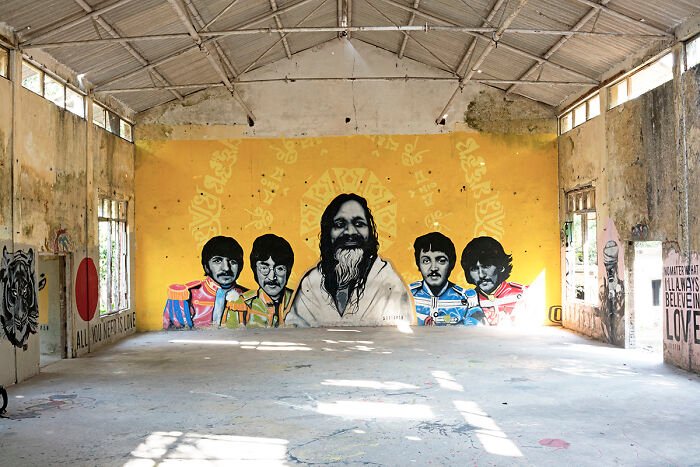
- Larger-than-life portraits of John Lennon, Paul McCartney, George Harrison, and Ringo Starr
- Lyrics from Beatles songs, including “All You Need Is Love” and “Dear Prudence”
- Peace signs, psychedelic patterns, and spiritual symbols
- Messages of love, peace, and unity from fans around the world
The central meditation hall features a large wall painting of the Fab Four with the Maharishi in the middle – a must-photograph spot for any visitor.
3. The Ruins of the Residential Complex
Explore the crumbling buildings where the Beatles and other guests once lived. The structures are now skeleton frames overgrown with ivy, with roots creeping into the walls – a haunting reminder of nature’s resilience. The residential quarters included separate facilities for the Beatles, befitting their superstar status at the time.
4. The Central Meditation Hall
The main hall, where group meditation sessions and discourses by the Maharishi took place, is the largest structure in the ashram. Today, it stands as a roofless ruin with colourful graffiti on every wall. Sunlight filters through the cracks in the ceiling, creating a dramatic, almost sacred atmosphere.
5. The Nature Trails
The ashram is set within the Rajaji Tiger Reserve, offering excellent opportunities for birdwatching and nature walks. The forest department has laid out walking trails through the property, lined with benches for resting. Keep an eye out for:
- Peacocks – frequently seen strutting across the pathways
- Monkeys – common; hold onto your belongings
- Woodpeckers – several species can be spotted
- Himalayan birds – various species, especially during the winter months
The wooded knoll offers stunning views of the Ganges River and the hills beyond.
6. The Amphitheatre Area
A large open area within the ashram features stone benches arranged in a semi-circle, likely used for group lectures and gatherings. This is a peaceful spot to sit, reflect, and soak in the atmosphere.
7. Mushroom Hut Meditation Spots
Several of the meditation domes have been cleared and can be entered. Sit inside and imagine the Beatles sitting in the same space, chanting mantras and composing some of their most famous songs. Bring a cushion or yoga mat for comfort, as the stone floors are hard.
8. The “Dear Prudence” Spot
One of the 84 huts is famously associated with the song “Dear Prudence”. Prudence Farrow (sister of actress Mia Farrow) was a fellow meditator who became so absorbed in her practice that she rarely left her hut. John Lennon wrote the song as a gentle reminder to come out and enjoy the beauty of the ashram.
Nearby Places to Visit
| Destination | Distance | Highlights |
|---|---|---|
| Ram Jhula | 1 km | Iconic suspension bridge, walking route to ashram |
| Parmarth Niketan Ashram | 800 m | Iconic suspension bridge, walking route to the ashram |
| Swarg Ashram | Walking distance | Peaceful area with temples and guesthouses |
| Laxman Jhula | 2.5 km | Historic suspension bridge, Laxman Temple |
| Triveni Ghat | 4 km | Evening Ganga Aarti, holy bathing ghat |
| Neelkanth Mahadev Temple | 12 km | Ancient Shiva temple, hilltop views |
| Rajaji National Park | 5 km (gate) | One of the largest ashrams, the evening Ganga Aarti |
| Shivpuri | 16 km | Rafting starting point, camping |
| Beatles Ashram | 0 km | The main attraction |
Flora and Fauna
Forests and Vegetation
The ashram lies within the Rajaji Tiger Reserve, which is known for its rich biodiversity. The vegetation includes:
| Forest Type | Dominant Species | Characteristics |
|---|---|---|
| Sal Forests | Shorea robusta | Dominant tree, tall canopy |
| Mixed Deciduous | Haldu, Rohini, Khair | Dense undergrowth |
| Riverine Forests | Khair, Sissoo | Along water bodies |
| Grasslands | Elephant grass | Open areas for wildlife |
Wildlife
The Rajaji Tiger Reserve is home to a wide variety of wildlife:
| Species | Status | Likelihood of Sighting |
|---|---|---|
| Asian Elephant | Endangered | Moderate (rare inside the ashram) |
| Bengal Tiger | Endangered | Extremely rare (present in deeper forest) |
| Leopard | Vulnerable | Rare |
| Himalayan Black Bear | Vulnerable | Rare |
| Spotted Deer (Chital) | Least Concern | Uncommon within ashram |
| Wild Boar | Least Concern | Occasional |
| Langur | Least Concern | Frequently seen |
| Rhesus Macaque | Least Concern | Very common – hold onto your belongings |
| Peafowl | Least Concern | Frequently seen |
Birds
The ashram is excellent for birdwatching :
| Bird Species | Description |
|---|---|
| Peafowl | India’s national bird; frequently seen |
| Woodpeckers | Several species |
| Himalayan Monal | State bird of Uttarakhand (rare) |
| Eagles | Various species |
| Parakeets | Bright green, often in flocks |
| Kingfishers | Near water bodies |
Travel Tips and Important Information
Before You Go
- Carry Cash: Tickets are sold by the Forest Department at the gate; cards may not be accepted.
- Wear Comfortable Shoes: The ashram is spread over 18 acres, and you will do a lot of walking on uneven surfaces.
- Carry Water: There are limited shops inside; carry your own water bottle.
- Sun Protection: Wear a hat, sunglasses, and sunscreen – there are exposed areas.
- Check Closing Days: The ashram is closed on Tuesdays. Plan your visit accordingly.
- Best Time: Visit on weekdays to avoid crowds. Arrive by 9:00 AM for the best light and fewest people.
During Your Visit
- Stay on Marked Paths: The ashram is inside a tiger reserve; do not wander off into the dense forest areas.
- Respect the Ruins: Do not climb on unstable structures or remove any bricks or stones.
- Do Not Add Graffiti: While the existing graffiti is part of the ashram’s history, new additions are prohibited and punishable by fine.
- Mind the Monkeys: Monkeys are common and can be aggressive. Keep food and belongings secure; do not feed them.
- Carry a Torch: Some of the meditation domes are dark inside; a small flashlight is helpful.
- Be Aware of Wildlife: If you see a leopard or bear, do not approach. Alert forest department staff immediately.
Safety Tips
- Road Safety: The roads in Rishikesh can be busy; be cautious when crossing.
- Monkey Safety: Keep a safe distance; do not carry uncovered food in your hands.
- Monsoon Precautions: Avoid visiting during heavy rain; paths become slippery.
- Emergency Numbers: Keep local contacts handy (police, forest department, ambulance).
What to Pack
| Category | Items |
|---|---|
| Clothing | Light cotton for summer; light woolens for winter; comfortable clothes for walking |
| Footwear | Sturdy walking shoes or trainers (avoid flip-flops – the terrain is uneven) |
| Accessories | Hat, sunglasses, sunscreen, mosquito repellent, water bottle, flashlight |
| Health | Personal medications, first-aid kit |
| Other | Cash, camera, power bank |
Photography Tips
- Best Spots: Meditation domes, central meditation hall, graffiti wall, views of the Ganges from the hillside
- Best Time: Morning (9:00–11:00 AM) for soft light; late afternoon for golden hour shots
- Camera Gear: Wide-angle lens for the domes and hall; macro lens for details of the graffiti
- Tip: The natural light filtering through the broken ceiling of the meditation hall creates dramatic photo opportunities
Etiquette
- Do not write or carve anything on the walls – new graffiti is strictly prohibited
- Dispose of litter only in designated bins
- Respect the spiritual significance of the site (it was, after all, a meditation ashram)
- Avoid loud music or shouting
Frequently Asked Questions (FAQs)
Q1: Why is the Beatles Ashram famous?
A: The Beatles Ashram is famous for being the place where The Beatles – John Lennon, Paul McCartney, George Harrison, and Ringo Starr – stayed in 1968 to learn Transcendental Meditation from Maharishi Mahesh Yogi. During their stay, they wrote approximately 48 songs, many of which appeared on the iconic White Album.
Q2: What is the entry fee for Beatles Ashram?
A: Indian nationals: ₹200 per person; Senior citizens: ₹100; Foreign tourists: ₹1,200 per person; Students: ₹50–100 depending on age.
Q3: What are the timings of the Beatles Ashram?
A: Summer (April–June): 9:00 AM – 5:00 PM; Winter (October–March): 9:00 AM – 4:00 PM. Last entry is 1 hour before closing. The ashram is closed on Tuesdays.
Q4: What is Chaurasi Kutia?
A: “Chaurasi Kutia” means “84 huts” in Hindi. The ashram has 84 meditation huts (kutiyas), which is a spiritually significant number in yogic traditions, representing the 84 classic yoga asanas and the 84 lakh life forms in Hindu philosophy.
Q5: How do I reach the Beatles Ashram?
A: From Ram Jhula, walk towards Parmarth Niketan for about 10 minutes along the riverbank. The ashram entrance is on the right. Alternatively, take an auto-rickshaw from Rishikesh city centre (10–15 minutes, ₹50–100).
Q6: Is the Beatles Ashram inside Rajaji National Park?
A: Yes, the ashram is located inside the Rajaji Tiger Reserve (also known as Rajaji National Park). This is why there is an entry fee, and visitors must follow the forest department rules.
Q7: Are there toilets available at the ashram?
A: Basic toilet facilities are available at the entrance of the ashram.
Q8: How much time should I spend at the Beatles Ashram?
A: Most visitors spend 1.5–2.5 hours exploring the ashram. This includes walking through the main areas, exploring a few meditation domes, and taking photographs.
Q9: Is there a cafeteria inside the ashram?
A: There are plans to set up a cafeteria, but currently, there are only basic refreshments available at the entrance. Carry your own water and snacks.
Q10: Can I visit the ashram during the monsoon?
A: Monsoon (July–September) is not recommended due to heavy rainfall, waterlogging, and slippery walking paths.
Q11: Is photography allowed inside the ashram?
A: Yes, photography is allowed and encouraged. However, commercial photography or filming may require special permission from the forest department.
Q12: Are there guided tours available?
A: The ashram does not have official guided tours, but local guides are available outside the gate who can explain the history. Alternatively, you can explore on your own using online resources.
Q13: Why was the ashram closed for so long?
A: The ashram was abandoned in 1981 after the lease granted to Maharishi Mahesh Yogi expired. The forest department regained control, and the property was left to decay until it was officially reopened to the public in 2015.
Q14: Are there accommodation options near the ashram?
A: Yes, there are numerous hotels, guesthouses, and ashrams in the Swarg Ashram and Tapovan areas, all within walking distance of the ashram.
Q15: Is the ashram suitable for senior citizens?
A: Yes, the ashram has mostly flat walking paths, and benches are placed along the trails for resting. However, some areas (like climbing inside meditation domes) require bending and navigating uneven steps.
Plan Your Beatles Ashram Visit with Discover Uttarakhand
At Discover Uttarakhand, we’ve been organising unforgettable spiritual and cultural journeys across Devbhoomi since 1997. As a trusted local operator with deep knowledge of Rishikesh and the Garhwal region, we offer:
- ✅ Customised Rishikesh tour packages (1 to 4 days)
- ✅ Combined itineraries covering the Beatles Ashram, Ganga Aarti, rafting, and yoga
- ✅ Comfortable transport with experienced local drivers
- ✅ Verified accommodations in Rishikesh (budget to luxury)
- ✅ Local guides for heritage walks and ashram exploration
- ✅ 24/7 customer support throughout your journey
Recommended Rishikesh Packages
| Package | Duration | Starting Point | Highlights |
|---|---|---|---|
| Beatles Ashram Half Day | 1 Day | Rishikesh | Ashram exploration, walking tour |
| Rishikesh Spiritual Tour | 2 Nights / 3 Days | Haridwar | Beatles Ashram, Ganga Aarti, yoga session |
| Rishikesh with Rajaji Safari | 3 Nights / 4 Days | Haridwar | Beatles Ashram, jungle safari, rafting |
| Complete Rishikesh Explorer | 4 Nights / 5 Days | Delhi | Ashram, Haridwar, rafting, Neelkanth Mahadev |
Book your Beatles Ashram journey today and walk in the footsteps of rock and roll legends.
📞 Call / WhatsApp: +91-9997187178, 9760222178, 8171977178
📍 Visit Our Office: Himalayan Colony, opposite DSVV, Haripur Kalan, Haridwar, Motichur Range, Uttarakhand 249411
🌐 Website: www.discover-uttarakhand.com
📧 Email: info@discover-uttarakhand.com
“All you need is love” – and a journey to where the music was born. 🎸🙏
Discover Uttarakhand – Your Local Partner for Unforgettable Himalayan Journeys Since 1997