
Introduction: The Sacred Site of Shiva’s Sacrifice
Perched at an altitude of 1,330 metres (4,363 feet) amidst the dense forests of the Pauri Garhwal district, the Neelkanth Mahadev Temple is one of the most revered pilgrimage sites in Uttarakhand. Located approximately 32 km from Rishikesh, this ancient temple is dedicated to Lord Shiva in his manifestation as Neelkanth—the “Blue-Throated One”.
The temple holds profound significance in Hindu mythology as the sacred location where Lord Shiva consumed the deadly Kalki poison that emerged during the Samudra Manthan (churning of the ocean). This selfless act of consuming poison to save the universe turned Shiva’s throat blue, earning him the name Neelkanth. According to legend, Shiva then meditated at this very spot for 60,000 years to allay the effects of the poison, and the current sanctum is built on that exact meditation site beneath a Panchpani tree.
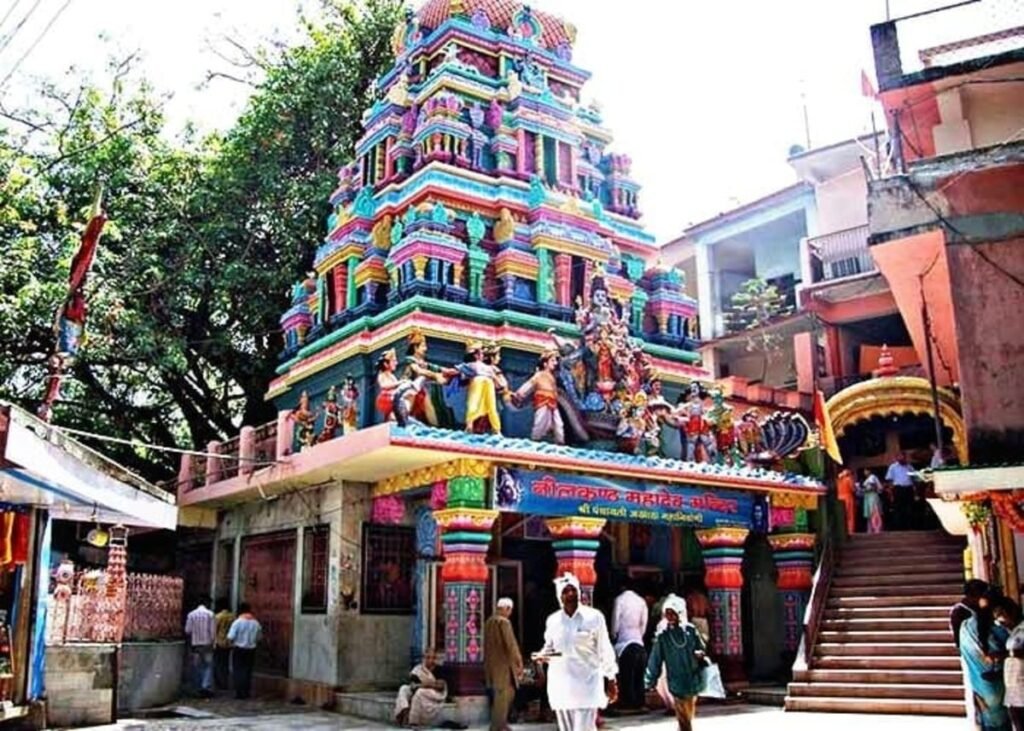
Surrounded by the forested valleys of Manikoot, Brahmakoot, and Vishnukoot, and located at the confluence of the rivers Pankaja and Madhumati, the temple is enveloped in a serene, mystical atmosphere that draws thousands of devotees throughout the year. The temple’s architecture is uniquely influenced by the Dravidian style, with a towering gopura (shikhara) adorned with intricate carvings depicting the Samudra Manthan.
Whether you are a devout pilgrim seeking the blessings of Lord Shiva, a trekker looking for a scenic 12-14 km forest trail, a nature lover wanting to explore the biodiversity of Rajaji National Park, or a traveller seeking a peaceful day trip from Rishikesh, Neelkanth Mahadev Temple promises an experience that is both spiritually uplifting and naturally breathtaking.
Key Information at a Glance:
History and Mythology: The Legend of the Blue Throat
The Samudra Manthan – The Churning of the Ocean
The most significant legend associated with Neelkanth Mahadev Temple is the story of the Samudra Manthan (churning of the ocean). According to Hindu scriptures, the Devas (gods) and Asuras (demons) once joined forces to churn the cosmic ocean in search of Amrita—the nectar of immortality.
Using Mount Mandara as the churning rod and the serpent Vasuki as the rope, they churned the ocean for a thousand years. As they churned, 14 sacred treasures (ratnas) emerged, including the wish-fulfilling tree Kalpavriksha, the celestial elephant Airavata, and the goddess Lakshmi.
The Emergence of Kalkut – The Deadly Poison
Among the 14 treasures emerged a deadly poison known as Kalkut or Halahala—a substance so potent that it could destroy the entire universe. The poison spread across the cosmos, threatening all of creation. The gods and demons, terrified of its destructive power, turned to Lord Brahma and Lord Vishnu for guidance.
They were advised that only Lord Shiva had the power to consume this poison without being destroyed. Shiva, residing on Mount Kailash, agreed to save creation from this catastrophe.
Lord Shiva’s Sacrifice
Lord Shiva consumed the deadly poison, holding it in his throat rather than swallowing it. The poison’s intense heat turned his throat blue—giving him the name Neelkanth, meaning “Blue-Throated One”.
The gods and demons, relieved and grateful, praised Lord Shiva. Goddess Parvati, Shiva’s consort, placed her hand on his throat to help contain the poison’s potency.
The 60,000-Year Penance
According to the Shruti-Smriti Puranas, to allay the effects of the Kalkut poison, Lord Shiva meditated for 60,000 years at the confluence of the Pankaja and Madhumati rivers, beneath a Panchpani tree. This exact location is where the current Garbha Gruh (sanctum sanctorum) of the Neelkanth Mahadev Temple is constructed.
After completing his penance, Lord Shiva installed the present-day “throat-shaped” Shivalinga beneath the Panchpani tree, which is now worshipped as the presiding deity of the temple.
The Temple Walls – A Visual Depiction
The temple’s walls and the gopura are adorned with intricate carvings and sculptures depicting the entire story of the Samudra Manthan. These artistic representations show the Devas and Asuras churning the ocean, the emergence of the 14 treasures, and Lord Shiva consuming the poison. This visual storytelling makes the temple a living museum of Hindu mythology.
Other Associated Legends
Garudachatti Connection: The trekking route from Garudachatti to the temple passes through Rajaji National Park, and local traditions associate this area with Lord Vishnu’s mount, Garuda.
The Sacred Peepal Tree: Inside the temple premises, there is a sacred peepal tree where devotees tie threads and pray, believing that their wishes will be fulfilled and their souls purified.
Temple Architecture
Dravidian Style in the Himalayas
What makes Neelkanth Mahadev Temple unique among the temples of the Garhwal Himalayas is its architectural style. Unlike the typical North Indian (Nagara) style of the region, this temple is built in the Dravidian style of South Indian temple architecture.
The Natural Spring
The temple complex features a natural spring where devotees traditionally take a holy bath before entering the main shrine. The water is considered sacred and purifying, preparing pilgrims for darshan of Lord Shiva.
The Sacred Peepal Tree
On the premises of the temple, there is a sacred peepal tree believed to have special spiritual significance. Devotees tie threads around the trunk of the peepal tree and pray, believing that their prayers will be answered and their souls will be purified.
How to Reach Neelkanth Mahadev Temple
By Air
Nearest Airport: Jolly Grant Airport, Dehradun
By Train
Nearest Railway Station: Rishikesh Railway Station
| Details | Information |
|---|---|
| Distance | ~30 km from the temple |
| Travel Time | 1–1.5 hours by taxi |
| Connectivity | Well-connected from Delhi, Mumbai, Kolkata, Varanasi |
Popular Trains from Delhi to Haridwar/Rishikesh:
| Train Name | From Delhi | Departure | Arrival | Destination |
|---|---|---|---|---|
| Shatabdi Express | Delhi | 6:00 AM | 11:40 AM | Haridwar |
| Jan Shatabdi | Delhi | 3:20 PM | 9:00 PM | Haridwar |
| Mussoorie Express | Delhi | 10:05 PM | 5:30 AM | Haridwar |
From the railway station, you can hire a taxi or take a shared jeep to the temple.
By Road from Rishikesh
There are three main ways to reach Neelkanth Mahadev Temple from Rishikesh:
1. By Cab/Taxi – The Simplest Option
| Aspect | Details |
|---|---|
| Distance | 25–32 km |
| Travel Time | 1–1.5 hours |
| One-way Fare | ₹1,800 – ₹2,500 (approx.) |
| Route | Rishikesh → Neelkanth Road (scenic drive) |
Tip: The drive offers beautiful views of the Himalayan foothills, and it is best to book a taxi for a round trip to ensure availability for the return journey.
2. By Trek – The Adventure Route (12-14 km)
What to Expect:
- The trail winds through dense forests of sal, pine, and deodar
- You will pass through Garudachatti village and enter Rajaji National Park
- The route offers spectacular views of the Shivalik ranges
- Various viewpoints along the way for birdwatching and photography
Tip: The trek is ideal for adventure seekers and nature lovers, but ensure you are physically prepared and carry sufficient water and snacks.
3. By Shared Jeep / Public Transport – The Budget Option
| Aspect | Details |
|---|---|
| Availability | Shared taxis and jeeps are available from the Rishikesh bus stand |
| Cost | ₹100–200 per person (approx.) |
| Time | 1.5–2 hours |
Distances from Major Cities
| City | Distance (km) |
|---|---|
| Delhi | ~250 |
| Dehradun | ~49 |
| Rishikesh | 25–32 |
| Haridwar | ~60 |
| Pauri | ~120 |
Temple Timings and Darshan
Regular Timings
| Period | Timings |
|---|---|
| Summer (April–October) | 5:00 AM – 6:00 PM |
| Winter (November–March) | 6:00 AM – 5:00 PM |
| Afternoon Break | 10:30 AM – 11:30 AM (daily aarti and bhog) |
| Shravan Month (July–August) | 24 hours open |
Best Time for Darshan
| Time | Experience |
|---|---|
| Morning (5:00–7:00 AM) | Peaceful darshan, best for witnessing the morning aarti |
| Late Morning (9:00–10:30 AM) | Good for darshan before the afternoon break |
| Afternoon (11:30 AM–3:00 PM) | Moderate crowds |
| Evening (4:00–6:00 PM) | Beautiful sunset views, evening aarti |
Aarti Timings
Note: Timings may vary during festivals. It is advisable to check with the temple authorities before planning your visit.
Festivals and Celebrations
Maha Shivratri – The Grand Festival
Maha Shivratri (February–March) is the most prominent festival celebrated at Neelkanth Mahadev Temple. During this festival:
| Aspect | Details |
|---|---|
| Significance | The “Great Night of Shiva”; commemorates Shiva’s cosmic dance and his marriage to Parvati |
| Celebrations | All-night vigil, special prayers, chanting of mantras |
| Devotee Influx | Thousands of devotees flock to the temple |
| Atmosphere | Charged with devotion and festivities |
Shravan Month – The Holy Month (July–August)
The month of Shravan (July–August) is considered highly auspicious for worshipping Lord Shiva.
Shivratri of Shravana
A second fair is held annually on the occasion of Shivratri in the month of Shravana (July–August), during which the Kawarias trek from Haridwar to the temple.
What to Offer to Lord Shiva
| Offering | Significance |
|---|---|
| Bael Leaves (Bel Patra) | Most sacred offering; believed to cool Shiva’s throat |
| Milk and Water | Used for abhishekam (ritual bathing of the Shivalinga) |
| Honey and Fruits | Traditional offerings |
| Coconut and Flowers | Common offerings for blessings |
Nearby Places to Visit
Rishikesh – The Yoga Capital of the World
Just 25–32 km from the temple, Rishikesh offers numerous attractions:
Rajaji National Park
The trekking route to Neelkanth Mahadev Temple passes through Rajaji National Park, one of the most biodiverse protected areas in Uttarakhand.
| Aspect | Details |
|---|---|
| Area | 820 sq km |
| Location | Shivalik range, foothills of the Himalayas |
| Wildlife | Elephants, tigers, leopards, deer, ghorals |
| Birds | Wide variety of birds; known for scenic beauty and bio-diversity |
Note: The park marks the northern limits of the Asiatic elephant and is one of the safe havens for jumbos in the country.
Kunjapuri Devi Temple
Located approximately 27 km from the temple, Kunjapuri Devi Temple is a revered Shakti Peeth offering spectacular sunrise views of the Himalayan peaks, including Nanda Devi, Trishul, and Chaukhamba.
Flora and Fauna
Trekking Through Rajaji National Park
The trekking route to Neelkanth Mahadev Temple passes through the Rajaji National Park, making the journey as rewarding as the destination for nature lovers.
Forests and Vegetation
| Elevation Zone | Vegetation Type | Characteristics |
|---|---|---|
| Lower Forests | Sal, Pine, Deodar | Dense forests, rich birdlife |
| Mid-Altitude | Mixed deciduous, Oak | Shivalik range vegetation |
| Streams and Waterfalls | Riparian vegetation | Along the trek route |
Wildlife
The region is part of Rajaji National Park, known for its rich biodiversity :
Birds
Rajaji National Park is home to over 300 species of birds :
| Bird Species | Description |
|---|---|
| Himalayan Monal | State bird of Uttarakhand; iridescent plumage |
| Peafowl | Abundant |
| Partridges | Various species |
| Eagles and Vultures | Birds of prey |
| Woodpeckers | Multiple species |
| Kingfishers | Found near streams and the Ganga |
The Trekking Experience
The trek from Garudachatti to the temple is known for its scenic beauty and rich biodiversity :
Weather and Best Time to Visit
Climate Overview
Neelkanth Mahadev Temple is situated at 1,330 metres, offering a pleasant climate for most of the year. However, the region experiences distinct seasons.
Month-by-Month Guide
Best Time to Visit by Season
Why Visit in Spring (February–April)
This is the best time to visit Neelkanth Mahadev Temple :
- Pleasant weather with moderate temperatures
- Clear skies offering beautiful views of the surrounding hills
- Ideal conditions for the 12-14 km trek
- Comfortable for elderly pilgrims
Why Visit in Autumn (October–November)
Autumn is another excellent time to visit:
- Post-monsoon freshness brings out the lush greenery
- Crisp, invigorating air with clear, cloudless skies
- Perfect for photography
- Comfortable temperatures for darshan
Why Avoid Monsoon (July–September)
The monsoon months are not recommended for visiting due to:
- Heavy rainfall is making the trek slippery and dangerous
- High risk of landslides on mountain roads
- Leeches in forested sections
- Cloud cover obscuring mountain views
Festival Visits
| Festival | Time | Best For |
|---|---|---|
| Maha Shivratri | February–March | Witnessing grand celebrations, experiencing devotion |
| Shravan Month | July–August | Seeing the 24-hour temple opening, Kawaria pilgrimage |
Note: During the Shravan month, the temple remains open 24 hours, but be prepared for heavy crowds and monsoon conditions.
Best Time of Day for Visit
Travel Tips and Important Information
Before You Go
- Plan Your Route: Decide whether you want to drive (1–1.5 hours) or trek (4–5 hours) from Rishikesh.
- Check Temple Timings: The temple closes from 10:30 AM – 11:30 AM daily. Plan your visit accordingly.
- Carry Cash: There are limited ATMs near the temple. Bring sufficient cash from Rishikesh.
- Dress Modestly: Neelkanth Mahadev Temple is a sacred site; dress appropriately when visiting.
- Check Weather: Avoid monsoon (July–September) due to heavy rainfall and trek hazards.
- Carry Essentials for Trek: If trekking, carry water, snacks, comfortable shoes, and rain protection.
During Your Visit
- Take a Holy Dip: Bathe in the natural spring before entering the temple for purification.
- Remove Shoes: Before entering the temple premises.
- Offer Bael Leaves: The most sacred offering to Lord Shiva.
- Tie a Thread: Tie a thread around the sacred peepal tree and pray for wish fulfilment.
- Respect Temple Rituals: Maintain silence during aarti and follow instructions.
For Trekkers
Safety Tips
- Road Safety: The mountain roads to the temple are winding; avoid night driving
- Monsoon Travel: Avoid July–August due to landslide risk
- Trekking Safety: The trail can be slippery after rain; stay on marked paths
- Wildlife: Do not feed animals; maintain a safe distance
- Medical Facilities: Basic facilities in Rishikesh; carry personal medications
Packing Checklist
| Season | Essentials |
|---|---|
| All Year | Comfortable walking shoes, sunscreen, hat, reusable water bottle, camera, cash |
| Summer (Feb–Jun) | Light cotton clothes, light sweater for mornings, hat, sunglasses |
| Monsoon (Jul–Sep) | Raincoat, waterproof footwear (avoid travel if possible) |
| Winter (Oct–Jan) | Heavy woollens, jacket, gloves, woollen cap |
Photography Tips
- Best Spots: Temple gopura with carvings, natural spring, sacred peepal tree, and surrounding hills
- Best Time: Morning for soft light; golden hour for warm tones
- Note: Ask permission before photographing inside the sanctum
Frequently Asked Questions (FAQs)
Q1: Where is Neelkanth Mahadev Temple located?
A: Neelkanth Mahadev Temple is located approximately 32 km from Rishikesh in the Pauri Garhwal district of Uttarakhand, at an altitude of 1,330 metres.
Q2: What is the best time to visit Neelkanth Mahadev Temple?
A: The best time to visit is February to April (spring) and October to November (autumn). The weather is pleasant, and the skies are clear.
Q3: How far is Neelkanth Mahadev Temple from Rishikesh?
A: The distance from Rishikesh to the temple is approximately 25–32 km, with a travel time of 1–1.5 hours by road.
Q4: How do I reach Neelkanth Mahadev Temple from Rishikesh?
A: You can reach by taxi (1–1.5 hours), by trekking (12-14 km, 4–5 hours), or by shared jeep (₹100–200).
Q5: What is the trek distance to Neelkanth Mahadev Temple?
A: The trek from near Ram Jhula / Swarg Ashram to the temple is approximately 12–14 km, taking 4–5 hours.
Q6: What is the altitude of Neelkanth Mahadev Temple?
A: The temple is situated at an altitude of approximately 1,330 metres (4,363 feet) above sea level.
Q7: What are the temple timings?
A: Summer: 5:00 AM – 6:00 PM; Winter: 6:00 AM – 5:00 PM; Afternoon break: 10:30 AM – 11:30 AM; Shravan month: 24 hours open.
Q8: Is there an entry fee for Neelkanth Mahadev Temple?
A: No, entry to the temple is free.
Q9: Why is the temple called Neelkanth Mahadev?
A: The name “Neelkanth” means “Blue-Throated One.” According to mythology, Lord Shiva’s throat turned blue after he consumed the deadly poison that emerged during the Samudra Manthan.
Q10: What is the significance of the Samudra Manthan depiction on the temple walls?
A: The carvings on the temple walls depict the entire story of the Samudra Manthan (churning of the ocean), including the emergence of the 14 treasures and Lord Shiva consuming the poison.
Q11: What is the sacred peepal tree at the temple?
A: There is a sacred peepal tree on the temple premises where devotees tie threads and pray, believing that their wishes will be fulfilled and their souls purified.
Q12: What festivals are celebrated at Neelkanth Mahadev Temple?
A: The main festivals are Maha Shivratri (February–March) and Shravan month (July–August). During Shravan, the temple remains open 24 hours.
Q13: Is there a natural spring at the temple?
A: Yes, the temple complex has a natural spring where devotees take a holy bath before entering the main shrine.
Q14: What wildlife can I see on the trek to the temple?
A: The trek passes through Rajaji National Park, which is home to elephants, tigers, leopards, deer, ghorals, and over 300 species of birds.
Q15: What should I wear when visiting Neelkanth Mahadev Temple?
A: Dress modestly out of respect for the temple’s religious significance. Comfortable walking shoes are recommended for the steps and trekking routes.
Plan Your Neelkanth Mahadev Temple Journey with Discover Uttarakhand
At Discover Uttarakhand, we’ve been organising unforgettable spiritual journeys across Devbhoomi since 1997. As a trusted local operator with deep knowledge of the Garhwal Himalayas and the Rishikesh region, we offer:
- ✅ Customised Neelkanth Mahadev Temple tour packages (1 to 3 days)
- ✅ Combined itineraries covering Neelkanth Temple, Rishikesh, and Haridwar
- ✅ Comfortable transport with experienced local drivers
- ✅ Trekking arrangements for the 12-14 km forest trail
- ✅ Verified accommodations in Rishikesh
- ✅ Local guides for temple visits and nature walks
- ✅ 24/7 customer support throughout your journey
Recommended Neelkanth Mahadev Temple Packages
| Package | Duration | Starting Point | Highlights |
|---|---|---|---|
| Neelkanth Darshan Day Trip | 1 Day | Rishikesh | Temple darshan, natural spring, sacred peepal tree |
| Neelkanth Trekking Adventure | 1 Day | Rishikesh | 12-14 km trek through Rajaji National Park |
| Rishikesh & Neelkanth Pilgrimage | 2 Nights / 3 Days | Haridwar | Neelkanth Temple, Rishikesh, Ganga Aarti |
Book your Neelkanth Mahadev Temple journey today and experience the sacred site where Lord Shiva’s sacrifice saved the universe.
📞 Call / WhatsApp: +91-9997187178, 9760222178, 8171977178
📍 Visit Our Office: Himalayan Colony, opposite DSVV, Haripur Kalan, Haridwar, Motichur Range, Uttarakhand 249411
🌐 Website: www.discover-uttarakhand.com
📧 Email: info@discover-uttarakhand.com
Om Namah Shivaya! Har Har Mahadev! 🙏
Discover Uttarakhand – Your Local Partner for Sacred Himalayan Journeys Since 1997 💙