
Introduction: Where Divine Love Was Sealed in Eternal Fire
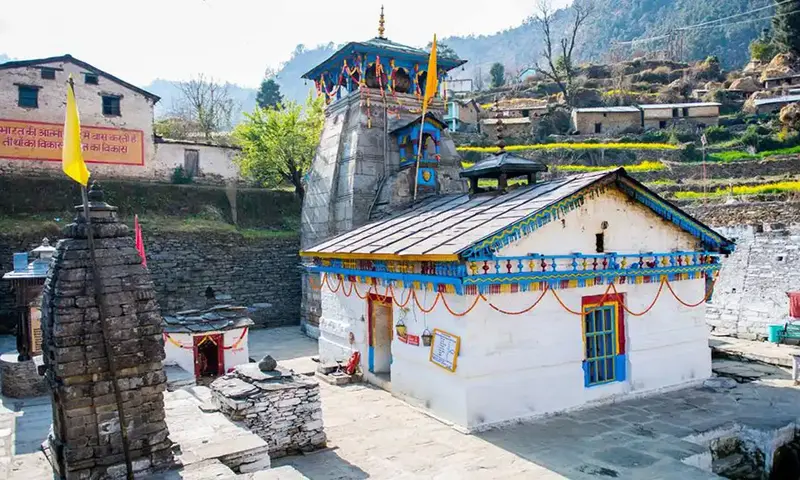
Nestled in the Garhwal Himalayas of Uttarakhand’s Rudraprayag district at an altitude of 1,980 metres (6,500 feet), the Triyuginarayan Temple is one of the most sacred and unique pilgrimage sites in India. This ancient temple, dedicated to Lord Vishnu (Narayana), derives its fame from a celestial event that occurred here—the divine marriage of Lord Shiva and Goddess Parvati, witnessed by Lord Vishnu himself, with the sacred fire as the eternal witness.
The name “Triyuginarayan” combines three Sanskrit words: “Tri” (three), “Yugi” (era or Yuga), and “Narayan” (another name for Lord Vishnu). This sacred place has witnessed the divine presence across all three Yugas—Satya, Treta, and Dwapara—and continues to bless devotees in the current Kali Yuga.
What makes this temple truly extraordinary is the Akhand Dhuni (eternal flame) that burns continuously in front of the temple—believed to have been kindled during the divine wedding of Shiva and Parvati and never extinguished since. The temple courtyard is also the source of a sacred stream that feeds four holy kunds (ponds): Brahma Kund, Vishnu Kund, Rudra Kund, and Saraswati Kund.
The architectural style of the temple closely resembles the famous Kedarnath Temple, and its spiritual significance makes it one of the most revered sites in the Garhwal Himalayas. The shrine houses a 2-foot silver idol of Lord Vishnu, accompanied by Goddess Lakshmi and Goddess Saraswati.
Whether you are a devout pilgrim seeking the blessings of the divine couple, a devotee of Lord Vishnu, a couple wanting to tie the knot at the site where Shiva and Parvati were married, or a traveller drawn to the mystical, eternal flame and Himalayan beauty, Triyuginarayan Temple promises an experience that is both spiritually profound and visually breathtaking.
Key Information at a Glance:
History and Mythology: The Celestial Wedding of Shiva and Parvati
The Legend of the Divine Marriage
The most profound legend associated with Triyuginarayan Temple is that of the divine marriage of Lord Shiva and Goddess Parvati. According to Hindu mythology, Goddess Parvati—the daughter of Himavan (the personification of the Himalayas)—performed intense penance at Gauri Kund (5 km away) to win Lord Shiva as her husband.
After years of rigorous austerity, Lord Shiva was pleased with her devotion. According to the Shiva Purana, Shiva proposed to Parvati at Guptakashi, and the divine wedding was solemnised at Triyuginarayan village, at the confluence of the Mandakini and Sone-Ganga rivers.
The wedding was a grand celestial affair witnessed by all the gods and sages. Lord Vishnu formalised the wedding and acted as Parvati’s brother, performing the Kanyadaan (giving away of the bride). Lord Brahma officiated as the priest of the wedding ceremony . The Brahma Shila—a sacred stone in front of the temple—marks the exact spot where the divine marriage took place.
The Akhand Dhuni: The Eternal Flame Witness
The most unique feature of Triyuginarayan Temple is the Akhand Dhuni (eternal flame) that burns in the Havana-kund (sacred fire pit) in front of the temple. According to legend, this fire was kindled during the wedding ceremony of Shiva and Parvati and has been burning continuously ever since—witnessing the divine union across the ages.
Devotees offer samidha (sacrificial wood) to this eternal flame and collect the ashes as sacred blessings (prasad). It is believed that these ashes promote conjugal bliss and harmony in married life. This is why the temple is also known as the Akhand Dhuni Temple.
The Sacred Kunds: Divine Bathing Ponds
The temple courtyard is the source of a sacred stream that feeds four holy ponds (kunds) :
| Kund | Deity | Purpose |
|---|---|---|
| Saraswati Kund | Goddess Saraswati | Source of all kunds; originates from Vishnu’s navel |
| Brahma Kund | Lord Brahma | For sipping water (achaman) |
| Vishnu Kund | Lord Vishnu | For cleansing |
| Rudra Kund | Lord Shiva | For bathing |
According to legend, before the wedding ceremony, the gods took a bath in these sacred kunds. The water from these kunds is considered to have healing properties, and it is believed that the water can cure infertility.
The Legend of the Name “Triyuginarayan”
The name “Triyuginarayan” is deeply significant. “Tri” means three, “Yugi” denotes a period of time (Yuga), and “Narayan” is another name for Lord Vishnu. The temple is called by this name because Lord Vishnu has witnessed and blessed this sacred site across all three Yugas—Satya Yuga, Treta Yuga, and Dwapara Yuga—and continues to grace devotees in the current Kali Yuga.
The Sthala-Purana and Spiritual Significance
The greatness of this place is recorded in the Sthala-Purana (a scripture specific to a pilgrimage centre). According to the scripture, pilgrims who visit this temple consider the ashes from the burning fire as holy and carry them with them. It is also believed that ashes from this fire are supposed to promote conjugal bliss.
The Capital of Himavat
According to mythology, Triyuginarayan is believed to be the capital of Himavat (the personification of the Himalayas) and the father of Goddess Parvati. This adds another layer of significance to this already sacred location.
Adi Shankaracharya’s Restoration
The present temple structure is believed to have been built by the great philosopher-saint Adi Shankaracharya in the 8th century CE. Shankaracharya is credited with building and restoring many temples across Uttarakhand as part of his mission to revive Hinduism and establish the Char Dham pilgrimage circuit.
Temple Architecture and Features
Architectural Style
The Triyuginarayan Temple is built in the North Indian Himalayan architectural style, closely resembling the famous Kedarnath Temple. The structure is constructed using local stone and features intricate carvings that reflect the rich artistic heritage of the region.
| Feature | Description |
|---|---|
| Style | North Indian Himalayan architecture |
| Construction Material | Local stone |
| Architectural Resemblance | Similar to Kedarnath Temple |
| Built By | Adi Shankaracharya (8th century CE) |
The Sanctum Sanctorum
The main shrine (sanctum) houses a 2-foot silver idol of Lord Vishnu (Narayana), accompanied by his consort—the goddess of wealth and prosperity—Goddess Lakshmi, and the goddess of music and learning—Goddess Saraswati.
| Deity | Significance |
|---|---|
| Lord Vishnu (Narayana) | Goddess of knowledge, music, and the arts |
| Goddess Lakshmi | Goddess of wealth and prosperity |
| Goddess Saraswati | Goddess of knowledge, music, and arts |
Other Deities in the Temple Complex
The temple complex also houses other deities :
| Deity/Shrine | Location | Significance |
|---|---|---|
| Vishnu in a sleeping posture with Lakshmi and Ganesha | Inside sanctum | Blessing devotees |
| Saligrama Shila of Vishnu | Just outside | Vishnu in sleeping posture with Lakshmi and Ganesha |
| Badrinarayan | Within complex | Another form of Vishnu |
| Sita Ramachandra | Within complex | Rama and Sita |
| Kubera | Within complex | God of wealth |
| Panchanama Devatas | Small temple outside | Goddess Annapurneshvari, Lord Ishaneshwar, Lord Hanuman, Lord Shiva |
| Lord Ganesha | On the dwara (door) | Remover of obstacles |
The Akhand Dhuni: The Eternal Flame
The Havana-kund (sacred fire pit) in front of the temple houses the Akhand Dhuni—the eternal flame that has been burning since the time of Shiva and Parvati’s wedding.
| Aspect | Details |
|---|---|
| Location | In front of the temple |
| Significance | Witness to the divine wedding |
| Duration | Burning continuously since the wedding |
| Devotee Practice | Offer samidha (sacrificial wood); collect ashes as blessings |
Brahma Shila: The Exact Wedding Spot
The Brahma Shila is a sacred stone located in front of the temple, believed to mark the exact spot where the divine marriage of Shiva and Parvati took place. This is one of the most venerated spots in the temple complex.
Gauri Cave (2 km away)
At a distance of 2 km from Triyuginarayan Temple, there is a cave dedicated to Gauri (Goddess Parvati). This cave is associated with Parvati’s penance before her marriage to Lord Shiva.
Akhanda Jyothi Inside the Sanctum
There is also an Akhanda Jyothi (eternal lamp) burning inside the sanctum, adding to the temple’s spiritual energy.
Spiritual Beliefs and Significance
The Divine Wedding Venue
Triyuginarayan is revered as the actual venue of the celestial marriage of Lord Shiva and Goddess Parvati. This alone makes it one of the most sacred pilgrimage sites in the Garhwal Himalayas. Devotees believe that visiting this temple and offering prayers brings the blessings of both Shiva and Vishnu—the preserver and the destroyer—making it uniquely powerful.
The Eternal Flame as Witness
The Akhand Dhuni is not merely a flame—it is the eternal witness to the divine union of Shiva and Parvati. Devotees believe that:
- Offering samidha (wood) to the eternal flame brings blessings
- Collecting ashes from the Havana-kund promotes conjugal bliss and harmony in marriage
- The flame represents the eternal nature of divine love
The Power of the Sacred Kunds
The four sacred kunds (ponds) are considered highly auspicious:
Marriage at Triyuginarayan Temple
The temple has become an emerging and popular wedding destination for couples who wish to tie the knot in the same sacred space where Shiva and Parvati were married. The temple courtyard provides a breathtaking setting for wedding ceremonies, with green slopes and distant snow-capped peaks creating an enchanting backdrop.
The temple is also a registered venue for weddings, and the local Jamloki Brahmins of Kedarghati serve as the chief priests (Pujaris) for wedding ceremonies.
The Brahma Shila Blessings
The Brahma Shila—marking the exact spot of the divine wedding—is considered highly sacred. Devotees offer prayers here seeking:
- Happy and harmonious married life
- Resolution of marital disputes
- Blessings for childless couples
Shiva-Parvati Blessings
Inside the sanctum, there is an idol of Shiva and Parvati blessing devotees in newly wed form . This idol is particularly significant for:
- Newly married couples seeking blessings
- Couples celebrating anniversaries
- Devotees seeking marital harmony
How to Reach Triyuginarayan Temple
By Air
Nearest Airport: Jolly Grant Airport, Dehradun
From the airport, you can hire a taxi to Sonprayag or directly to Triyuginarayan Temple.
By Train
Nearest Railway Station: Rishikesh
| Details | Information |
|---|---|
| Distance | ~261 km |
| Travel Time | 8–10 hours by taxi |
| Connectivity | Well-connected from Delhi |
Alternative: Haridwar Railway Station (similar distance).
Popular Trains from Delhi to Haridwar/Rishikesh:
| Train Name | From Delhi | Departure | Arrival | Destination |
|---|---|---|---|---|
| Shatabdi Express | Delhi | 6:00 AM | 11:40 AM | Haridwar |
| Jan Shatabdi | Delhi | 3:20 PM | 9:00 PM | Haridwar |
| Mussoorie Express | Delhi | 10:05 PM | 5:30 AM | Haridwar |
From the railway station, taxis and buses are available for Sonprayag.
By Road
Step-by-Step Route from Delhi:
Total Distance from Delhi: Approximately 450–500 km
Total Travel Time: 12–14 hours
From Sonprayag to Triyuginarayan Temple:
The final 12 km can be covered by:
Trek Routes
| Route | Distance | Difficulty | Duration |
|---|---|---|---|
| Sonprayag to Temple | 10 km paved road + trek | Easy to Moderate | 4–5 hours |
| Sitapur to Temple | 7 km trek | Easy to Moderate | 3–4 hours |
| Kedarnath to Temple | ~25 km | Moderate | 1 day |
Distances from Major Cities
| City | Distance (km) |
|---|---|
| Delhi | ~450-500 |
| Dehradun | ~250 |
| Rishikesh | ~261 |
| Haridwar | ~260 |
| Rudraprayag | ~50 |
| Guptkashi | ~38 |
| Sonprayag | 10–12 |
| Kedarnath | 27 km |
| Gaurikund | 13 km |
Weather and Best Time to Visit
Climate Overview
Triyuginarayan experiences a high-altitude Himalayan climate with distinct seasons. The temple is situated at 1,980 metres, making it significantly cooler than the plains.
Month-by-Month Guide
| Month | Season | Day Temp (°C) | Night Temp (°C) | Conditions | Suitability |
|---|---|---|---|---|---|
| April | Summer | 15–25 | 5–10 | Pleasant, clear skies | ⭐ Best |
| May | Summer | 15–25 | 5–10 | Pleasant, ideal | ⭐ Best |
| June | Summer | 15–25 | 8–12 | Warm, pre-monsoon | ⭐ Best |
| July | Monsoon | 8–18 | 10–15 | Heavy rain, landslides | ❌ Avoid |
| August | Monsoon | 8–18 | 10–15 | Heavy rain, slippery roads | ❌ Avoid |
| September | Autumn | 5–15 | 5–10 | Post-monsoon, clearing | ⭐ Good |
| October | Autumn | 5–15 | 0–5 | Crisp, clear skies | ⭐ Excellent |
| November | Autumn | 5–15 | 0–5 | Cool, pleasant | ⭐ Excellent |
| December | Winter | -5–10 | -5–0 | Cold, possible snow | ⭐ Moderate |
| January | Winter | -5–10 | -5–0 | Very cold, snow | ⭐ Moderate |
| February | Winter | -5–10 | -5–0 | Cold, snow | ⭐ Moderate |
| March | Spring | 10–20 | 0–5 | Pleasant, spring blooms | ⭐ Good |
Best Time to Visit by Season
Why Visit in Summer (April–June)
This is the most popular time to visit Triyuginarayan Temple :
- Pleasant weather with temperatures ranging from 15°C to 25°C
- Clear skies offering spectacular views of the Himalayan peaks
- Ideal conditions for the trek and temple visit
- Perfect for weddings—the temple courtyard provides flexible outdoor wedding locations
- Comfortable for elderly people and children
Why Visit in Autumn (October–November)
Autumn is another excellent time to visit :
- Post-monsoon freshness brings out the lush greenery
- Crisp, invigorating air with clear, cloudless skies
- Perfect for photography
- Fewer crowds—ideal for intimate weddings
- The temple area feels more personal and spiritually fulfilling
Why Avoid Monsoon (July–September)
The monsoon months are not recommended due to :
- Heavy rainfall is making paths slippery and dangerous
- High risk of landslides on mountain roads
- Roads frequently become inaccessible for hours or days
- The terrain becomes a delight yet a dangerous environment
- Wedding arrangements become difficult
Winter Visit (December–March)
Winter transforms the region into a pristine white landscape :
- Snow-covered peaks create a magical setting
- The temple stays open for visitors, but getting inside the area becomes problematic
- Most local guesthouses shut down during peak winter
- Emergency help becomes scarce
- Only for snow lovers willing to brave harsh conditions
Wedding Season Considerations
Triyuginarayan has become an emerging and popular wedding destination :
Temple Timings
Timings may vary during festivals.
Annual Mela (Fair)
The annual fair (mela) is held on the Shukla Paksha Dwadasi—the 12th day in the Hindu month of Bhadrapad (August/September).
Nearby Places to Visit
Kedarnath Temple – The Jyotirlinga
Located approximately 25–27 km from Triyuginarayan Temple, Kedarnath is one of the 12 Jyotirlingas and a cornerstone of the Char Dham pilgrimage circuit. The temple is dedicated to Lord Shiva and sits at an altitude of 3,583 metres.
Distance: 27 km from Triyuginarayan
Access: Drive + trek (16 km from Gaurikund)
Gauri Kund – The Penance Site
Located just 5 km from Triyuginarayan, Gauri Kund is the sacred pond where Goddess Parvati is believed to have performed intense penance to win Lord Shiva as her husband. It is also the base camp for the Kedarnath trek.
Distance: 5 km
Significance: Where Parvati meditated
Guptkashi – The Hidden Kashi
Located approximately 38 km away, Guptkashi is a sacred town known for its ancient Vishwanath Temple and Ardhanarishwar Temple. It serves as the base camp for the Kedarnath Yatra and offers helicopter services to Kedarnath.
Distance: 38 km
Key Attractions: Vishwanath Temple, Ardhanarishwar Temple
Chopta – The Mini Switzerland of India
Chopta is a picturesque hill station known for its lush meadows, trekking trails, and panoramic Himalayan views. It serves as the base for treks to Tungnath Temple (the highest Shiva temple in the world) and Chandrashila Peak.
Distance: 85 km
Key Attractions: Tungnath Temple, Chandrashila Peak, Deoria Tal
Where to Stay: Accommodation Options
In Triyuginarayan Village (Limited)
| Accommodation | Features | Price Range |
|---|---|---|
| Basic Guesthouses | Simple rooms, basic amenities | ₹800–1,500 |
| Temple Guesthouse | Managed by temple trust | ₹500–1,000 |
In Sonprayag (10–12 km from Temple)
| Category | Price Range | Features |
|---|---|---|
| Budget Guesthouses | ₹800–1,500 | Basic amenities |
| Mid-Range Hotels | ₹1,500–3,000 | Comfortable rooms |
In Guptkashi (38 km from Temple)
| Category | Price Range | Features |
|---|---|---|
| Budget Hotels | ₹800–1,800 | Basic amenities |
| Mid-Range Hotels | ₹2,000–4,000 | Comfortable rooms, hot water |
| Homestays | ₹1,200–2,500 | Authentic Garhwali experience |
In Rudraprayag (50 km from Temple)
| Category | Price Range | Features |
|---|---|---|
| Budget Hotels | ₹800–1,800 | Basic amenities |
| Mid-Range Hotels | ₹1,500–3,500 | Comfortable rooms |
Booking Tips
- Book well in advance for the wedding season (April–June & October–November)
- For stays at the temple guesthouse, contact the temple management directly
- Guptkashi offers the best range of accommodation options
- Carry cash—card facilities may be limited in smaller towns
Local Cuisine: What to Eat
At the Temple
| Item | Description |
|---|---|
| Prasad | Offerings made to the deities |
| Ashes from Akhand Dhuni | Sacred blessings collected by devotees |
| Chai | Hot tea available |
In Nearby Towns
| Dish | Description |
|---|---|
| Aloo Ke Gutke | Spiced fried potatoes, a Garhwali speciality |
| Chainsoo | Protein-rich black gram curry |
| Kafuli | Spinach and fenugreek curry |
| Mandua Roti | Finger millet flatbread |
| Gahat Ki Dal | Horse gram lentil soup |
| Jhangora Kheer | Barnyard millet sweet pudding |
Dining Tips
- Most hotels offer meal packages
- Pure vegetarian options are widely available
- Carry packaged snacks for the journey
- Stay hydrated—carry water for the trek
Travel Tips and Important Information
Before You Go
- Dress Modestly: Triyuginarayan Temple is a sacred site; dress appropriately
- Carry Cash: ATMs are limited in Triyuginarayan; bring sufficient cash from Rudraprayag or Guptkashi
- Check Weather: Avoid monsoon (July–August) due to heavy rainfall and landslide risk
- Best Time for Darshan: Morning (7:00–10:00 AM) offers peaceful darshan
- Book in Advance for Weddings: If planning a wedding, book 2–3 months in advance for the summer season
During Your Visit
- Remove Shoes: Before entering the temple premises
- Respect Temple Rituals: Offer samidha to the eternal flame and collect ashes as blessings
- Take a Holy Dip: Bathe in the sacred kunds (Rudra Kund, Vishnu Kund, Brahma Kund) for purification
- Photography: May be restricted inside the sanctum; ask permission
- Offerings: Wood (samidha), flowers, and coconut are traditional offerings
Wedding at Triyuginarayan Temple
If you are planning to get married at this sacred venue :
| Aspect | Details |
|---|---|
| Best Season | April–June & October–November |
| Booking | Contact temple management 2–3 months in advance |
| Priests | Jamloki Brahmins of Kedarghati |
| Venue | Temple courtyard with Himalayan backdrop |
Safety Tips
- Road Safety: The mountain roads from Sonprayag to Triyuginarayan are winding; avoid night driving
- Monsoon Travel: Avoid July–August due to landslide risk
- Altitude Awareness: At 1,980 m, altitude sickness is rare but possible; stay hydrated
- Trekking Safety: The path can be slippery after rain
Packing Checklist
| Category | Items |
|---|---|
| Clothing | Cash, camera, and samidha (wood) for offering |
| Footwear | Comfortable trekking/walking shoes |
| Accessories | Hat, sunscreen, sunglasses, flashlight |
| Health | Personal medications, water bottle, snacks |
| Documents | ID proof (Aadhaar/Passport) |
| Other | Cash, camera, samidha (wood) for offering |
Photography Tips
- Best Spots: Akhand Dhuni (eternal flame), Brahma Shila, sacred kunds, temple exterior with mountain backdrop
- Best Time: Morning for natural light
- Note: Ask permission before photographing inside the sanctum
Frequently Asked Questions (FAQs)
Q1: What is the Triyuginarayan Temple famous for?
A: Triyuginarayan Temple is famous for being the venue of the divine wedding of Lord Shiva and Goddess Parvati. It is known for the Akhand Dhuni (eternal flame) that has been burning since the wedding, and the Brahma Shila marking the exact wedding spot.
Q2: What is the best time to visit Triyuginarayan Temple?
A: The best time to visit is April to June (summer) and October to November (autumn). The weather is pleasant, and the skies are clear.
Q3: How far is the Triyuginarayan Temple from Delhi?
A: The distance from Delhi is approximately 450–500 km, with a travel time of 12–14 hours by road.
Q4: How do I reach Triyuginarayan Temple?
A: By road to Sonprayag (via Rishikesh, Rudraprayag, Guptkashi), then a 10–12 km drive or trek. The nearest airport is Dehradun (~250 km), and the nearest railway station is Rishikesh (~261 km).
Q5: What is the altitude of Triyuginarayan Temple?
A: The temple is situated at an altitude of approximately 1,980 metres (6,500 feet) above sea level.
Q6: What is the Akhand Dhuni?
A: The Akhand Dhuni is the eternal flame that burns in front of the temple, believed to have been kindled during the wedding of Shiva and Parvati and burning continuously ever since.
Q7: What are the temple timings?
A: The temple is open from 7:00 AM to 2:00 PM and 4:00 PM – 8:00 PM.
Q8: Is there an entry fee for Triyuginarayan Temple?
A: No, entry to the temple is free.
Q9: What is the significance of the sacred kunds?
A: The four sacred kunds (Rudra Kund, Vishnu Kund, Brahma Kund, and Saraswati Kund) are used for bathing, cleansing, and sipping. The water is believed to have healing properties and can cure infertility.
Q10: What is Brahma Shila?
A: Brahma Shila is a sacred stone in front of the temple that marks the exact spot where the divine marriage of Shiva and Parvati took place.
Q11: Can I get married at Triyuginarayan Temple?
A: Yes, the temple is an emerging and popular wedding destination. Couples can register for weddings at this sacred site where Shiva and Parvati were married.
Q12: What is the distance from Kedarnath to Triyuginarayan Temple?
A: The distance from Kedarnath is approximately 27 km.
Q13: What is the annual mela at Triyuginarayan Temple?
A: The annual fair (mela) is held on Shukla Paksha Dwadasi—the 12th day in the Hindu month of Bhadrapad (August/September).
Q14: What is the Gauri Cave?
A: The Gauri Cave is located approximately 2 km from Triyuginarayan Temple and is dedicated to Goddess Parvati, associated with her penance.
Q15: Who built the Triyuginarayan Temple?
A: The present temple is believed to have been built by Adi Shankaracharya in the 8th century CE.
Plan Your Triyuginarayan Temple Journey with Discover Uttarakhand
At Discover Uttarakhand, we’ve been organising unforgettable spiritual journeys across Devbhoomi since 1997. As a trusted local operator with deep knowledge of the Garhwal Himalayas, we offer:
- ✅ Customised Triyuginarayan Temple tour packages (2 to 4 days)
- ✅ Combined itineraries covering Triyuginarayan, Guptkashi, and Kedarnath
- ✅ Wedding arrangements at the sacred temple
- ✅ Comfortable transport with experienced hill drivers
- ✅ Verified accommodations in Guptkashi and Rudraprayag
- ✅ Local guides for the temple and nearby attractions
- ✅ 24/7 customer support throughout your journey
Recommended Triyuginarayan Packages
| Package | Duration | Starting Point | Highlights |
|---|---|---|---|
| Triyuginarayan Darshan Day Trip | 1 Day | Guptkashi | Akhand Dhuni, Brahma Shila, sacred kunds |
| Triyuginarayan & Guptkashi Pilgrimage | 2 Nights / 3 Days | Haridwar | Triyuginarayan Temple, Vishwanath Temple, Ardhanarishwar Temple |
| Triyuginarayan with Kedarnath | 4 Nights / 5 Days | Haridwar | Both sacred sites, Guptkashi base |
| Wedding at Triyuginarayan | Custom | Haridwar | Complete wedding arrangements at the divine venue |
Book your Triyuginarayan Temple journey today and witness the sacred flame that witnessed the divine union of Shiva and Parvati.
Best Destination Wedding Planner in Triyuginarayan Temple
📞 Call / WhatsApp: +91-9997187178, 9760222178, 8171977178
📍 Visit Our Office: Himalayan Colony, opposite DSVV, Haripur Kalan, Haridwar, Motichur Range, Uttarakhand 249411
🌐 Website: www.discover-uttarakhand.com
📧 Email: info@discover-uttarakhand.com
Om Namah Shivaya! Jai Triyuginarayan! 🙏
Discover Uttarakhand – Your Local Partner for Sacred Himalayan Journeys Since 1997 🔥